

Benchmark ADC1 USB A/D converter
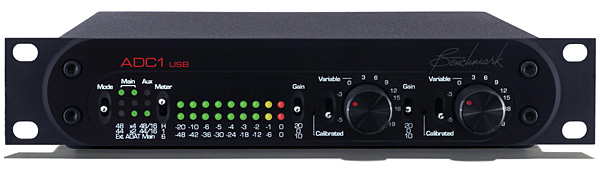
Erick Lichte's review of Benchmark's DAC2 HGC D/A converter in this issue gave me an ideal opportunity to spill some ink on the company's ADC1 USB A/D converter. The ADC1 is housed in the same small case as the DAC (one rack unit high, half the rack unit width), and is offered with a black front panel with rack ears, or a silver aluminum panel without ears, either for $1795.
Benchmark DAC1 Pre USB D/A headphone amplifier
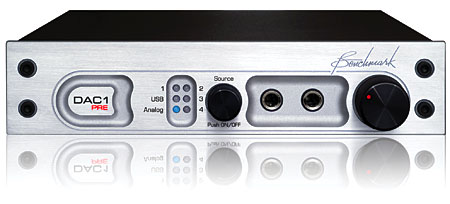
Most of this column is dedicated to two hi-fi products for the massesnot from Lvov, via Vladimir Lamm, of Lamm Industries; or from Leningrad, via Victor Khomenko, of Balanced Audio Technologies; nor from any other Soviet-born audio hero. (Neither Vladimir nor Victor is on the list of "Name of Russia" contenders for greatest Russian of all time.) Nor from any consumer audio company, but from the world of professional audio. An Iron Curtain almost separates the two.
Benchmark DAC1 USB D/A processor & headphone amplifier
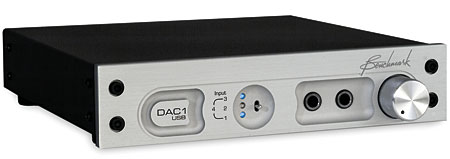
In his July 2003 "The Fifth Element" column, John Marks enthusiastically wrote about the Benchmark Media Systems DAC1 D/A processor and headphone amplifier. Comparing its sound playing CDs with that of a three-times-more-expensive Marantz SA-14 SACD player, he concluded that the DAC 1's "Red Book" performance was at least as good as that of the Marantz, being "slightly more articulate in the musical line, and slightly more detailed in spatial nuances, particularly the localization of individual images in space, and in soundstage depth."
Bryston BDA-1 D/A converter
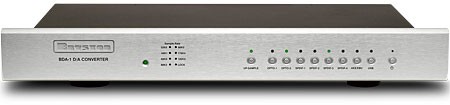
In February 2009, I reviewed Bryston Ltd.'s first CD player, the $2695 BCD-1, and was very impressed by what I heard. The BDA-1 ($1995) is the Canadian company's first standalone DAC. It's slim, only 2.75" high, with the engraved company name, model number, and infrared sensor grouped at the extreme left of a front panel of polished aluminum. Farther to the right are two columns of four LEDs each that comprise the sample-rate indicator, which identifies the selected input's signal frequency and whether the BDA-1 has locked to it. Closer to the center is the Upsample control, which governs the conversion of the incoming digital signal synchronously to 192kHz or 176.4kHz. The Upsample LED turns green for 192kHz, red for 176.4kHz. Digital sources are selected by pressing one of eight pushbuttons just right of center: two TosLink, four S/PDIF (coaxial), one AES/EBU XLR, and one USB 1.1, the last accepting only signals with sample rates at or below 48kHz. An LED above each pushbutton lights green for an incoming PCM datastreams and red for other types, including multichannel Dolby Digital streams.
Cambridge Audio Azur DacMagic D/A converter
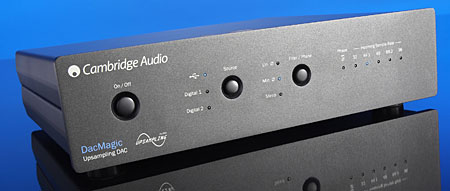
In 1989, Cambridge Audio, then run by Stan Curtiswho is still active in hi-fi introduced their DAC 1. At about the same time, within a few weeks of each other, Arcam introduced their Delta Black Box and Musical Fidelity their Digilog. I forget who was first among the three. Arcam, I think. But the DAC race was on, led by the British. (There was even a DAC called the Dacula.) US companies got into the DAC race, tooat higher prices, of course.
CEntrance DACmini CX D/A converter
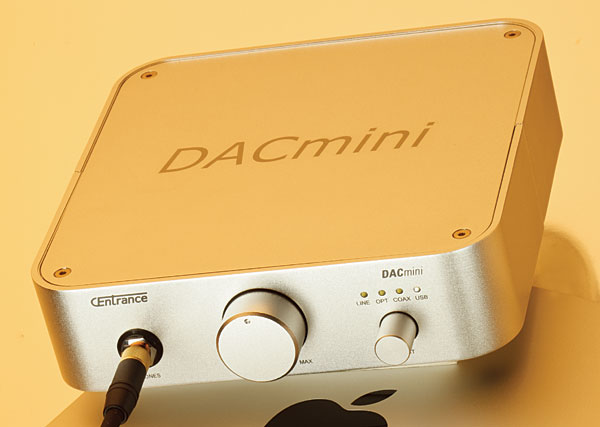
Sure, Stereophile gets letters to the editor. We also get some colorful responses for our "Manufacturers' Comments" section. (Vince Bruzzese and Roy Hall are literary standouts among their component-making peers.) And, as one of the magazine's Contributing Editors (Audio), I get lots of personal mail from readers seeking my advice. I thought I might share some of these letters with you, and my responses.
CEntrance DACport USB headphone amplifier
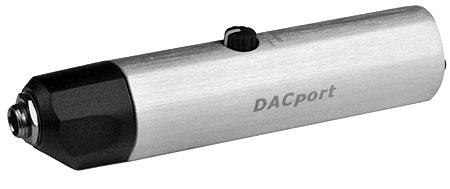
I have built up a large collection of CDs since the medium's launch more than a quarter century ago, along with a modest number of SACDs and a small number of DVD-As. But I find these days that, unless I'm getting down to some serious listening and can give the music my uninterrupted attention, I use iTunes to feed computer files to my high-end rig (footnote 1). I've mostly been using the superb-sounding combination of dCS">http://www.stereophile.com/hirezplayers/dcs_puccini_sacd_playback_syste… Puccini U-Clock and Puccini player/DAC that I reviewed last December to take a USB feed from a Mac mini, but I've also been using the Bel">http://www.stereophile.com/digitalprocessors/bel_canto_usb_link_2496_us… Canto USB Link 24/96 and Stello">http://www.stereophile.com/digitalprocessors/lindemann_amp_stello_usb-s… U2 USB-S/PDIF converters, particularly for headphone listening, when I use one of those two format converters with a Benchmark">http://www.stereophile.com/digitalprocessors/886">Benchmark DAC1 D/A headphone amplifier.
Channel D Pure Vinyl 5 & Seta L phono preamplifier
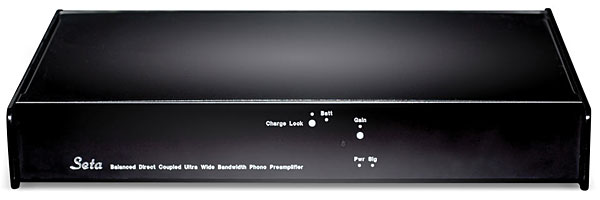
Ever since I stopped using my Audio Research SP10 preamplifier in the early 1990sits eight phono-stage tubes used to get too noisy too quicklyI tried a variety of standalone phono preamplifiers. Seeing the most service through the 1990s and 2000s were, first, a Mod Squad Phono Drive EPS, then a Linn Linto, both of which I purchased. But when I measured Channel D's Seta Model L, which Michael Fremer reviewed in the August 2010 issue, the Linto was pushed to one side. The battery-powered Seta L (footnote 1) had the lowest noise and distortion I had encountered in a phono preamplifier, and I eventually bought the sample I had been sent for a follow-up review in 2013.
Channel Islands Audio Transient Mk.II & VDC•5 Mk.II USB D/A processor & power supply
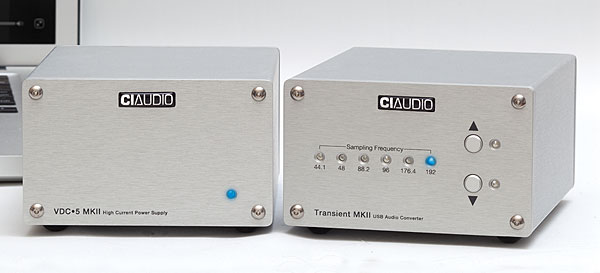
Most folks don't even know they exist, but the Channel Islands are a chain of eight moderately sized mountains poking through the Pacific Ocean along the coast of southern California, between Santa Barbara and San Diego. The most famous of these is Catalina Island and its city, Avalon, which sit opposite San Clemente. The other Channel Islands are relatively wild and have been preserved mostly uninhabited.
Chord Chordette Gem D/A processor
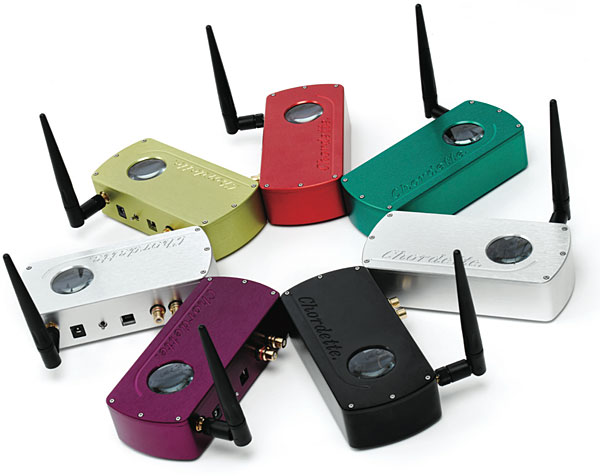
There's home cooking on one side of the hedge and fast food on the other, and the world moves farther from the former and nearer to the latter with each passing day. So it goes in domestic audio, where virtually every new milestone of the past quarter-century has pointed far more toward convenience than toward quality.
Depressed? Don't be. Those of us in the perfectionist community have a history of dealing with such things, howsoever slowly and inefficiently. (footnote 1). We're getting better at it, too, year by year. An example: Chord Electronics, of sunny southern England, has now brought to market their Chordette Gem D/A converter ($799) which they offer as an affordable means of getting perfectionist-quality sound from computer-music files.