

A Matter of Dimensions
I have been reading a lot of late. Whether it is due to the reduced appeal of recorded music owing to the ever-decreasing shelves of LPs in our local specialty record store (the owner explains that he still wants to sell LPs; it's the record companies that make it increasingly harder for him to do so with punitive returns policies and deaf ears to back orders), or the fact that it's Spring, I don't know. But the fact remains that I have recently found myself devouring a shelf-full of titles sometimes only vaguely related—horrors!—to high fidelity. Stuart Chase's The Tyranny of Words, for example, first published in 1938 and a finer examination of what came to be called semantics you wouldn't want to find, should be essential reading for anyone involved in writing articles that are still intended to communicate some meaning.
A Matter of Measurements
Beginning with this issue, Stereophile readers will notice that more of the subjective equipment reviews are augmented with technical reports describing certain aspects of the component's measured performance. Although test data have lately been increasingly included in reviews, Stereophile has recently made a major commitment to providing readers with relevant measurements of products under review. We have just finished building an audio test laboratory featuring the Audio Precision System One, a sophisticated, computer-based audio test measurement system.
A New Size For Stereophile
By now you've no doubt realized that Stereophile has changed its size—from 5½" by 8 7/16" to 7½" by 10¼". (All right—maybe you didn't know the exact dimensions of the change, but that's what they are.) We have Edward Chen, Publisher of Stereophile's Chinese edition, to thank for our new size. It is the same size as the Chinese Stereophile and a common size in the Far East. We've been admiring it in Chinese for the last two-and-a-half years, and we thought it would make sense in English as well.
A Trojan Horse in Washington
"Tax proposed to fund Public TV, radio," read the newspaper headline. The Working Group for Public Broadcasting, described as a "private study group," was proposing to free public broadcasting "from improper political and commercial influences" by replacing its $228 million in congressional appropriations and $70 million or so in corporate funding with $600 million to be raised from a new sales tax on electronic equipment. The article went on to say that the proposal was being sent to the congressional panels concerned with communications (ie, the commerce committees), where it could become the basis for a new Public Broadcasting Act.
Adcom GFA-555 power amplifier
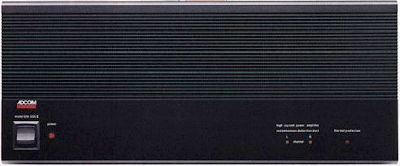
I am reluctant to call any given transistor power amplifier a "best buy" or "breakthrough." From my talks with designers and other audiophiles, it is clear that the state of the art in power amplifiers is about to change. From where I stand, the Adcom GFA-555 is the first sample of this new wave. It is so clearly superior to past amplifiers in the low- to mid-priced range—not to mention most amplifiers two to three times its pric—that I can unhesitatingly recommend it for even the most demanding high end system.
Altec A-7 & Electro-Voice Patrician 800 loudspeakers
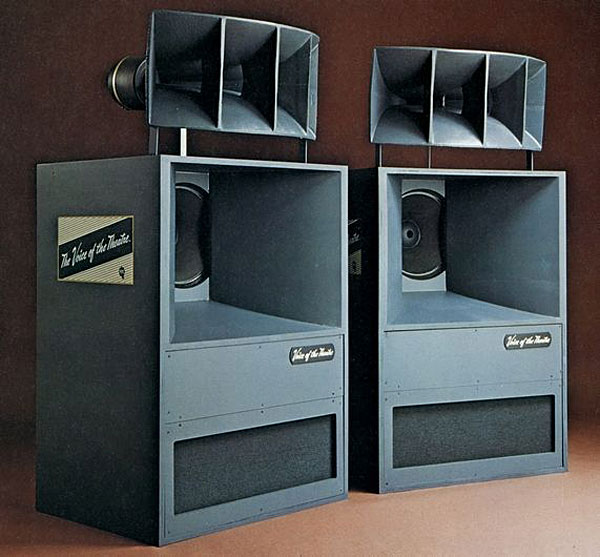
In the introduction to "Recommended Components" in the final issue in Volume One of what was then called The Stereophile, published in May 1966, founder J. Gordon Holt briefly described his Top-Rated Loudspeaker Systems.
Altec A-7
A highly efficient horn-loaded system for use in large to very large listening rooms (at least 15' from the listening area), or for very high-volume "Row-A" listening. Excellent woofer-tweeter blending, moderately deep (useful 45Hz limit in most rooms) and very taut, well-defined low end. Highs smooth and slightly soft, yielding most natural high-end quality at high listening levels. Middles smooth, rather forward, placing closely miked instruments somewhat in front of the system itself.
A highly efficient horn-loaded system for use in large to very large listening rooms (at least 15' from the listening area), or for very high-volume "Row-A" listening. Excellent woofer-tweeter blending, moderately deep (useful 45Hz limit in most rooms) and very taut, well-defined low end. Highs smooth and slightly soft, yielding most natural high-end quality at high listening levels. Middles smooth, rather forward, placing closely miked instruments somewhat in front of the system itself.
Altec Lansing 301 loudspeaker

One of the oldest names in US audio, Altec Lansing was building speakers for theaters and recording studios long before the introduction of the microgroove LP in 1948 (which date many see as marking the inception of high fidelity). Started in 1931 under the name All-Technical Services ~Corp., the firm later purchased another audio firm called Lansing Engineering, and merged the names. Altec's Model 604, one of the first true coaxial speakers, was adopted for home use by many early hi-fi buffs and, several permutations later, is still widely used for monitoring in disc-cutting rooms.
Amplifier Power: How Much is Enough?

Considering the amount of careful research, cautious theorizing and wild speculation that have been lavished on the amplifier power question, we should expect to be considerably closer to the answer in 1962 than we were five years ago. This does not seem to be the case.
Analog vs Digital: Home-Brew Science at the Edge of the Art
Publisher's note: The following article, from the early days of Compact Disc, is presented with no claim for absoluteness. (In fact, just as we go to press in the spring of 1986, we received a manuscript from Philip Greenspun, Product Review Editor of Computer Music Journal (Cambridge, MA), who had precisely the opposite result when comparing CD to analog versions of the same recording, though it was unclear that his test procedures were as thorough as in the tests by these authors.) The tests described are neither single- nor double-blind, and the author's decision to forego conversation while listening to the same products does not by any means guarantee lack of mutual influenceespecially because their musical tastes are so well known to each other. Moreover, repeating the test with different phono equipment, a different CD player, and a different replica of the master tape would likely yield somewhat different results.
Nevertheless, I think the basic conclusion is sound: good CD reproduction is remarkably close to a fairly good version of master tape sound; there's a good chance that it's more accurate than what you'll get from the average cartridge, tonearm, and turntable.
Anniversaries
By the time you read this, I will have been fortunate enough to have attended a banquet put on by Harry Pearson in celebration of The Abso!ute Sound's 20th anniversary. Stereophile and TAS may have had their disagreements from time to time, but I take this opportunity to congratulate Harry and his staff on 20 years of excellent high-end publishing. I believe it's not excessively immodest to report that high-end manufacturers frequently remind me of their gratitude for the healthy and vibrant high-end publishing community which exists in the United States—and does not in most other countries. Many publications make up this community, but Stereophile and TAS are certainly the most widely read.