

Bricasti Design M1 D/A converter
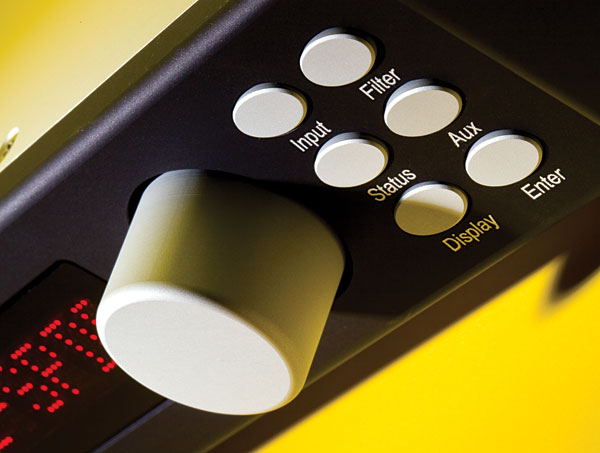
Back in the late 1980s, it seemed a good idea: Separate a CD player's transport section from its D/A circuitry so that each could be optimally designed, and, as D/A technology improved, the sound of your CD player could be upgraded by replacing the outboard D/A processor. The catch was that the transport and D/A chassis needed to be connected with a serial data link: S/PDIF in optical or electrical flavors, or balanced AES/EBU. To minimize the number of cables required, the format of that link embedded the clock data within the audio data, which rendered the link sensitive to interface timing uncertainty, or jitter. (See "Bits Is Bits?," by Malcolm Hawksford and Chris Dunn.)
Bricasti Design M1SE MDX D/A processor
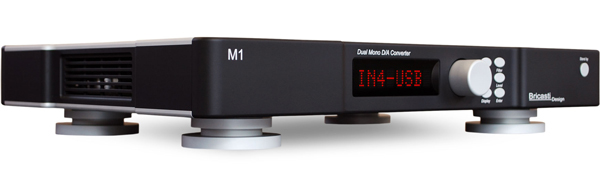
I have owned the SE version of the Bricasti M1 D/A converter for several years. It's my reference DAC. When, recently, I became aware of the availability of the factory-installed MDx Processor Board upgrade, I packed up the M1SE and sent it off to the Bricasti factory, which is in Shirley, Massachusetts, northwest of Boston. The factory-installed MDx upgrade costs $1000a lot less than the $10,000 it costs today to buy a new M1SE with the MDx board.
Bricasti Design M21 D/A processor
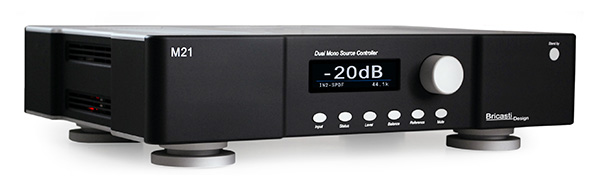
Those of us who review audio equipment, and even audiophiles who don't, often talk about our reference systems. The term implies a certain level of consistency. If you are changing components every week, your system probably lacks the stability to be a true reference. In the case of reviewers, this presents an irony . . .
Brilliant Corners #3: On the Horns of a Dilemma—A for Ara speakers, the Lejonklou Källa streaming DAC

The Amtrak Empire service snakes north along the Hudson River before reaching Albany, where it pitches sharply to the west, eventually winding up in Niagara Falls. In November I rode itthe Amtrak Empire service, not Niagara Fallsfrom New York City to the town of Hudson, New York. On my left, the sun beat down on the river's expanse while an occasional sailboat flashed by. Above the water, the undulating domes of the Catskills, with their fading yellow and red streaks, looked like the work of an unsuccessful colorist at a busy hair salon.
I was traveling upstate to visit Rob Kalin, a founder and former CEO of the online craft marketplace Etsy and proprietor of a newish speaker company called A for Ara.
Brilliant Corners #31: Campfire Earphones & Relay DAC & the FiiO M15S portable player
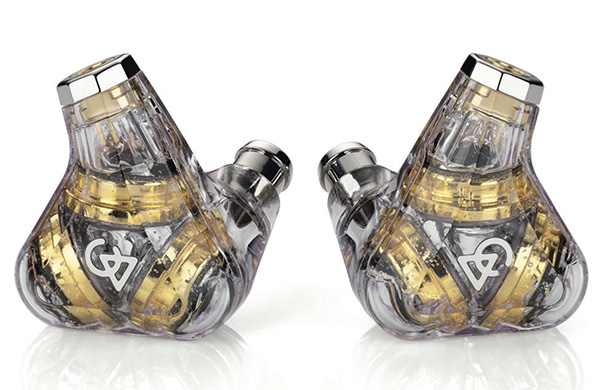
Over the years, I've listened to many headphones, beginning with the Grado SR60s I bought with my first paycheck. Since then, I've been lucky enough to sample many exotic cans, but I always return to the admittedly controversial realization that I happen to prefer ... earphones.
Brilliant Corners #37: A Lejonklou System
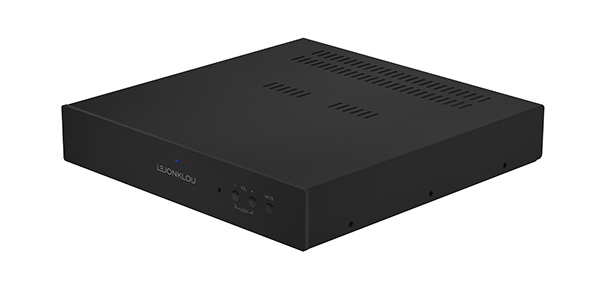
The more I listen—to gear I'm reviewing as well as other people's hi-fis—the more I believe in intangibles. One of these intangibles is the art of system building.
Brilliant Corners #9: a DAC and a Streamer from France's Totaldac
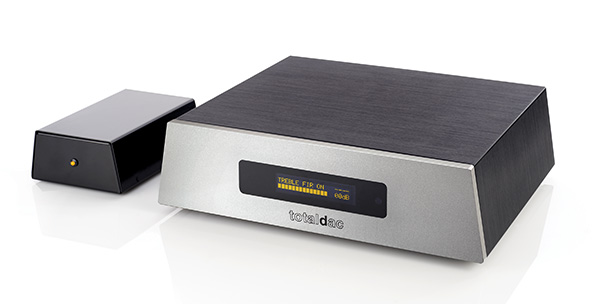
To misquote Morrissey, some knobs are better than others. The Manley Neo-Classic 300B amplifiers that I've been listening to, for example, have a knob marked "feedback" that goes from 0 to 10. I've learned so much from using it that I've come to believe that if your amp doesn't have such a knob, it should. You see, the higher you set this control, the better the amp will measure. Applying more global negative feedback to these amps lowers their nonlinear distortion and noisefloor, increases their bandwidth, renders them less sensitive to the speaker's impedance variations and otherwise makes them more stable and efficient. In fact, by applying lots of feedback to an amplifier, it's possible to reduce distortion to barely measurable levels.
So what's the problem? Well, a few turns of the knob suggest that negative feedback isn't as useful as it appears on paper.
Brinkmann Audio Nyquist D/A processor
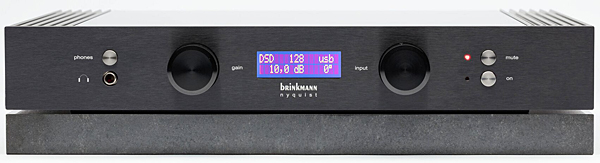
What? Johnny-come-lately turntable manufacturer Brinkmann Audio now makes a DAC? Are they desperate? What sampling rates does it support162/3, 331/3, 45, and 78? I guess the vinyl resurgence is over! Why else would Brinkmann make a DAC?
If that's what you're thinking, consider that Helmut Brinkmann began designing, manufacturing, and marketing electronics well before he made the first of the turntables for which his company is best known in the US.
Bryston B100-DA SST DAC/integrated amplifier
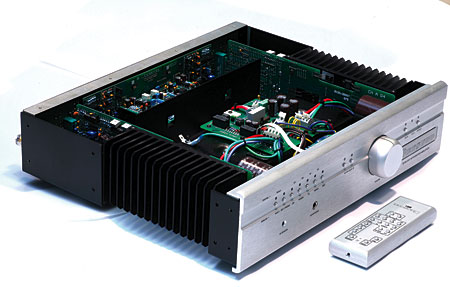
Over the years, I have used and enjoyed in my audio system large, single-purpose components. Each of these chassis has had but one role: preamplifier, amplifier, digital-to-audio converter (DAC), etc. I guess I've been just a little suspicious of products with multiple functions crammed into a single small chassis; I've figured that the designer may have cut a corner that could affect the sound.
Bryston BDA-1 D/A converter
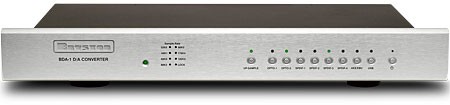
In February 2009, I reviewed Bryston Ltd.'s first CD player, the $2695 BCD-1, and was very impressed by what I heard. The BDA-1 ($1995) is the Canadian company's first standalone DAC. It's slim, only 2.75" high, with the engraved company name, model number, and infrared sensor grouped at the extreme left of a front panel of polished aluminum. Farther to the right are two columns of four LEDs each that comprise the sample-rate indicator, which identifies the selected input's signal frequency and whether the BDA-1 has locked to it. Closer to the center is the Upsample control, which governs the conversion of the incoming digital signal synchronously to 192kHz or 176.4kHz. The Upsample LED turns green for 192kHz, red for 176.4kHz. Digital sources are selected by pressing one of eight pushbuttons just right of center: two TosLink, four S/PDIF (coaxial), one AES/EBU XLR, and one USB 1.1, the last accepting only signals with sample rates at or below 48kHz. An LED above each pushbutton lights green for an incoming PCM datastreams and red for other types, including multichannel Dolby Digital streams.