

Bel Canto e.One DAC3.5VB D/A converter
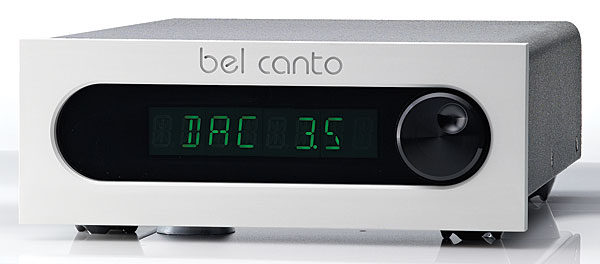
Minnesota pride is a funny thing. As Garrison Keillor points out weekly on A Prairie Home Companion, to be a Minnesotan, the first and crucial step to be taken is that of self-effacement. It is unclear to me whether this is the cause or symptom of Minnesotans ability to endure brutal winters, excel at the creation and consumption of hot dish (which the rest of the God-fearing world knows as casseroles), or their miraculous lineage from generations of Norwegian bachelor farmers. Whatever it is, Minnesotans tend to quietly get their jobs done with little more fanfare than a cup of coffee and a slice of rhubarb pie.
Bel Canto e1X DAC/Control Preamplifier

My late father-in-law used to say that life is like a roll of toilet paper. The closer you get to the end, the quicker it passes. I was reminded of that when I was asked to review Bel Canto's new e1X DAC/Control Preamplifier ($6800). It didn't seem that long ago that I favorably reviewed the Minnesota company's e.One DAC3, but Google told me that it was 15 years ago! "Other than the jitter performance via its USB input, the Bel Canto e.One DAC3 is the best-measuring digital component I have encountered," I wrote in November 2007 (footnote 1), adding that it "offers some impressive audio engineering in both the digital and analog domains."
Bel Canto USB Link 24/96 USB-S/PDIF converter
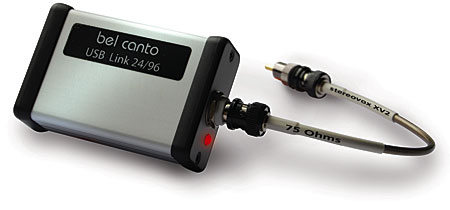
The speed with which audiophiles have adopted a computer of some sort as their primary source of recorded music might be thought breathtaking. But with the ubiquitous Apple iPod painlessly persuading people to get used to the idea of storing their music libraries on computer hard drives, the next logical step was to access those libraries in listening rooms as well as on the move. A few months back, I wrote a basic guide to the various strategies for getting the best sound from a computer: "Music Served: Extracting Music from your PC." Since then, Minnesota manufacturer Bel Canto Design has released a product that aims to simplify matters even further.
Benchmark ADC1 USB A/D converter
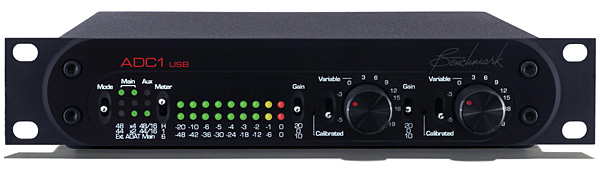
Erick Lichte's review of Benchmark's DAC2 HGC D/A converter in this issue gave me an ideal opportunity to spill some ink on the company's ADC1 USB A/D converter. The ADC1 is housed in the same small case as the DAC (one rack unit high, half the rack unit width), and is offered with a black front panel with rack ears, or a silver aluminum panel without ears, either for $1795.
Benchmark DAC1 Pre USB D/A headphone amplifier
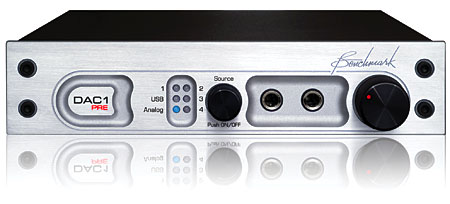
Most of this column is dedicated to two hi-fi products for the massesnot from Lvov, via Vladimir Lamm, of Lamm Industries; or from Leningrad, via Victor Khomenko, of Balanced Audio Technologies; nor from any other Soviet-born audio hero. (Neither Vladimir nor Victor is on the list of "Name of Russia" contenders for greatest Russian of all time.) Nor from any consumer audio company, but from the world of professional audio. An Iron Curtain almost separates the two.
Benchmark DAC1 USB D/A processor & headphone amplifier
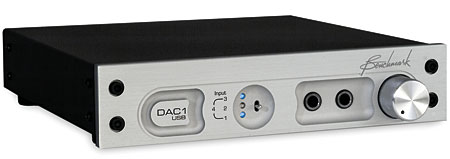
In his July 2003 "The Fifth Element" column, John Marks enthusiastically wrote about the Benchmark Media Systems DAC1 D/A processor and headphone amplifier. Comparing its sound playing CDs with that of a three-times-more-expensive Marantz SA-14 SACD player, he concluded that the DAC 1's "Red Book" performance was at least as good as that of the Marantz, being "slightly more articulate in the musical line, and slightly more detailed in spatial nuances, particularly the localization of individual images in space, and in soundstage depth."
Benchmark DAC2 HGC D/A processor/headphone amplifier
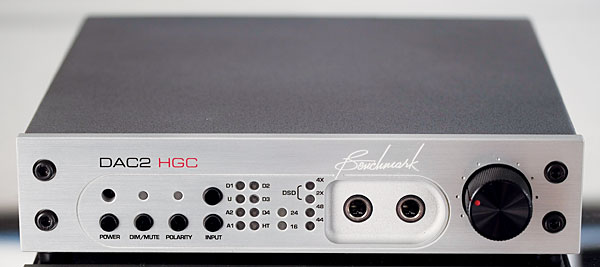
I totally called this one.
In 2007, I spent time with Bel Canto Design's e.One DAC3 D/A processor. In his review of the DAC3 in the November 2007 issue, John Atkinson quoted my comparison of it with the Benchmark DAC1, which I called "the Swiss army knife of audio" and "one of the only future-proof source components you can buy these days."
Benchmark DAC3 HGC D/A preamplifier-headphone amplifier
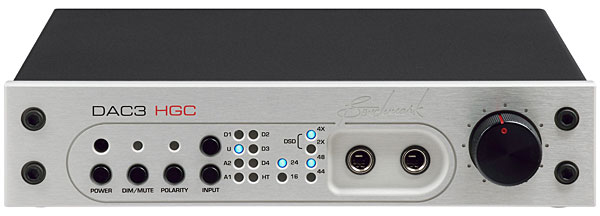
Much has been written about the divide in high-end audio between subjectivists, who trust their ears, and objectivists, who believe that anything not scientifically proven is fake news. I respect both sides and am skeptical of both extremes, and I like to think that's how most audiophiles feel. High-end audio is about experiencing musicthat's the whole pointbut scientific and technological rigor lie behind every real advance, past and future. I regret the cynical snake-oil salesmanship, bad thinking, and clumsy engineering that pervade certain parts of our hobby.
BorderPatrol Digital to Analogue Converter SE
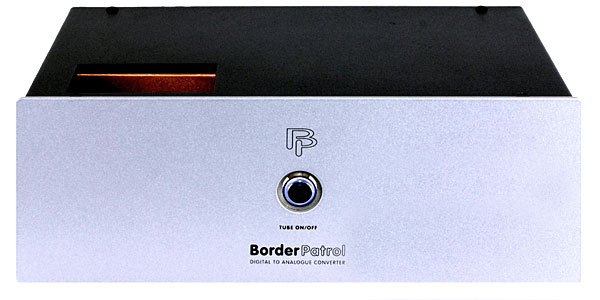
The trouble with a classicist he looks at the sky
He doesn't ask why, he just paints a skyJohn Cale and Lou Reed, "Trouble with Classicists," from Songs for Drella Left brain/right brain, yin/yang, male/female, Apollonian/Dionysian, classical/romantic, painterly/linear, dark/light, hard/soft, warm/cool...I use these contrasting adjectives in my reviews because I feel some confidence in their ability to convey the nature of what I experience while listening to recordings with whatever new audio box sits before me in the listening studio. I also use: accurate (I hate that word), neutral (what's that?), colored, clean, transparent, open, musical. Sadly, I have little confidence in their ability to describe my experiences.
He doesn't ask why, he just paints a skyJohn Cale and Lou Reed, "Trouble with Classicists," from Songs for Drella Left brain/right brain, yin/yang, male/female, Apollonian/Dionysian, classical/romantic, painterly/linear, dark/light, hard/soft, warm/cool...I use these contrasting adjectives in my reviews because I feel some confidence in their ability to convey the nature of what I experience while listening to recordings with whatever new audio box sits before me in the listening studio. I also use: accurate (I hate that word), neutral (what's that?), colored, clean, transparent, open, musical. Sadly, I have little confidence in their ability to describe my experiences.
Boulder 1012 D/A preamplifier
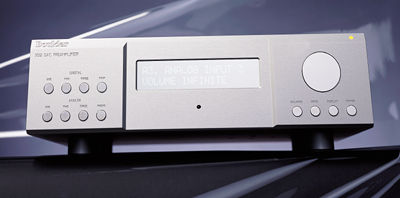
The Boulder 1012's is a line-level preamplifier and DAC in one box. Its design and build qualities are icons to elegant engineering know-how. No screws show on the rectangular box of large but not massive proportions, for example, which is all done up in matte aluminum and set off with a few highly polished stainless-steel buttons. The chassis construction uses tongue-and-groove techniques. The sides of the 1012 benefit from styling cues found on Boulder's newer amplifiers. As you can see from the photograph, the look is both elegant and hi-tech in a way very few other manufacturers manage.