

Analog Corner #217: Sutherland Engineering Insight phono preamplifier
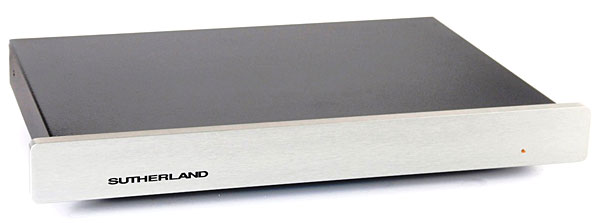
Veteran phono-preamplifier designer Ron Sutherland has been partial, of late, to battery power. Getting off the grid can produce superb results, as demonstrated by his Hubble phono preamp ($3800), powered by 16 alkaline batteries.
I favorably reviewed the Hubble in the February 2010 issue, and remember loving most everything about itparticularly its drop-dead-quiet backdrops, its solid, weighty bottom end, and its fully fleshed-out instrumental textures. I was less enthused by its somewhat soft, muted high-frequency transients, though of course tastes and associated gear will differ. I need more grit, particularly for rock; you may not.
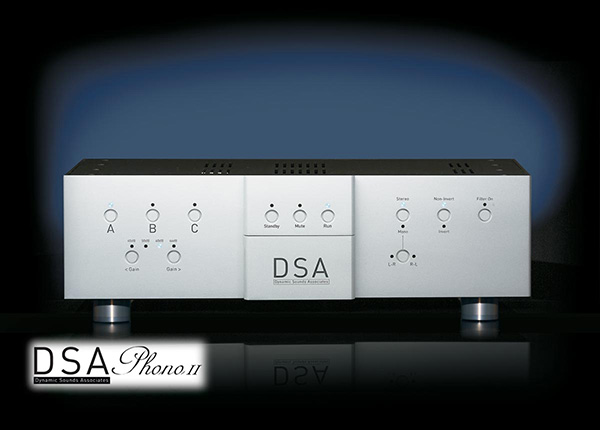
Analog Corner #219: DSA Phono II preamplifier, Stein Music and Miyajima phono cartridges
Shortly after the July 2013 issue of Stereophile hit the newsstands, I received an e-mail from audio restoration expert Doug Pomeroy, who specializes in the digital preservation of disc pressing metal parts, acetates, and 78s . . . His and my opinions about digital sound couldn't be more divergent.
Analog Corner #221: Trinity Electronic Design & Thrax Phono Preamplifiers
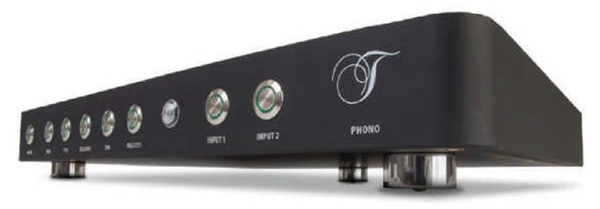
The quest for vinyl quiet seems, at best, quixotic. By "vinyl quiet" I don't mean "quiet vinyl," which we now reliably get from pressing plants like QRP, RTI, Pallas, and a few others. I'm referring to makes of phono preamplifiers who set as a primary design goal electronic "quiet," ie, an absence or minimum of electronic noise. A stylus coursing through the groove of even the quietest LP still produces a considerable amount of noise.
Analog Corner #223: Acoustical Systems SMARTractor & Hagerman Trumpet Reference Phono Preamp
On analogplanet.com you'll find coverage of my visit in November 2013 to the 10th annual Manila Hi-Fi Show, which took place the weekend of the devastating typhoon Haiyan (Filipinos call it Yolanda). Because the people I met there are such big Stereophile fans, I wanted to be sure to give them a shout-out in this column, too.
Despite the weather, which prevented audiophiles living on other islands of the archipelago from flying in for the event, at least 2000 managed to attend. These are passionate, enthusiastic audiophilesand the high proportion of young people, particularly among the vinyl buyers, was encouraging.
The greeting I received throughout the show was beyond my most vivid egomaniacal daydreams. I was treated so well that I don't know how to express my gratitude, other than to just say "Thanks"and get back to work.
Analog Corner #229: Three Expensive Phono Preamplifiers, Phasemation, PBN, Qualia
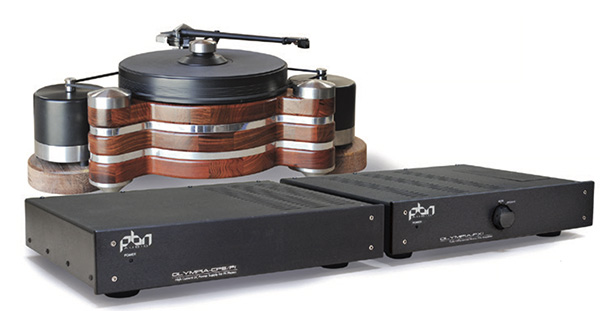
Other than being well built and high priced ($15,000, $22,000, $60,000), these three phono preamps have very little in common, in design or in sound. One has vacuum tubes, including a direct-heated 5U4G rectifier tube (the Phasemation). Two are solid-state (the PBN and Qualia). Two feature separate chassis for the left and right channels (the Qualia and Phasemation). All three have outboard power supplies. Two come from Japan (the Qualia and Phasemation), one is made in the US (PBN). All three are elegantly built, inside and out. Two are physically attractive, one is lab-grade butt ugly. One has a host of convenience features, including various equalization curves and three inputs (Phasemation). One offers no adjustability whatsoever (Qualia). One has two gain settings and multiple loading options (PBN). Two are designed to be used only with moving-coil cartridges, while the third (Phasemation) can also accommodate moving-magnets. One is fully balanced and dual- differential (PBN), two are not.
Analog Corner #232: HiFiction Simplicity II tonearm, Miyajima Labs Madake phono cartridge, Rogers High Fidelity PA-1A phono preamplifier
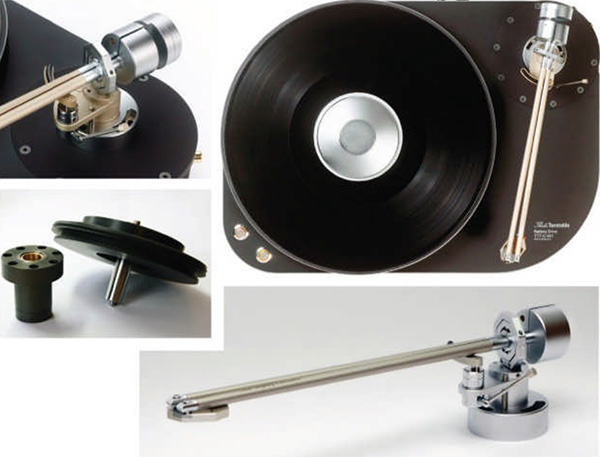
In my January 2014 column, I reviewed HiFiction's Thales TTT-Compact turntable and Simplicity tangential-tracking pivoted tonearm, an intriguing combo from Micha Huber, a talented Swiss watchmaker turned turntable designer.
The TTT-Compact's particulars, including its battery-powered motor and exceptional ease of setup, are described in detail in that review, which includes a link to a useful animation that shows how the design, as Huber says, "reduces the perfectly tangential tracking to pivot points, while the pick-up cartridge is taken and aligned on the Thales' Circle."
Suffice it to say that while the HiFiction tonearm is named Simplicity, its design is anything but.
Analog Corner #235: Kiseki & Lamm
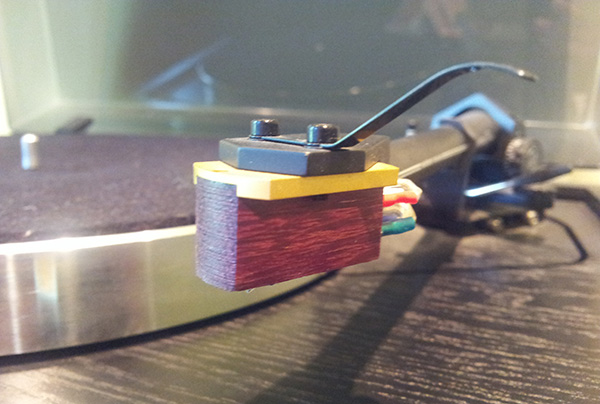
At the 2011 Consumer Electronics Show, Herman van den Dungen handed me a surprise: a brand new Kiseki Blue cartridge manufactured from new-old-stock parts. It wasn't mine to take homeonly to look at, to prove it was real.
Herman van den Dungen may not be a household name even for audiophiles, but his products are: his PrimaLuna electronics are exported from the Netherlands to the US and distributed by tube connoisseur and collector Kevin Deal for PrimaLuna USA.
In the 1980s, Kiseki was legendary among audiophiles, even if their cartridges' prices were beyond the reach of most. But the brand's history is less well knownand younger analog devotees may not have heard of Kiseki at all.
Analog Corner #249: LKV Research Veros One phono preamp, Triangle Art Apollo MC cartridge
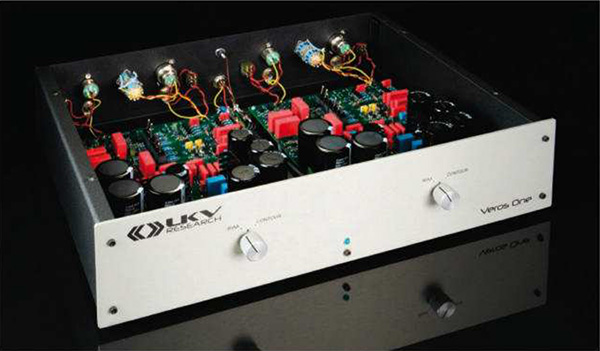
Designer Bill Hutchins, of LKV Research, builds the 2-SB moving-magnet/moving-coil phono preamplifier in North Conway, in the White Mountains of New Hampshire; he uses as many US-sourced parts as possible, and sells his products factory direct. I reviewed the 2-SB in March 2014, on AnalogPlanet.com: the 2-SB's sound was exceptionally fineespecially if you like refined, solid-state quiet and detail, and especially considering its then-price of $2500. Since that review's publication, the 2-SB has been upgraded with a version of the third gain stage from LKV's JFET-based Veros One phono preamp ($6500; see below), and its price has risen to a still-reasonable $3000.
In May 2014, Bill Hutchins introduced the Veros One phono preamplifier ($6500).
Analog Corner #251: ModWright PH 150 phono stage
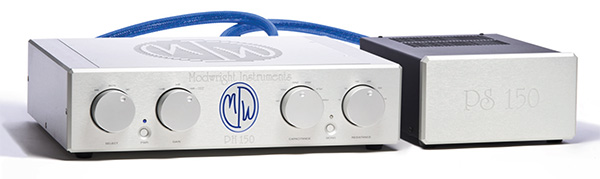
ModWright Instruments' PH 150 moving-coil/moving-magnet phono stage measures 17" wide by 5" high by 12" deep and weighs 19lb. Knobs on its front panel let you easily make adjustments that with some phono preamps require accessing the rear panel or going inside. Starting at the left, the Select knob offers settings for MC, MM, and Mute. The Gain knob offers levels of 0dB, 6dB, and 12dB. With MC selected, those settings would correspond with 72, 66, and 60dB of gain, respectively; with MM, the numbers would be 57, 51, and 45dB, the last being more typical of most MM stages.
First, let's talk about problems with grounding and hum...
Analog Corner #255: Kuzma Stabi M turntable, Audio Tekne TEA-8695 and Xactive Argo phono preamplifiers

Do good things come in small packages, or is bigger better? Your call. But regarding the products they've sent my way for review this month, designers Franc Kuzma, Kiyoaki Imai, and Velissarios Georgiadis are all in the latter camp. Kuzma's Stabi M, designed to accommodate the 14" version of his 4Point tonearm, is a massive turntable with a big footprint. Imai's Audio Tekne TEA-8695 tubed phono preamplifier has 11 Permalloy core transformers and weighs nearly 100lb. And although it uses just four signal-path tubes and a pair of rectifier tubes, Georgiadis's Xactive Argo phono preamplifier fills the full width, height, and depth of a Harmonic Resolution System shelfand not because it's a big but mostly empty housing.