

Classé Sigma 2200i integrated amplifier

The last few years have seen a flood of new integrated amplifiers in an audiophile market traditionally wedded to separate preamps and power amps. That might reflect the fact that integrated amps make a lot of sense, and not only because they usually cost less than equivalent separates. The latter gained a foothold in audio's Paleolithic era, when tubes were the only game in town. Tubes generate lots of heatan enemy of electronicsand separating the preamp stages from the output devices kept this under control. Yes, there were integrated amplifiers back then, but they were generally of very low power25Wpc was once considered monumental.
Conrad-Johnson CAV50 integrated amplifier

The search for signal transparency has led to much experiment and debate concerning losses in fidelity that can be traced to the preamplifier or—as it's more often and awkwardly called these days when the phono stage is omitted—the "line controller."
Creek 4240 Special Edition integrated amplifier
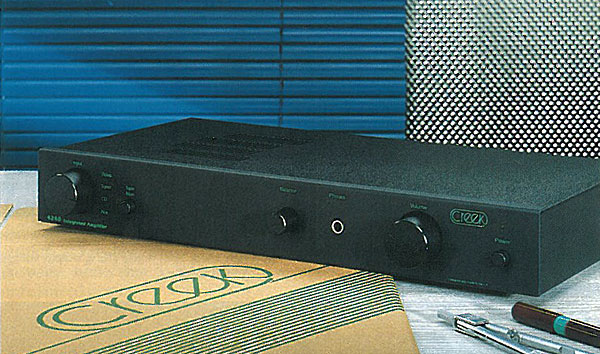
In this, my first equipment review for Stereophile, I'll begin by explaining my philosophy regarding reviewing inexpensive components. In my quest for products by designers who strive to establish new benchmarks for reproducing sonic realism at lower prices, I'll be looking for "value" components (a more appropriate term than "budget") whose designers logically fall into two camp. . .
Creek 5350SE integrated amplifier
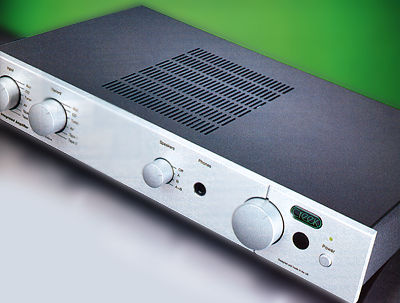
Creek Audio founder/designer/co-owner Michael Creek is a quiet, friendly, unassuming man. Unlike some ego-driven electronics designers who tout their products very loudly from their pulpits, Michael Creek has been quietly designing high-quality, musical, and affordable integrated amps in black-metal boxes for nearly 20 years. His target market is the passionate music-lover who wants something a notch above an entry-level NAD or Rotel receiver, but whose bank manager would frown on splurging on electronic separates.
Creek Audio Destiny integrated amplifier

The one thing I've liked about designer Mike Creek of Creek Audio as much as his design talent is his predictability. I've been following his integrated-amplifier designs for nearly 20 years now, having reviewed, in sequence, the CAS4140s2 (for another magazine), the 4240SE (Stereophile, December 1995, Vol.18 No.12), and the 5350SEhttp://www.stereophile.com/integratedamps/327">5350SE; (March 2001, Vol.24 No.3). In each case, I was sufficiently impressed with the review sample that I bought it and made it my new reference in my second, affordable system. The predictable part comes from Creek's traditional nomenclature: an "s2" or "SE" (Special Edition) designation has always denoted a modest upgrade, and a numerical uptick in the model number a more significant upgrade, the level of significance denoted by the specific digit being increased. Hence, the update from 4240 to 5350 is intended to indicate a greater improvement in sound than the update from 4140 to 4240.
Creek Evolution 100A integrated amplifier

As an audio scribe, the fiercest demons I wrestle are beliefsyours and mine; those of my friends, my editors, my fellow reviewers; and those of the engineers and promoters of the products I write about. Sometimes the force of these rabidly held and (mostly) conflicting beliefs paralyzes me with self-doubt: What do I know? What makes me qualified to listen and judge?
Creek Evolution 50A integrated amplifier

It seems I'm always reviewing an integrated amplifier from Creek Audio. It started in the late 1980s, when I fell in love with the capabilities of inexpensive, well-designed audio equipment, sparked by the spectacular sound of a pair of Celestion 5 bookshelf speakers at a Consumer Electronics Show in Chicago. I was reading an issue of Hi Fi Heretic (now defunct), for which my friend Art Dudley wrote, and it included a survey of various inexpensive British integrated amplifiers, some of them made by Creek. I was already familiar with the company, but hadn't listened to affordable British electronics since I'd lived in London, in the early '80s. I got a Creek 4140s2 integrated and was amazed at its neutrality, its lack of etched sound, its natural reproduction of instrumental timbres. I ended up buying it, and used it to review bookshelf loudspeakers.
Croft Acoustics Phono Integrated integrated amplifier
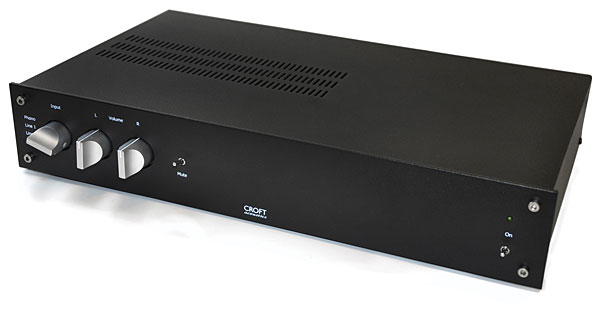
The name sounds perfect. It fits neatly next to those of Messrs. Leak, Sugden, Walker, Grant, Lumley, and others of Britain's most rightly revered amplifier builders. In fact, when their distributor called and asked if I'd like to review the latest amplifier from Croft Acoustics, I accepted without actually knowing who they are, simply because they sounded like someone I was supposed to knowsomeone who's been around for 60 years or so, shellacking bell wire in an old mill with a thatched roof.
Cyrus 6vs integrated amplifier
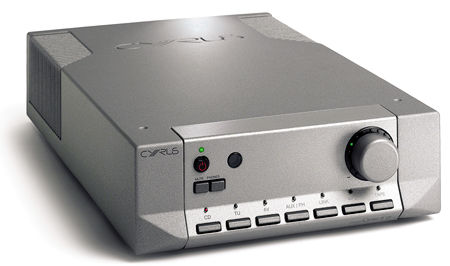
Living with a brand-new Cyrus amp was a pleasantly nostalgic thing to do, even from the start: It arrived in a clean and downright attractive carton that seemed designed specifically to contain a brand-new Cyrus amplifier. Think of it! And I haven't even mentioned the nice owner's manual or the balance control or the headphone jack. As I said: the good old days.
darTZeel CTH-8550 integrated amplifier
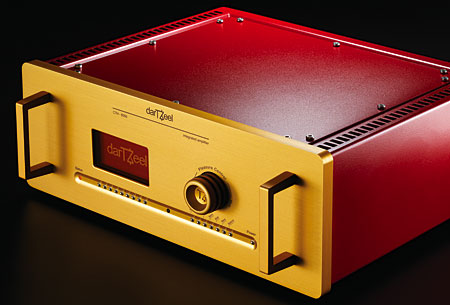
As the 2009 Consumer Electronics Show neared its end, I wandered into Blue Light Audio's room, which was dominated by the innards of darTZeel's new NHB-458 monoblocks—think of a 3D "exploded" diagram and you'll be on target. So impressive was that display of brute engineering that I almost didn't notice the amplifier that was actually making the music: the CTH-8550 integrated ($20,300).