

Ayre AX-7 integrated amplifier
Dating was murder, especially in the months just before I met my wife. I knew some nice women back then, many of whom were good-hearted and others of whom were beautiful. One was both, and talented, too: She gave me presents for no reason and wrote tender things in cards with pictures of sweet meadows or the sea: My love goes on and on, they said. But for whatever reason, I just couldn't love her back, and Oh! how the shit hit the fan the day I told her so. I meant it as a respectful act of honesty and forthrightness; she took it as a cowardly act of rejection, and responded in a manner that would forever remind me of Maggie bouncing the rolling pin off Jiggs's head while calling him an insect. That day, I learned two things: 1) women are unlearnable; and, 2) honesty, while an unassailably good thing in and of itself, makes a poor tool, mostly because it lacks a safety handle.
B.M.C. Audio Amplifier C1 integrated amplifier
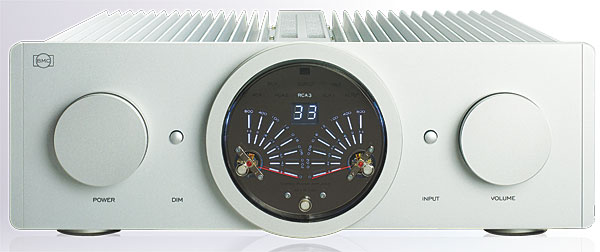
B.M.C. Audio GmbH (the initials stand for Balanced Music Concept) designs its high-performance audio products in Germany, where the company was founded in 2009, and has them manufactured in its own wholly owned factory in China. The design team is headed by Carlos Candeias, whose earlier designs included a belt-driven CD transport for C.E.C. and, for Aqvox, a high-performance, current-gainbased, balanced phono preamplifier that's reasonably priced. These have won him a lot of attention, and made him something of a celebrity in certain sectors of the audiophile world.
Bel Canto Design Black ACI 600 integrated amplifier
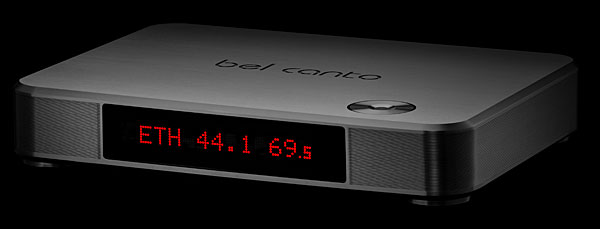
When Michael McCormick, president of Bel Canto Design, suggested that I review their Black ACI 600 integrated amplifier, I accepted without hesitation. As wonderful as my reference system may sound, its dCS digital front end alone comprises four boxes and a web of cables complex enough to send many a spider spinning. Given the choice between connecting that front end to a pair of expensive, enormous monoblockswith their similarly expensive AC cords and equipment racks/isolation platformsor to a single, visually elegant, 45-lb box that costs $25,000, produces 300Wpc into 8 ohms, and requires only a single power cord and shelf, I think many an audiophile, even those with lots of money, might gravitate toward the latter.
Bel Canto Design C7R D/A receiver

As a young music lover, I never knew there were such things as separate preamplifiers, amplifiers, and FM tuners. All I knew was that if I wanted to play music from my CD player, hook up my VCR to my stereo, or listen to the radio, I needed that magical device: a receiver. It was all I ever wanted.
Bel Canto e.One S300iu integrated amplifier

After using Bel">http://www.stereophile.com/digitalprocessors/1107bc">Bel Canto's e.One DAC3 with the McIntosh">http://www.stereophile.com/mediaservers/108mac">McIntosh Laboratory MS750 music server, I was so impressed that I wanted to hear Bel Canto's CD transports as well. But willing as Bel Canto president and CEO John Stronczer was to supply me with a CD-2, he suggested I audition the S300iu ($2195, footnote 1).
Bluesound PowerNode streaming integrated amplifier

Old-school audiophiles like me cling to our vinyl records and CDs. We spin them on turntables and slide them into transports, which send electric signals through wires to solid state or tubed amplifiersa string of hardware devices. But, despite our object-attached ways, we're quite aware that we are living in a software-enabled, Bluetooth-connected, Wi-Fifacilitated world. Even our Milky Way galaxy is wireless; as that pontificator of everything galactic, scientist Neil DeGrasse Tyson, has proclaimed, "We're all connected."
Boulder 865 integrated amplifier

After Fred">http://www.stereophile.com/solidpreamps/1207bo">Fred Kaplan reviewed Boulder Amplifiers' 810 line preamplifier and 860 power amplifier for the December 2007 Stereophile, John Atkinson requested that I listen to the 860 in my own system for a while. Never having reviewed any Boulder kit, I was curious.
Boulder 866 integrated amplifier

What's the first thing that comes to mind when you hear the word "boulder"? I think of a rugged, mountainous landscape with jagged snow-capped peaks. I see images of the last time I drove up from sunny Boulder, Colorado, to Rocky Mountain National Park and discovered so much snow coming down that if we had dared walk too far in, our trail would have been covered with snow and we'd never have been able to find our way out. But how magical it was!
Bow Technologies Wazoo integrated amplifier

I hate all those automobile reviews that go on and on about a car's design aesthetics. C'mon, I can see what it looks like, even if only in the pictures. Just tell me things I can't appreciate without a run on the Autobahn.
Brilliant Corners #12: Balanced Audio Technology VK-80i integrated amplifier, Ortofon Cadenza Bronze phono cartridge
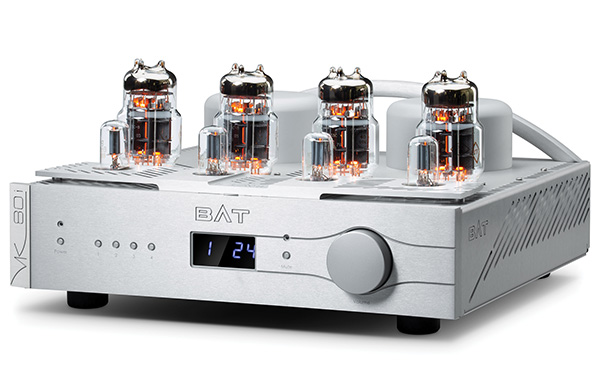
In 1976, a Soviet fighter pilot named Viktor Belenko made an emergency landing in Hokkaido, Japan. He was flying a MiG-25 supersonic interceptor jet and, upon touching down, requested political asylum. This proved to be a stroke of brilliant luck for the Americans. The MiG-25 remains one of the fastest and highest-flying aircraft ever produced, and Belenko's defection allowed them to have a tantalizing look at the technology inside.
Among the top-secret loot found inside the Soviet jet was a large, heavy triode vacuum tube used as a regulator in the power supply of the MiG's radio. It was known as the 6C33C. (The enormous electromagnetic pulse caused by a nuclear explosion would fry a transistor. Tubes were used in military equipment with such an eventuality in mind.)