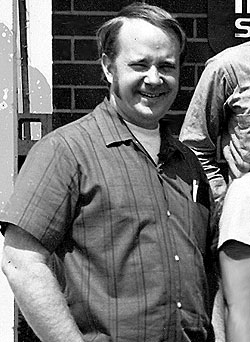
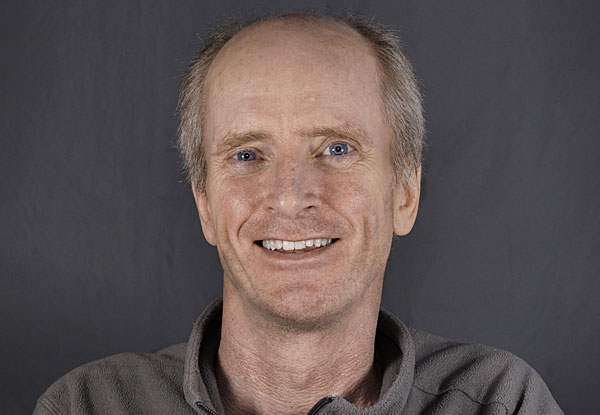
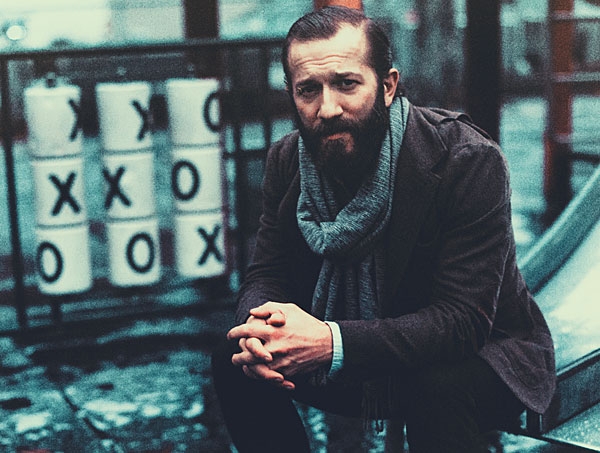
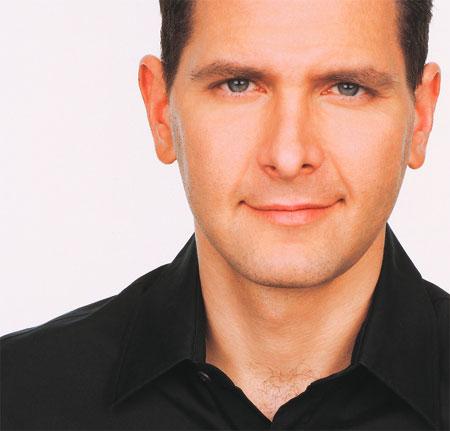
Editor's Note: John Crabbe was Editor of Hi-Fi News & Record Review when I joined that magazine as a lowly editorial assistant in September 1976. At the end of 2007, I had asked Steve Harris to interview John for Stereophile, as part of an ongoing project to create an oral history of high-end audio (footnote 1). Sadly, John passed away in December 2008see "As We See It" and "Industry Update," in our March issue. We are publishing Steve's interview as a tribute to a man from whom I learned my craft as an audio magazine editor.John Atkinson
"This won't be a short job," says Arcam's president, John Dawson (footnote 1). He's talking about the challenge of engineering the next generation of Arcam home-theater products to embrace the new high-resolution video formats. It's possibly the biggest technical challenge English company Arcam has faced since, almost exactly 30 years ago, Dawson and his original business partner, Chris Evans, launched their first product—an unpretentious, 35W hi-fi amplifier called the A&R Cambridge A60.
Canadian speakers from such companies as Mirage, PSB, and Paradigm have acquired international reputations for offering good sound at more-than-competitive prices. The latest Canadian speaker manufacturer to hit the big time might well be Energy, which has actually been around for about 15 years, but has only recently introduced a flagship speaker. Energy's $6000/pair Veritas v2.8 earned Tom Norton's commendation for having produced one of the best sounds at the 1993 Las Vegas WCES. [TJN's review appears in this issue.—Ed.]
Judy Spotheim, maker of the SpJ arm and the gorgeous La Luce turntable that I reviewed a while back for Stereophile (October 1998) and that has subsequently become one of my references for LP playback. She's an intelligent, well-read individual who has a penchant for asking me, "You didn't read that in the manual?!" Ahem. Although the following interview was taped on the phone from her home in the Netherlands, I hope to meet her sometime soon.
Stereophile Editor John Atkinson walked into our office brandishing a CD (footnote 1). "Guess what Ken Kantor did? He took a year off from running NHT (footnote 2) to make this disc."
Kevin Hayes: Valve Amplification Company arose out of my dissatisfaction with the stereo gear I could buy. I've been an audiophile since before I knew what the word meant, going back to the mid-'70s. I had an epiphany when I first heard a piece of old tubed gear, a Fisher X101, that simply blew away a highly touted receiver that I happened to own. It was a 25W integrated amplifier, using 7591s on the output, and except for sustained organ-pedal notes, it was far better than what I had at that time.
Since he joined Snell Acoustics in the mid-1980s, Kevin Voecks, their chief designer (footnote 1), has been involved in the design or redesign of the entire Snell line, from the minor revision of the Type A/III (incorporation of a new tweeter), to the complete redesign of the Type C (now the CIII). Snell Acoustics is located in Massachusetts, and although Kevin spends a good deal of time there or at the measurement and analysis facilities of the Canadian National Research Council (NRC) in Ottawa, he does a great deal of his conceptual and preliminary design work, as well as his listening, in Los Angeles, where he makes his home. I visited him there last summer to gather a little insight into his background and loudspeaker design philosophy. I started by asking Kevin when had he first become interested in loudspeaker design...
When Hong Kong–based music lover and electronics-equipment distributor Klaus Heymann (footnote 1), now 70, first began organizing classical-music concerts as a way to boost sales, he had no idea he would end up founding the world's leading classical-music label. But after starting a record-label import business and meeting his future wife, leading violinist Takako Nishizaki, the German-born entrepreneur sought a way to promote her artistry. First he founded the HK label, which specialized in Chinese symphonic music (including Nishizaki's recording of Butterfly Lovers, the famous violin concerto by Chen Gang). Next he established Marco Polo, a label devoted to symphonic rarities.
For the musically prolific, releasing too many records too close together can be problematic or worse. Just because you can make a record every week in your home studio doesn't mean you should. The impulse to commit every golden thought and performance to tape without self-editing or even pausing to reflect screams narcissism run amok. Asking listenerseven dedicated fansto then buy and spend time listening to half-baked nonsense that might have become something, given more time and care, is a sure career destroyer. There's truth in the old saw about building demand, avoiding saturation, and creating a hunger among the listening public. Most critical of all, despite downloads, piracy, and Lady Gaga's pointy hats and eggshell entrances, the old Hollywoodism still applies: while spontaneity may sound like a radical idea, you're only as good as your last album.
In 1862, skepticism among the educated was exemplified by the medical establishment, which ridiculed Joseph Lister's notion of "animals in the air." By contrast, the professional skeptic of 2012yes, it's now possible to make a comfortable living in the fieldfinds himself inconvenienced by 150 years of discovery, and makes do with ridiculing Lister for his Quaker faith. I guess that passes for progress in some circles.
Consider the fate of Giordano Bruno, a 16th-century astronomer who challenged Ptolemy's notion of Earth being the center of a finite universe—and in doing so went head to head with the church of Rome. Bruno's scholarly diligence and fearlessness were rewarded not with fame, riches, or accolades from his colleagues, but with a hot-lead enema, after which he was burned at the stake. Next heretic in line, step right up, please.
Even when Loudon Wainwright III (left in photo with Ramblin' Jack Elliot) was a young man he was writing autobiographical songs, and his old themes of family, sex, and death resonate more deeply on his new record, Older Than My Old Man Now. He usually performs solo, armed with just an acoustic guitar or a banjo, but most of his recordings present more heavily produced versions of LWIII's music. When I chatted with LWIII in late April I wanted to explore that dichotomy and how those transformations take place.
One of the characteristic traits, I have found, that defines the loudspeaker designer is that they are loners—they seem to avoid one another's company as if on purpose. But if ever you sit down with a designer, all you need to do to open him up is to ask him what he feels to be important in loudspeaker performance.
Our meeting was propitious and totally unexpected. The locus was Los Angeles' Sheraton Gateway Hotel last May, on which we had all descended for Home Entertainment 2006. As a contributor to Stereophile's Show blog, my assignment was as liberal as they come: Go where you are drawn, listen as you will, and record your impressions.
Brilliant designs, spectacular initial success, rave reviews, explosive growth that stretches resources way beyond limits, too much attention to technology and too little to manufacturing and business practices, long hours, quality problems, conflicts between partners, and finally...