

AAD Reference Silver-1 loudspeaker
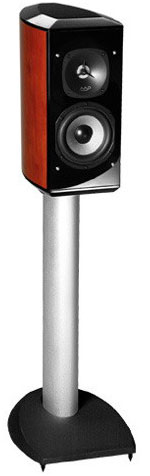
Bookshelf loudspeaker. The phrase may be common usage, but I really dislike describing small speakers as "bookshelf" models. Place a pair of high-performance minis on a bookshelf against the wall and you destroy much of the sound quality for which you've paid. Yet place the same speakers on good stands well away from room boundaries, and while it could be argued that their footprint is no smaller than a conventional tower speaker, with the best designs you'll get true high-end sound, particularly regarding the accuracy of midrange reproduction and the stability of stereo imaging.
Acarian Alón Li'l Rascal Mk.II loudspeaker

Since 1991, Acarian Systems' Carl Marchisotto has brought home the bacon by focusing most of his efforts on conventional dynamic, three-way, floorstanding designs in the $2000-$7000/pair range—28 different loudspeaker designs in 12 years, 13 of them still in production. That's why Home Entertainment 2001 showgoers who were familiar with previous Alón efforts were taken aback when Marchisotto unveiled a new flagship for his Alón speaker line: the Exotica Grand Reference, a $120,000 line-source ribbon/dynamic hybrid system comprising five 7' towers. For those attracted to cost-no-object designs, the debut of the Exotica Grand Reference was quite a spectacle.
Acarian Alón Petite loudspeaker & PW-1 woofer system
SLAM! My left foot went numb. My fellow salesman, Danny Shapiro, had lost control of the Thiel CS5 that we'd been walking into place in Demo Room V, and it had come crashing down on my foot with unerring accuracy—all 180 lbs worth. As I stared down in horror, I remembered that we'd left the spikes on. But wait a minute—there was no pool of blood spreading out from under the CS5. How could that be? Convinced that the heavy cabinet was acting as a tourniquet, I levered it off my foot, expecting a grisly sight. I got one: my new Rockport pierced by the carpet-point—right between my big and second toes. And people ask me why I like small loudspeakers.
Acelec Model One loudspeaker
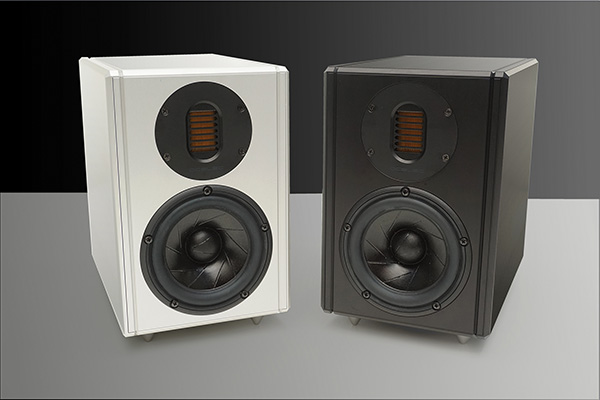
The Acelec Model One speakers I'm auditioning ($6495/pair) are not princesses in pink, or frog green, or made of some chemically distilled polypudding. Nor are they conventional-beyond-reason MDF boxes covered with stick-on vinyl pretending to be wood. The Model Ones are squat, small, serious-looking, two-way standmounts. They are 11.2" tall, 7.7" wide, 11.5" deep, and 37.5lb heavy.
Acora SRB loudspeaker

I'm a sucker for materials, whether it's finishes for loudspeakers and other audio equipment, a shoe's fine, supple leather, a crisp cotton shirt, or a cozy cashmere scarf.
Apart from their inherent sensuousness, materials can make a difference in the sonics of audio components, especially loudspeakers.
Acoustic Energy AE1 loudspeaker
"Who">http://www.Stereophile.com//features/44/">Who Stole The Bass?" asked Anthony H. Cordesman, writing about minimonitors in the April/May 1987 Stereophile (Vol.10 No.3). And for the designer of a box loudspeaker, the fundamental design decision, at any price level, is how much bass extension to aim for. It will always be possible to design a speaker with extension down to 20Hz, but will the result be musically and commercially successful? Will the designer end up with a speaker hypertrophied in that one area at the expense of every other? Will, indeed, the result be feasible technically? For example, for a given cabinet volume, gains in low-frequency extension have to be balanced against corresponding drops in sensitivity, and it is quite possible that to go for 20Hz extension will result in a 60dB/W/m sensitivity, equating with a speaker that only plays extremely quietly, and thus of no use to anyone.
Acoustic Energy AE1 Mk.III Reference Special Edition loudspeaker

One of the great divides in high-end audio concerns the question of how much bass is enough bass? The decision facing a speaker designer about how much low-frequency extension is appropriate is a fundamental one, so to speak: every extra 5Hz of bass will dramatically increase the retail price, as the speaker must be correspondingly bigger. Furthermore, the larger the speaker, the larger its problems, which in turn requires throwing more money at the design to solve those problems.
Acoustic Energy AE2 loudspeaker
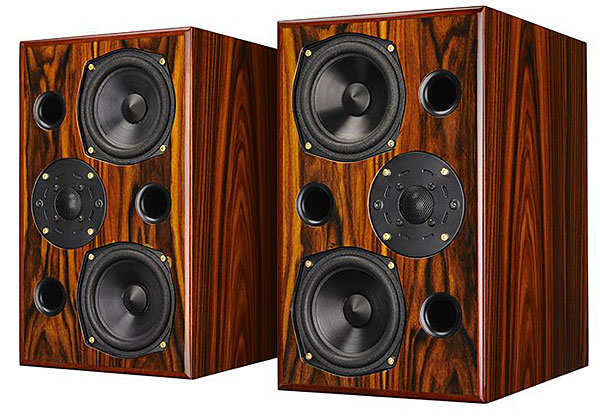
In the September 1988 issue of Stereophile, I wrote a rave review about the first speaker, the AE1, from what was to me a totally unknown English company, Acoustic Energy. Though tiny, and possessing an intrinsically limited low-frequency response, the $1500/pair AE1 was one of the most musical loudspeakers I have ever used, throwing a deep, beautifully defined soundstage, and possessed of a clean treble and a sweet, if rather forward-balanced, midband.
Acoustic Energy AE2 Signature loudspeaker
Flip flip flip]...Where the heck is it?...[flip flip flip]...Got it!" What am I looking for? There, in black and white, on p.634 of J. Gordon Holt's Really Reliable Rules for Rookie Reviewers (footnote 1), is the Prime Directive On Loudspeaker Setup: "Never, ever, choose a loudspeaker that has too much bass extension for your room!"
Acoustic Energy AE3 loudspeaker
Back in the Spring of 1988, I was sent a pair of diminutive two-way speakers that totally redefined for me what miniature loudspeakers were supposed to be about. That model, Acoustic">http://www.stereophile.com/standloudspeakers/526">Acoustic Energy's AE1, may have offered short measure in the low-bass department, but its apparently effortless dynamics, musically natural balance, and tangible imaging made it a winner. It also broke the mold of modern audiophile speaker design by featuring a 4.5" woofer with a metal cone just 3.5" in diameter. (Various companies have experimented with metal-cone drive-units in the past, only Ohm and pro-sound company Hartke having had any previous commercial success, though Monitor Audio now also offers a range of speakers with metal-cone woofers, their Studio line.) Since that time, Acoustic Energy has tried to produce a full-range speaker that built on the success of the AE1, but with only limited success, in my opinion. While their AE2 added a second identical woofer, and offered useful increases in bass extension and dynamic range, I felt it to be too colored in the midrange to be a real audiophile contender (see Vol.13 No.2, February 1990, p.134.)