| Columns Retired Columns & Blogs |

JL Audio Fathom f113 powered subwoofer
Carl Kennedy, director of JL Audio's Home and Professional Sales division, leaned forward and quietly asked, "Would you like to review our Fathom f113 subwoofer?"

We were standing in JL Audio's exhibit area at the 2007 Consumer Electronics Show, near a mob surrounding a display of an "exploded" f113. The sub's 13.5" cone had been pulled apart, and its huge magnet assembly, voice-coil, spider, internal amplifier, and control panel were suspended in air.
I nodded enthusiastic agreement.
"What would you think if I asked you to review a pair of f113s?"
"Let's do it!" But suddenly I was nervous about the prospect of lifting two slippery, 130-lb subwoofers. Why two?
I was visiting JL Audio's exhibit because of the praise Kal Rubinson had heaped on the Fathom f113 ($3400) in his "Music in the Round" columns of November 2006 (Vol.29 No.11) and May 2007 (Vol.30 No.5), particularly its built-in Automatic Room Optimization (ARO) function. For optimal response, a subwoofer's output should be placed in the spot that cancels out the most troublesome room modes. If that's not possible, then a subwoofer that can automatically and reliably achieve the same result by retuning itself would greatly simplify installation. Other subwoofers I have reviewed—including the Velodyne DD-18 (June 2004, Vol.27 No.6), REL Studio III (October 2004, Vol.27 No.10), and Revel Ultima Sub-30 (November 2004, Vol.27 No.11)—provide test tones and equalizer controls, but require the owner to interpret the findings and then manually make the appropriate adjustments. At the 2003 CES, Intelligent Audio presented a "concept" subwoofer system, the 1A-643 ($11,700), that could, for any room, automatically adjust the sub's directivity, crossover filter characteristics, and boundary equalization (May 2003, Vol.26 No.5, p.52). However, IA has yet to manufacture the 1A-643.
Sensing my hesitation, Kennedy explained that "Floyd Toole's work suggests that running multiple subs in one room can have beneficial effects on the room's modal response and create a larger useful listening area."
"Really? Why would two subs smooth the room response?"
"Their combined output can suppress room-mode interactions at your listening seat that would normally show up if each sub were tested independently."
Description
JL Audio started by making subwoofers exclusively for cars and boats. This may explain why their new models intended for domestic use, like the Fathom f113, are so rugged. Though nominally smaller, the f113 outweighs my Velodyne DD-18 subwoofer, with its 18" cone, by 7 lbs. More remarkable are the 4" peak–peak excursions of the f113's 13.5" woofer cone, driven by a 2.5kW class-D amplifier. To handle the internal forces, the f113's sealed enclosure is constructed of 1"-thick MDF and reinforced with two donut braces parallel to the front baffle.

The f113 brochure explains how the 13.5" cone maintains control during its huge excursions through a series of proprietary JL Audio technologies: The motor system has been designed to maintain a stable magnetic field over a wide power range; an expanded OverRoll rubber surround spans the driver's mounting flange; the Floating-Cone Attach Method of assembly ensures the proper surround geometry, to maintain voice-coil alignment at all sound levels; the W-Cone construction is said to provide torsional rigidity with minimal mass to maintain voice-coil alignment at the excursion limits; the Plateau-Reinforced Spider Attachment technique relieves stress on the spider material during peak excursions; the Elevated Frame Cooling Technology delivers cool air to the voice-coil to minimize power compression from overheating; and the Radially Cross-Drilled Pole Piece venting design increases thermal dissipation by directing a flow of air to the voice-coil former.
Other features include a front-facing control panel, a ground-lift switch to eliminate system hum pickup, and an optical interface between the unbalanced input jacks and the amplifier, also to prevent hum.
Like the Genelec HTS4B subwoofer, which I reviewed in November 2005 (Vol.28 No.11), the Fathom f113 doesn't have a high-pass filter to roll-off the bass response of the satellite speakers. This is because all surround-sound processors and receivers provide the high-pass filtration and bass management before the signal reaches the sub.
Controls in front, plugs in back
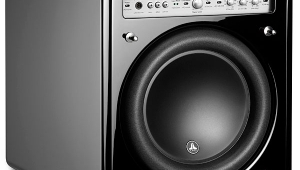
The Fathom f113's controls are arrayed on its brushed-aluminum front panel, just under the removable grille. Adjustments can thus be made without having to turn the 130-lb subwoofer around, or bend over it and figure out switch locations and settings from above. Some switches are standard: a Power switch with On, Off, and Auto Sensing positions; a Level control; and a Polarity toggle (0°/180°). The Phase control continuously adjusts phase from 0° to 280°. The Low Pass Filter Frequency control adjusts the low-pass filter point between 30 and 130Hz, and the Extremely Low Frequency Trim knob adjusts the slope of a 25Hz filter to damp any troublesome interactions the room might have with the f113 at extreme low frequencies.
The ARO calibration mike plugs into a front-panel jack, next to which are three buttons: Demo verifies the ARO functions with a 20-second sequence of demonstration tones; Defeat turns off the ARO calibration system to compare the ARO and non-ARO settings; and Calibrate initiates the ARO test tones to measure the room response and activate the automatic equalization routine.
All set-and-forget inputs are on the f113's rear panel, including two XLR connectors—one for signal input, the other to link out to a slave f113—and a pair of line-level RCA input jacks. At the bottom of the rear panel are the Master/Slave Mode selector switch, an input grounding mode switch, and an IEC socket for the detachable power cord. The class-D amplifier is attached to the inside of this panel, its rows of heatsinks lining the back.
The Fathom f113's fit'n'finish are professional and neat, and its veneer of glossy black lacquer is the equal of the most expensive audiophile subs I've reviewed for Stereophile. The hardware and connections are rugged, easily accessible, and look as if they'll last for years.
Setting up two Fathom f113s
Setup began when 345 lbs of Fathom f113s in their crates arrived at my door, the two cartons strapped to a huge shipping pallet. A bright orange unpacking sheet warned: "Due to the weight of the Fathom subwoofer, please exercise caution while unpacking and positioning it to prevent injury. If possible, enlist the help of a second person to facilitate the process. To minimize the risk of injury, bend your knees and lift with your legs, not your back."
Heeding this warning, I unpacked the f113s and "walked" them, one at a time, up the short flight of carpeted stairs to my listening room. I used my leg muscles to gently roll each one end over end, cloth covers securely fastened to protect its finish. Fifteen minutes later, both units sat undamaged in my listening room. After laying old towels under the f113s to protect my wood floors, I slid each sub behind one of my Quad ESL-989 speakers until there was one near each front corner of the room. The Quads were 5' from the front wall, 8' apart, 3' from the sidewalls, and slightly toed-in toward my listening chair. They were driven by Bryston 28B-SST monoblocks, whose 1kW output seemed enough to drive any speaker to good volumes in my 4056-cubic-foot, lightly damped listening room. (The room is 26' long by 13' wide by 12' high and opens onto a 25' by 15' by 8' kitchen.)
Following the directions in the JL manual, I connected the subs in Master/Slave configuration by setting the right f113 to Master, the left to Slave. Both will then reproduce the same bass signal. The full-range audio signal from my Krell KCT preamplifier was fed to a Bryston 10B-SUB electronic crossover via a pair of balanced interconnects (see reviews of the 10B-SUB in Stereophile, May 1994, Vol.17 No.5; and November 2005, Vol.28 No.11). I set the 10B-SUB to provide a summed R+L mono signal at its bass outputs, its right and left high-pass filter switches to 100Hz (18dB/octave), and its left channel's low-pass filter to 70Hz (18dB/octave). A short pair of balanced interconnects was run from the 10B-SUB's high outputs to the Bryston 28B-SSTs, which then drove the Quad ESL-989s. The crossover's left low-pass output was connected via a single balanced interconnect to the Master f113's input, this in turn connected to the Slave f113 by another long balanced interconnect. This passed a mono bass signal that incorporated all the Master's settings.
NEXT: Page 2 »
 | |||||||||||

|
|
| |||||||||
- Log in or register to post comments













| Loudspeakers Amplification Digital Sources | |
Analog Sources Accessories Featured | |
Music Columns Retired Columns | |
Show Reports | |
Features Latest News Community | |
Resources Subscriptions |
 © 2024 Stereophile
AVTech Media Americas Inc., USA
All rights reserved