Loudspeaker manufacturer Boston Acoustics made its name—and its fortune—building high-performance but low-cost speakers. Indeed, I recently set up a modest system for my mother-in-law that was based on Boston's classic A-40—a two-way design that sold for just $160/pair back in 1986—and was very pleasantly surprised at the quality these little speakers offered. Back in the early '90s, however, the Massachusetts-based company announced that they were taking a step into the High End with a new loudspeaker line, the Lynnfields (see Thomas J. Norton's interview with Boston's Andy Kotsatos elsewhere in this issue). These were designed by expatriate British engineer Phil Jones, previously responsible for the impressive Acoustic Energy speakers.
 When Robert Harley reviewed the top-of-the-line, floorstanding 500L for Stereophile back in August '93 (Vol.16 No.8), he found it overbright. I reached a similar conclusion about the smaller, stand-mounted 300L, but before a review of the latter could reach print, Boston Acoustics announced that they were revising the entire line. I returned my samples of the 300L, to await replacements.
In the meantime, Phil Jones left Boston Acoustics to found his own company, Platinum Audio—I reviewed the dynamic-sounding little Platinum Solo last November (Vol.18 No.11)—and David Fokos took his place at Boston Acoustics. Dave has been around for a while: he was responsible for the excellent-sounding series of Synthesis speakers that Conrad-Johnson marketed back in the mid-'80s, and ran his own loudspeaker company for a while, Icon Acoustics. David revised the 300L, reworking the crossover and revising the tweeter a little, but otherwise leaving well enough alone—"The cabinet and woofer are set in stone," he told me.
High Technology
When Robert Harley reviewed the top-of-the-line, floorstanding 500L for Stereophile back in August '93 (Vol.16 No.8), he found it overbright. I reached a similar conclusion about the smaller, stand-mounted 300L, but before a review of the latter could reach print, Boston Acoustics announced that they were revising the entire line. I returned my samples of the 300L, to await replacements.
In the meantime, Phil Jones left Boston Acoustics to found his own company, Platinum Audio—I reviewed the dynamic-sounding little Platinum Solo last November (Vol.18 No.11)—and David Fokos took his place at Boston Acoustics. Dave has been around for a while: he was responsible for the excellent-sounding series of Synthesis speakers that Conrad-Johnson marketed back in the mid-'80s, and ran his own loudspeaker company for a while, Icon Acoustics. David revised the 300L, reworking the crossover and revising the tweeter a little, but otherwise leaving well enough alone—"The cabinet and woofer are set in stone," he told me.
High Technology
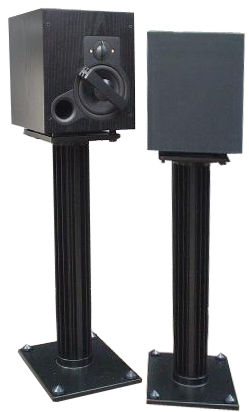
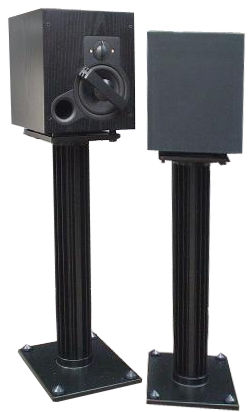
It's rare that a reviewer finds a loudspeaker that's totally new. Most designs are evolutionary rather than revolutionary, building on established wisdom. Everything about the Lynnfield 300L, however, is new, purpose-designed, which allows the designer to do things not possible with a model that is built with off-the-shelf parts. For example, though the 300L is a two-way design, the tweeter and woofer are not completely separate. They share a common front-plate/basket, which allows them to be physically much closer together than is usual, and helps dissipate heat. The rear of the woofer-basket part of this cast aluminum chassis is threaded so that it can be rigidly bolted to an internal figure-8 crossbrace. It also carries the 1.5"-diameter opening for the reflex port, this constructed from a plastic tube running the depth of the enclosure, but with the interior end cut at a diagonal.
The Lynnfield tweeter features a 1" anodized aluminum dome and a tiny neodymium magnet no larger than the dome itself, but specified as having the same flux density as a conventional 3" magnet. Externally, the most unusual aspect of the tweeter's design is the small vertical bar placed in front of the dome. Made from high-temperature, glass-filled nylon, this injection-molded bar has a series of holes running from side to side. Called an "Amplitude Modification Device" (AMD), the holes act as acoustic traps tuned to the frequency of the aluminum-dome tweeter's "oil-can" resonance frequency, attenuating it.
The 5.25" woofer's cone, dustcap, and voice-coil former are all formed from aluminum, again for good heat dissipation. The cone is anodized to increase its stiffness, and a second, larger AMD, machined from aluminum, runs diagonally in front of it. (Rather than holes, this AMD uses columns of air.)
Electrical connection is via two pairs of gold-plated binding posts on the cabinet rear. The crossover between the two drivers is set at 2.6kHz, with the hard-wired circuitry carried on a board behind the binding posts. High-quality components are used, including laminated-core inductors with wide-gauge windings for good power handling, and plenty of bypassed plastic-film capacitors, including some expensive MIT MultiCaps. The internal wiring is 14-gauge OFC. The filters themselves appear to be a second-order low-pass for the woofer and a fourth-order high-pass for the tweeter, with some resistive padding and treble shelving.
The Lynnfield 300L's handsome cabinet is made from MDF and is finished in either rosewood or "black ash" veneer. The grille comprises a plastic space frame covered with a knitted black cloth. The vertical edges are gently rounded and I found it to be quite transparent, acoustically. The 26" LST stand ($500/pair) should be considered essential to get the best from the Lynnfield 300L. It consists of a central, fluted, cylindrical aluminum pillar with cast aluminum top and bottom plates. The pillar can be loaded with sand and/or lead shot but doesn't hold as much filling as you might expect. Cone-ended spikes screw into the base plate and can easily be leveled from above. These are a little short to penetrate through the thickest rugs and pads to the floor beneath, however. Molded standoffs hold the speaker away from the top plate, with four hex-headed bolts used to secure the two together. (Be careful how much you tighten these; with my first pair of Lynnfields, one of the bushings in the speaker base came loose when I tried to take the speaker/stand assembly apart.)
Sound
After some experimenting, I set the 300Ls up on their stands with the tweeters on the outside edges of the mirror-imaged speakers; ie, closest to the sidewalls. With the tweeters in what some might have thought the intuitively correct positions—with the tweeters on the speakers' inside edges—the balance became somewhat too bright. A subsequent conversation with Boston's David Fokos revealed that tweeters to the outside edges was indeed the preferred setup, the opposite of that mentioned in the excellent manual. With that little difficulty out of the way, I sat down for some serious listening. The Lynnfield 300L turned out to be somewhat of a chameleon, its character depending quite heavily both on playback level and on the kind of music played. At moderate spls—86dB or below—its sound was a little on the bright side but impressively clean, particularly through the treble. Whether this is due to the "Amplitude Modulation Device" or not, this is quite obviously a high-performance tweeter.
The midrange was not quite as uncolored as the treble, there being a trace of character noticeable. Robert Silverman's big Steinway on Stereophile's Sonata CD (STPH008-2), for example, sounded more clangy than I remembered from the live sessions. Voices, too, were a little more forward-balanced than I'm used to.
The Lynnfields' soundstaging was wide and deep, with well-defined imaging and a clear view to the back of the recorded stage. I had no difficulty "hearing the walls" of the concert halls on naturally recorded recordings of acoustic instruments.
So far, my comments apply to the speakers reproducing well-recorded classical music. On rock, however, the 300L's bass could be heard to be a bit "woofy," both not that well defined and more lumpy than I'm used to, some bass guitar notes standing out more than others. My ultimate test for this aspect of a speaker's performance is Pat Metheny's "Last Train Home," from Still Life (Talking) (Geffen GEFD 24145-2). Metheny's electric sitar is underpinned by a repeated-eighth-note line on the Fender bass. The Lynnfields just couldn't keep these repeated notes sufficiently well separated. Instead, they tended to run into one another, taking away some of this track's urgent sense of pace. (This lack of definition is actually what I feel some audiophiles mean when they talk about a speaker having "slow" bass. The actual "speed" of any woofer, provided it has a sufficiently large motor to drive its moving mass, is actually defined by the crossover's low-pass filter.)
But all in all, at moderate levels, the little 300Ls were quite pleasant-sounding. And there actually seemed to be a reasonable amount of bass present, despite the speaker's diminutive size. The 40Hz 1/3-octave warble tone on Stereophile's Test CD 3 (STPH006-2) actually had some weight to its sound—not something I had been anticipating. This added a nice sense of power to well-recorded double bass, such as the instrument played by Stanley Clarke on Airto Moreira and the Gods of Jazz's "Never Mind" (Stereophile Test CD 3, excerpted from Killer Bees, B&W Music 041). Although there wasn't any obvious doubling, the little metal-coned woofer seemed to be working hard at low frequencies, with noticeable wind noise coming from the port on warble tones between 25Hz and 50Hz.
It was when I turned up the wick that things started to fall apart. The loose bass remained loose, but seemed to become a little more disconnected from the midrange. More important, a narrow band of hardness/brightness developed in the lower treble that had me reaching for the volume control on all but inherently mellow-balanced recordings. And on recordings that were themselves mixed to be on the bright side—the Rolling Stones' Stripped (Virgin 41040 2), for example, or Van Morrison's A Night In San Francisco (UK release Polydor 521 290-2), the sound became too fatiguing too quickly for me to get much pleasure from the music.
I have to say that the Series II 300L was much better in this respect than the earlier version of the Lynnfield, but it put a strict cap on the sound pressure level at which the speaker felt comfortable. At least to my ears.
Using the single-ended tube Cary amplifier, the speaker's brightness was less apparent, although whether this was due to the voltage divider action between the speaker's impedance modulus and the amplifier's high output impedance or just the fact that I couldn't raise levels at the listening seat of more than about 85dB, I can't say. As expected, the 300L's midbass region was less well-controlled with the tube amp, which was a step in the wrong direction. As always with the Cary, however, I marveled at the pristine, natural-sounding midrange it wrought from the speakers, no doubt aided here by the Lynnfield's excellent clarity and soundstaging.
Conclusion
Designed from the ground up, Boston Acoustics' Lynnfield 300L features some impressive speaker engineering. Sitting on its matching LST stand, it also looks beautiful, at least in this audiophile's opinion. However, while the Series II design sounds considerably more neutral than its predecessor, and offers superb clarity, its tonal balance—rather bright, with an ill-defined if weighty midbass region—was ultimately not to my taste. Despite the 300L's positive attributes, particularly regarding the clarity of its treble—this is an excellent tweeter—and the definition of its imaging, this was not enough to endear the speaker to me in the long term. Sorry, Boston Acoustics—while the Lynnfield 300L II does many things well, the competition at its $2300–$2500/pair price point (including the essential stands) is just too intense for me to be able to recommend it.
When Robert Harley reviewed the top-of-the-line, floorstanding 500L for Stereophile back in August '93 (Vol.16 No.8), he found it overbright. I reached a similar conclusion about the smaller, stand-mounted 300L, but before a review of the latter could reach print, Boston Acoustics announced that they were revising the entire line. I returned my samples of the 300L, to await replacements.
In the meantime, Phil Jones left Boston Acoustics to found his own company, Platinum Audio—I reviewed the dynamic-sounding little Platinum Solo last November (Vol.18 No.11)—and David Fokos took his place at Boston Acoustics. Dave has been around for a while: he was responsible for the excellent-sounding series of Synthesis speakers that Conrad-Johnson marketed back in the mid-'80s, and ran his own loudspeaker company for a while, Icon Acoustics. David revised the 300L, reworking the crossover and revising the tweeter a little, but otherwise leaving well enough alone—"The cabinet and woofer are set in stone," he told me.
High Technology
It's rare that a reviewer finds a loudspeaker that's totally new. Most designs are evolutionary rather than revolutionary, building on established wisdom. Everything about the Lynnfield 300L, however, is new, purpose-designed, which allows the designer to do things not possible with a model that is built with off-the-shelf parts. For example, though the 300L is a two-way design, the tweeter and woofer are not completely separate. They share a common front-plate/basket, which allows them to be physically much closer together than is usual, and helps dissipate heat. The rear of the woofer-basket part of this cast aluminum chassis is threaded so that it can be rigidly bolted to an internal figure-8 crossbrace. It also carries the 1.5"-diameter opening for the reflex port, this constructed from a plastic tube running the depth of the enclosure, but with the interior end cut at a diagonal.
After some experimenting, I set the 300Ls up on their stands with the tweeters on the outside edges of the mirror-imaged speakers; ie, closest to the sidewalls. With the tweeters in what some might have thought the intuitively correct positions—with the tweeters on the speakers' inside edges—the balance became somewhat too bright. A subsequent conversation with Boston's David Fokos revealed that tweeters to the outside edges was indeed the preferred setup, the opposite of that mentioned in the excellent manual. With that little difficulty out of the way, I sat down for some serious listening. The Lynnfield 300L turned out to be somewhat of a chameleon, its character depending quite heavily both on playback level and on the kind of music played. At moderate spls—86dB or below—its sound was a little on the bright side but impressively clean, particularly through the treble. Whether this is due to the "Amplitude Modulation Device" or not, this is quite obviously a high-performance tweeter.
Designed from the ground up, Boston Acoustics' Lynnfield 300L features some impressive speaker engineering. Sitting on its matching LST stand, it also looks beautiful, at least in this audiophile's opinion. However, while the Series II design sounds considerably more neutral than its predecessor, and offers superb clarity, its tonal balance—rather bright, with an ill-defined if weighty midbass region—was ultimately not to my taste. Despite the 300L's positive attributes, particularly regarding the clarity of its treble—this is an excellent tweeter—and the definition of its imaging, this was not enough to endear the speaker to me in the long term. Sorry, Boston Acoustics—while the Lynnfield 300L II does many things well, the competition at its $2300–$2500/pair price point (including the essential stands) is just too intense for me to be able to recommend it.