| Columns Retired Columns & Blogs |

is it good choice for vocal and violin music?
i want to buy Cary 300 SEI for my ProAc 1sc
thanks.

But I had second, even third thoughts when assigning to myself an Equipment Report on the Response One SC. In the years since that first review, I've been exposed to some awfully rarefied speaker designs—wouldn't it be embarrassing if I no longer found the Response One special?
All features great & small
ProAc calls the Response One SC a "radical refinement" of the Response One S. It has a new woofer, featuring a copper magnet assembly and stationary "phase plug," as well as a crossover modification (footnote 1). (An upgrade kit is available for $500, dealer-installed.) If this description sounds sketchy, blame ProAc—Stewart Tyler has never been terribly forthcoming about the details of his designs, not deigning to specify crossover points, or even crossover types. In one sense, I find this refreshing; the man is definitely not trying to baffle us with technical BS. On the other hand, I want to know more!
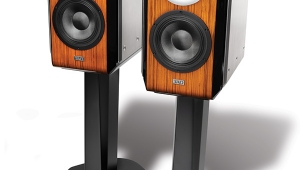
The speaker is a small two-way: 12" H by 7" W by 9.25" D, and that is really small. (In fact, ProAc's literature refers to it as a "miniature" loudspeaker.) The speaker barely covered the 6" by 9" top-plate of my Foundation stands. The tweeters are mirror-imaged, and the speakers should (in most cases) be set up with the tweeters on the inside edges of the cabinets. The One SCs come with grilles, but I chose not to use them—they noticeably dulled the sound. Speaker connections are made by way of two pairs of five-way binding posts. The posts are solid rhodium, including the knurled tightening nuts. Rhodium jumpers allow a single pair of cables to drive the speakers, but I recommend bi-wiring them. They sound much better that way.
As with all ProAc loudspeakers, the Response One SC's fit'n'finish is exemplary. My review pair came dressed in yew veneer, a custom finish that made for the handsomest pair of small monitors I have ever beheld. Yummy! ("Oh, it's yew," punned my wife.)
Like most speakers, the Response One SCs sounded better after I tightened the drivers firmly to the baffles. This free tweak can improve the sound of almost any speaker, but be adult about it: Don't strip the threads by over-tightening, or let your screw- or nut-driver get dragged through a woofer cone by its magnet.
Placement makes all the difference in the world with this loudspeaker—put it on the most rigid stand you can afford. I had them on 24" Foundation stands filled with lead and concrete, and they rewarded me with solid imaging and deep bass. I wouldn't put 'em on stands over 28" tall—you lose bass and they get shouty—but don't mount them too low either.
The Response One SCs must be placed pretty far out into the room. In my 28' by 17' by 14' listening room, I pulled the One SCs 4' off the front wall; I may have lost some bass reinforcement, but the gains in openness and freedom from boundary coloration made the decision a no-brainer.
Many people make the assumption that small speakers are at their best in small rooms, and there's some truth to this. However, like every generalization, this one is too simplistic. You can easily buy too much speaker for a given room, even a large one, and thus overload the space with too much bass. That way, you'll never get balanced, realistic sound. Matching a speaker to a room is every bit as important as matching it to the amplifier driving it, but too many audiophiles just assume that more speaker always gets them better sound.
I'm as guilty of this mindset as anyone, but recently I've listened to a brace of small monitors that have driven my room better than many large speakers I've brought into my system. The B&W Silver Signature so beloved by John Atkinson was a real eye-opener in this respect. As was the ProAc Response One SC—at about a quarter of the price.
To compare great things with small
$2100 is not an insubstantial sum. You can buy a lot of speaker for that kind of money—or, considering the ProAc's petite stature, perhaps I should say you can buy a helluva speaker for that kind of money. David Hendrick, Stereophile's shipping manager, put it well when he heard the One SCs. "Once you've heard them, you're not surprised they cost two grand," he said. "But on a per-pound basis, the price would seem high."
What makes the ProAc One SCs special? The first impression they give is one of incredible openness and spaciousness. Many other speakers can also claim these qualities, but the One SCs have an effortless presentation that transports you from your listening room to the performance space with seeming ease. Of course, small monitors are supposed to image superbly; even so, this quality of the ProAcs has to be counted as special.
 | |||||||||||

|
|
| |||||||||
COMMENTS
is it good choice for vocal and violin music?
i want to buy Cary 300 SEI for my ProAc 1sc
thanks.




| Loudspeakers Amplification Digital Sources | |
Analog Sources Accessories Featured | |
Music Columns Retired Columns | |
Show Reports | |
Features Latest News Community | |
Resources Subscriptions |
 © 2024 Stereophile