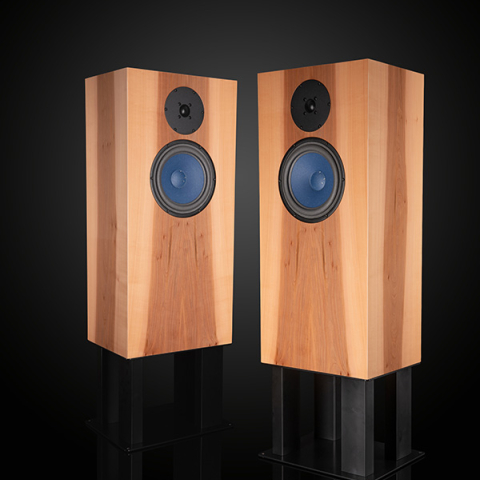
Room lock occurs when a set of loudspeakers reproduces the deep-bass notes of a pipe organ powerfully enough that the sounds can be felt as pressure waves. On Day 2 of the 2007 Home Entertainment Show, in one of the Sound By Singer rooms, our own John Marks played his recording of organist James Busby performing Herbert Howells' Master Tallis's Testament through a pair of Fremont loudspeakers from Escalante Design. The sustained bass note at the end of the passage took my breath away—the stand-mounted Fremonts sounded as open and dynamic as anything else I heard at HE2007. I wondered if they'd sound as good in my home listening room.
 Design Principle
Escalante Design's Tierry Budge, designer of the Fremont ($18,990/pair, including dedicated stands), explained his speaker's unusual bass power. Budge believed he could improve a dynamic drive-unit's bass response by lowering its risetime. To do this, he designed what he calls an "inversion circuit" to null out the mechanical problems, and in 2004 patented the circuit under US Patent number 6,816,598. As described in the patent, titled "Multiple Driver, Resonantly Coupled Loudspeaker," the result is a loudspeaker with "greatly reduced impedance as well as improved response and power handling in the low frequency range. The benefits of the present invention derive from a novel, synchronized, multiple driver design in which the output of the first driver is synchronized with the output of the second driver to produce an acoustically reinforced output. This synchronization is achieved through a phase shift of the input signals to the drivers." Budge uses this circuit in the Fremont. The Fremont comprises a loudspeaker cabinet that contains "one isobaric chamber and one acoustical chamber, two substantially similar loudspeaker drivers, and a synchronization circuit to align the output of the pair such that the back wave output of the first driver acoustically reinforces the front wave output of the second driver, thereby forming a reinforced wave." The external woofer's front wave is directed away from the cabinet, while its back wave is directed into the sealed isobaric chamber to the rear of the second driver, which in turn generates a wave that is directed into the larger, ported acoustic chamber. The two woofers are mounted facing away from each other but with the interior driver connected in reversed polarity, so that the cones move in the same direction. Budge found that the woofer arrangement reduced intermodulation distortion, increased power handling, and resulted in a quicker risetime and a lower resonant frequency. The woofers' free-air resonant frequency is now 18Hz rather than 42Hz.
Massive Construction, Hidden Drivers
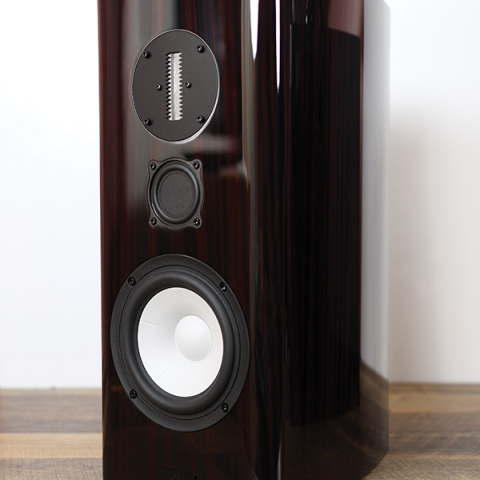
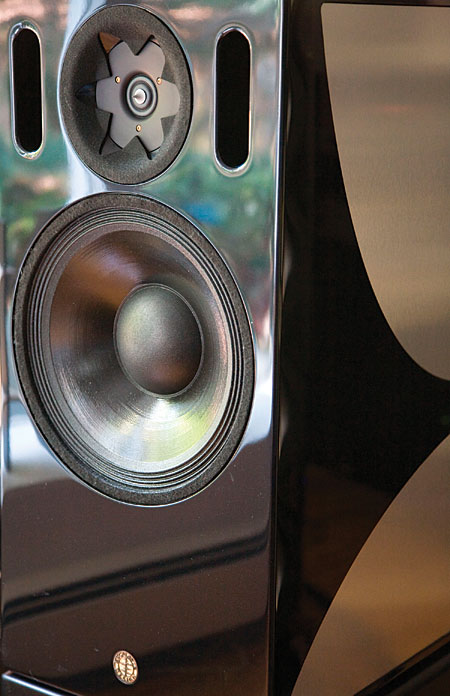
While the Fremont looks like an overgrown two-way monitor on a stand, it is claimed to behave as a four-way system. Its internal 12" woofer operates from 18 to 80Hz, then crosses over via a third-order slope to the external 12" woofer, which covers the 80–500Hz range. Both woofers have a double-thickness frame while their cones are made of a composite of treated paper and carbon fiber, the surfaces dimpled and the thickness varied across the diameter to reduce in- and out-of-band resonances. Rather than the usual rubber roll surround, the woofers use an accordion surround of treated cloth; this is claimed to avoid slowing the dynamic attack and to minimize cone breakup while permitting large excursions. The Fremont is reflex-loaded with a pair of 2"-wide, 4.5"-long ports with gently flared edges, these placed on either side of the tweeter. The midrange frequencies are handled by the external woofer's 4.35", convex black dustcap, a compound of three different low-Q materials. Frequencies above 3.2kHz are handled by a 1" soft-dome ring-radiator tweeter—a ScanSpeak Revelator—which provides treble extension out to 50kHz. The tweeter is recessed into the front baffle for time alignment and to fit smoothly with the surrounding felt diffraction pad, a placement said to increase dynamic efficiency in the lower part of its range. The Fremont's internal wiring consists of three leads wound together in a specific geometry claimed by Budge to reduce resonances, and whose combined diameter approximates that of a single 16-gauge wire. These leads are soldered to the drivers and crossover network. External speaker connections are made via the two rhodium-plated Cardas Patented Binding Posts on the rear panel. These posts have a single-knob adjustment that tightens a plate over the speaker cable's spade lug—thus avoiding overtightening separate nuts or stripping threads—and 0.25"-diameter, 0.25"-long contact posts made of nonmagnetic, cryogenically treated brass with rhodium-over-silver plate. I would have appreciated longer contact posts to grip the thick spade lugs of my speaker cables. The crossover is carried on a printed circuit board mounted on the bottom of the cabinet in a manner designed to reduce distortion from vibration.
The Fremont's 100-lb weight derives from its thick cabinet walls and multiple chambers. The two speakers with their dedicated stands have a combined shipping weight of 604 lbs. No wonder the owner's manual strongly recommends that two able-bodied adults unpack and install them. I was especially thankful that Budge and his local representative, Anthony Chiarella, were on hand to bring the Fremonts up the single flight of stairs and into my listening room.
The walls of the MDF cabinet vary in thickness from 1" to 2" and Budge uses a special bonding agent to minimize mechanical energy storage, which he feels is "the real cancer for mechanical speaker design." All the Fremont's internal surfaces are lined with foam. There's a vertical brace between the front and rear panels, offset from the middle to further minimize resonances. The edges of the cabinet are radiused, and the corners are made using "a joint construction that allows complete and maximum contact with the inner cores of the side panels for better construction and adhesion." Aluminum side-panel inserts increase the Fremont's visual elegance.
The Fremont's 88-lb stand raises the bottom edge of the external woofer 24" above the floor, to optimize the frequency of the floor reflection. The upper part of the stand, on which the speaker rests, is made from 18 laminated panels of MD. Also included are spike feet of nickel-plated steel, and a bull's-eye bubble level for setting the spikes' heights. The spikes thread into the corners of the stand's base; their height can be adjusted from the top of the base plate via knurled knobs. I'd recently finished and varnished my wood floors, so I never used the spikes.
The Fremont's fit'n'finish exude class and workmanship. I particularly admired the sidewalls' inlaid aluminum panels and the magnetically attached grilles.
Setup
The Fremont's internal wiring consists of three leads wound together in a specific geometry claimed by Budge to reduce resonances, and whose combined diameter approximates that of a single 16-gauge wire. These leads are soldered to the drivers and crossover network. External speaker connections are made via the two rhodium-plated Cardas Patented Binding Posts on the rear panel. These posts have a single-knob adjustment that tightens a plate over the speaker cable's spade lug—thus avoiding overtightening separate nuts or stripping threads—and 0.25"-diameter, 0.25"-long contact posts made of nonmagnetic, cryogenically treated brass with rhodium-over-silver plate. I would have appreciated longer contact posts to grip the thick spade lugs of my speaker cables. The crossover is carried on a printed circuit board mounted on the bottom of the cabinet in a manner designed to reduce distortion from vibration.
The Fremont's 100-lb weight derives from its thick cabinet walls and multiple chambers. The two speakers with their dedicated stands have a combined shipping weight of 604 lbs. No wonder the owner's manual strongly recommends that two able-bodied adults unpack and install them. I was especially thankful that Budge and his local representative, Anthony Chiarella, were on hand to bring the Fremonts up the single flight of stairs and into my listening room.
The walls of the MDF cabinet vary in thickness from 1" to 2" and Budge uses a special bonding agent to minimize mechanical energy storage, which he feels is "the real cancer for mechanical speaker design." All the Fremont's internal surfaces are lined with foam. There's a vertical brace between the front and rear panels, offset from the middle to further minimize resonances. The edges of the cabinet are radiused, and the corners are made using "a joint construction that allows complete and maximum contact with the inner cores of the side panels for better construction and adhesion." Aluminum side-panel inserts increase the Fremont's visual elegance.
The Fremont's 88-lb stand raises the bottom edge of the external woofer 24" above the floor, to optimize the frequency of the floor reflection. The upper part of the stand, on which the speaker rests, is made from 18 laminated panels of MD. Also included are spike feet of nickel-plated steel, and a bull's-eye bubble level for setting the spikes' heights. The spikes thread into the corners of the stand's base; their height can be adjusted from the top of the base plate via knurled knobs. I'd recently finished and varnished my wood floors, so I never used the spikes.
The Fremont's fit'n'finish exude class and workmanship. I particularly admired the sidewalls' inlaid aluminum panels and the magnetically attached grilles.
Setup
After an hour spent listening to a set of the music CDs he uses while designing speakers, Budge positioned each Fremont 45" from the front wall and 37" from a sidewall. This placed them 82" apart as measured from the tweeter centers, and 90" from my listening chair. I much preferred the Fremonts' sound when they were toed-in to face me directly, so that neither sidewall of either cabinet could be seen from my chair, as recommended in the owner's manual. This dramatically reduced a "cupped-hands" effect that otherwise seemed to muffle and mask the speaker's lower midrange. Soundstaging depth and width were optimized by moving objects away from the space between and just behind the speakers. (A stuffed chair 2' to the left of the left speaker had collapsed the soundstage depth.) Although I measured the distances from the Fremonts to the rear and sidewalls and to my listening chair, to make certain they were identical for the two speakers, I still needed to tune in the sweet spot by sitting forward or back. I drove the Fremonts with low-frequency warble tones from Stereophile's Test CD 3 (STPH006-2) and measured sound-pressure levels (SPLs) at each frequency with an ATI meter placed at ear level just in front of me. The Fremont's deep-bass output was relatively flat from 200Hz down to 40Hz, ±3dB, and fell off smoothly after that until 25Hz, –10dB, with no port chuffing. Moving the Fremonts closer to the front wall extended the ±3dB response down to 35Hz, but flattened the soundstage depth and made the midrange response too warm and fuzzy (footnote 1). Other tests—these done with the Fremonts' grilles removed—included listening to the phase-check and channel-identification tracks on Test CD 3 in the nearfield (8') and the farfield (18'). Playing the broadband pink-noise track, I heard no significant difference between sitting in my normal position and sitting 6" higher by resting on the arm of the chair. The latter position made my ears perfectly level with the centers of the Fremonts' tweeters, which are 43" above the floor. However, during the "sit down, stand up, walk around" test, the pink noise sounded duller as soon as I stood up or moved about the room. There was somewhat less dulling when I conducted this test at the 18' farfield position. This suggests that the Fremont will function well in large rooms in both the near- and farfield.
Footnote 1: To further tighten the Fremont's bass response, Escalante Design's Matthew Waldron recommends the separate purchase of 0.2"-tall, .2AP.7D Audio Point standoffs and APCD2-A Coupling Discs. Eight of each are needed to support the two Fremonts on their stands; the .2AP.7D Audio Points cost $18.49 each, the APCD2-A Coupling Discs $23.99 each, for a total cost of $339.84. More details are available here.
Design Principle
Escalante Design's Tierry Budge, designer of the Fremont ($18,990/pair, including dedicated stands), explained his speaker's unusual bass power. Budge believed he could improve a dynamic drive-unit's bass response by lowering its risetime. To do this, he designed what he calls an "inversion circuit" to null out the mechanical problems, and in 2004 patented the circuit under US Patent number 6,816,598. As described in the patent, titled "Multiple Driver, Resonantly Coupled Loudspeaker," the result is a loudspeaker with "greatly reduced impedance as well as improved response and power handling in the low frequency range. The benefits of the present invention derive from a novel, synchronized, multiple driver design in which the output of the first driver is synchronized with the output of the second driver to produce an acoustically reinforced output. This synchronization is achieved through a phase shift of the input signals to the drivers." Budge uses this circuit in the Fremont. The Fremont comprises a loudspeaker cabinet that contains "one isobaric chamber and one acoustical chamber, two substantially similar loudspeaker drivers, and a synchronization circuit to align the output of the pair such that the back wave output of the first driver acoustically reinforces the front wave output of the second driver, thereby forming a reinforced wave." The external woofer's front wave is directed away from the cabinet, while its back wave is directed into the sealed isobaric chamber to the rear of the second driver, which in turn generates a wave that is directed into the larger, ported acoustic chamber. The two woofers are mounted facing away from each other but with the interior driver connected in reversed polarity, so that the cones move in the same direction. Budge found that the woofer arrangement reduced intermodulation distortion, increased power handling, and resulted in a quicker risetime and a lower resonant frequency. The woofers' free-air resonant frequency is now 18Hz rather than 42Hz.
While the Fremont looks like an overgrown two-way monitor on a stand, it is claimed to behave as a four-way system. Its internal 12" woofer operates from 18 to 80Hz, then crosses over via a third-order slope to the external 12" woofer, which covers the 80–500Hz range. Both woofers have a double-thickness frame while their cones are made of a composite of treated paper and carbon fiber, the surfaces dimpled and the thickness varied across the diameter to reduce in- and out-of-band resonances. Rather than the usual rubber roll surround, the woofers use an accordion surround of treated cloth; this is claimed to avoid slowing the dynamic attack and to minimize cone breakup while permitting large excursions. The Fremont is reflex-loaded with a pair of 2"-wide, 4.5"-long ports with gently flared edges, these placed on either side of the tweeter. The midrange frequencies are handled by the external woofer's 4.35", convex black dustcap, a compound of three different low-Q materials. Frequencies above 3.2kHz are handled by a 1" soft-dome ring-radiator tweeter—a ScanSpeak Revelator—which provides treble extension out to 50kHz. The tweeter is recessed into the front baffle for time alignment and to fit smoothly with the surrounding felt diffraction pad, a placement said to increase dynamic efficiency in the lower part of its range.
The Fremont's internal wiring consists of three leads wound together in a specific geometry claimed by Budge to reduce resonances, and whose combined diameter approximates that of a single 16-gauge wire. These leads are soldered to the drivers and crossover network. External speaker connections are made via the two rhodium-plated Cardas Patented Binding Posts on the rear panel. These posts have a single-knob adjustment that tightens a plate over the speaker cable's spade lug—thus avoiding overtightening separate nuts or stripping threads—and 0.25"-diameter, 0.25"-long contact posts made of nonmagnetic, cryogenically treated brass with rhodium-over-silver plate. I would have appreciated longer contact posts to grip the thick spade lugs of my speaker cables. The crossover is carried on a printed circuit board mounted on the bottom of the cabinet in a manner designed to reduce distortion from vibration.
The Fremont's 100-lb weight derives from its thick cabinet walls and multiple chambers. The two speakers with their dedicated stands have a combined shipping weight of 604 lbs. No wonder the owner's manual strongly recommends that two able-bodied adults unpack and install them. I was especially thankful that Budge and his local representative, Anthony Chiarella, were on hand to bring the Fremonts up the single flight of stairs and into my listening room.
After an hour spent listening to a set of the music CDs he uses while designing speakers, Budge positioned each Fremont 45" from the front wall and 37" from a sidewall. This placed them 82" apart as measured from the tweeter centers, and 90" from my listening chair. I much preferred the Fremonts' sound when they were toed-in to face me directly, so that neither sidewall of either cabinet could be seen from my chair, as recommended in the owner's manual. This dramatically reduced a "cupped-hands" effect that otherwise seemed to muffle and mask the speaker's lower midrange. Soundstaging depth and width were optimized by moving objects away from the space between and just behind the speakers. (A stuffed chair 2' to the left of the left speaker had collapsed the soundstage depth.) Although I measured the distances from the Fremonts to the rear and sidewalls and to my listening chair, to make certain they were identical for the two speakers, I still needed to tune in the sweet spot by sitting forward or back. I drove the Fremonts with low-frequency warble tones from Stereophile's Test CD 3 (STPH006-2) and measured sound-pressure levels (SPLs) at each frequency with an ATI meter placed at ear level just in front of me. The Fremont's deep-bass output was relatively flat from 200Hz down to 40Hz, ±3dB, and fell off smoothly after that until 25Hz, –10dB, with no port chuffing. Moving the Fremonts closer to the front wall extended the ±3dB response down to 35Hz, but flattened the soundstage depth and made the midrange response too warm and fuzzy (footnote 1). Other tests—these done with the Fremonts' grilles removed—included listening to the phase-check and channel-identification tracks on Test CD 3 in the nearfield (8') and the farfield (18'). Playing the broadband pink-noise track, I heard no significant difference between sitting in my normal position and sitting 6" higher by resting on the arm of the chair. The latter position made my ears perfectly level with the centers of the Fremonts' tweeters, which are 43" above the floor. However, during the "sit down, stand up, walk around" test, the pink noise sounded duller as soon as I stood up or moved about the room. There was somewhat less dulling when I conducted this test at the 18' farfield position. This suggests that the Fremont will function well in large rooms in both the near- and farfield.
Footnote 1: To further tighten the Fremont's bass response, Escalante Design's Matthew Waldron recommends the separate purchase of 0.2"-tall, .2AP.7D Audio Point standoffs and APCD2-A Coupling Discs. Eight of each are needed to support the two Fremonts on their stands; the .2AP.7D Audio Points cost $18.49 each, the APCD2-A Coupling Discs $23.99 each, for a total cost of $339.84. More details are available here.