In some ways, building an inexpensive yet musical two-way loudspeaker is a greater design challenge than creating a cost-no-object reference product. Although the latter is a much more complex endeavor, the venerable two-way box seems to bring out the creativity and resources of the designer. Rather than throw money at the product in the form of more expensive drivers, enclosures, or components, the designer of a low-cost two-way is forced to go back to the basics, rethink closely-held tenets, and rely on ingenuity and sheer talent to squeeze the most music from a given cost. Consequently, the inexpensive two-way is the perfect vehicle for designers to develop their skills. If one has mastered this art form, one is much more likely to achieve success when more ambitious designs are attempted.
 Way back in Vol.7 No.4, Dick Olsher reviewed the Phase Technology PC60 loudspeaker and was quite impressed with its performance. Since then, Phase Technology has refined and upgraded their designs, the result being a line of loudspeakers ranging from the tiny PC40 Mk.II bookshelfs to the floorstanding PC8.5. The PC80 reviewed here ($650/pair), falls exactly in the middle of the five-product Phase Technology line.
Before getting to the PC80, a few words about the company. Phase Technology is a 36-year-old company founded and run by Bill Hecht and his son Ken. Although the name Bill Hecht may not be familiar to audiophiles, his designs certainly are: he is the inventor of, and held the patent on, the soft-dome tweeter (footnote 1). His designs and products have found their ways into a wide range of products since 1959, including those from Dynaco, Yamaha, Fisher Radio, MacIntosh, Pioneer, and Electro-Voice. In addition to the soft-dome tweeter, Phase Technology holds, or has held, other patents on raw driver design and fabrication methods including the basket-less woofer/midrange mounting assembly, the self-damping woofer voice-coil, silicone-injected drivers, and the manufacturing process for solid, flat-piston drivers. The company manufactures all the drivers used in their own products, and supplies many other brands with completed loudspeaker systems. In fact, most of Phase Technology's 60,000-square-foot factory is devoted to raw driver and complete speaker-system manufacture.
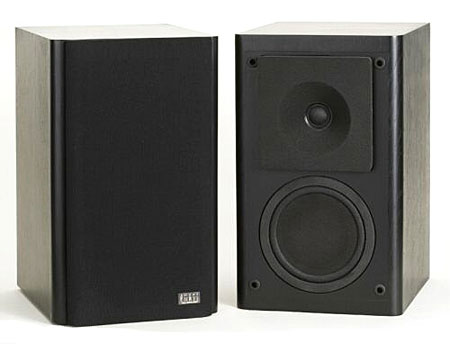
The PC80 is an attractive loudspeaker that is larger than most mini-monitors without approaching floorstanding dimensions. It's finished in real oak veneer (other finishes are available) rather than vinyl, as is common at this price point. The front baffle is rounded to reduce diffraction, which also adds to the PC80's appearance. A black fabric grille stretched over a wooden frame conceals the drivers. The rear panel contains a port 21/8" in diameter toward the top center of the cabinet. A large pair of knurled and gold-plated posts is angled in the terminal cup, making for easier connection.
The PC80 employs a 1" soft-dome tweeter recessed in a large piece of sculpted foam. The foam's funnel-shaped opening is centered on the tweeter, with the small end slightly larger than the tweeter's dome. This design absorbs tweeter energy that would otherwise be diffracted by the enclosure. The foam is unusual in that it is comprised of cells of unvarying size. Phase Technology calls this proprietary foam "Unicell" and has trademarked this name. Unicell foam reportedly works with the grille to reduce diffraction, suggesting that the grilles should be left in place for listening. The idea of reducing diffraction with the Unicell foam is so important to the overall design that the tweeter's dome geometry was optimized for working within the foam structure. This is a good example of how a loudspeaker system designer has an advantage in also being the driver designer and manufacturer: he has total control over the finished product, rather than having to accept less than optimum performance for a particular design.
The PC80 is also unusual in that it uses a flat, solid-piston woofer. This proprietary driver, designed by Phase Technology, is a solid conical configuration made from "Rigid Polymer Foam" and carries the "RPF" trademark. The solid construction reportedly eliminates cone break-up while launching all frequencies from the same plane, thereby eliminating phase anomalies. The woofer also features a unique damping system that absorbs energy at the end of the voice-coil's travel before it bottoms out on the rear of the pole piece. A small shock absorber cushions the voice-coil, while also preventing the spider from hitting the basket. The 1½" voice-coil is wound on a Kapton bobbin, and is supported in an oversized magnet structure. In addition, the pole piece is vented into the cabinet, providing additional voice-coil cooling while releasing the back pressure on the flat, solid diaphragm.
Significant attention has been paid to reducing the PC80's enclosure resonances, especially considering its moderate price. The side walls, front baffle, and rear panel are all 1"-thick MDF, and the enclosure was designed with the aid of an interferometer. Two internal braces support the cabinet, further increasing its rigidity. Giving the PC80 the "knuckle rap" test produced a dull thud, indicative of a very inert enclosure.
Crossover frequency is 2.1kHz, with 24dB/octave acoustic slopes in both high-pass and low-pass sections. This is accomplished with a 12dB/octave electrical network, the steeper 24dB/octave slopes achieved with the help of the drivers' acoustical rolloff. Because the tweeter's resonance is only an octave below the cutoff frequency, an "anti-resonant circuit" (presumably a notch filter) is incorporated in the network. All capacitors are Mylars in the tweeter circuit, and electrolytics in the woofer section) are bypassed with polypropylene types. The woofer is protected by a series capacitor that keeps out frequencies below which the woofer can reproduce.
Overall, the PC80 is well-made, with very good fit and finish. The real wood veneer cabinet is excellent, and adds to the PC80's overall "non-budget" look. More important, the PC80 appears to be a product designed with musical performance in mind. The 1"-thick cabinet construction, complex crossover, custom drivers, and solid construction all point to a loudspeaker that tries to get the most sonic performance for the money.
Listening
Way back in Vol.7 No.4, Dick Olsher reviewed the Phase Technology PC60 loudspeaker and was quite impressed with its performance. Since then, Phase Technology has refined and upgraded their designs, the result being a line of loudspeakers ranging from the tiny PC40 Mk.II bookshelfs to the floorstanding PC8.5. The PC80 reviewed here ($650/pair), falls exactly in the middle of the five-product Phase Technology line.
Before getting to the PC80, a few words about the company. Phase Technology is a 36-year-old company founded and run by Bill Hecht and his son Ken. Although the name Bill Hecht may not be familiar to audiophiles, his designs certainly are: he is the inventor of, and held the patent on, the soft-dome tweeter (footnote 1). His designs and products have found their ways into a wide range of products since 1959, including those from Dynaco, Yamaha, Fisher Radio, MacIntosh, Pioneer, and Electro-Voice. In addition to the soft-dome tweeter, Phase Technology holds, or has held, other patents on raw driver design and fabrication methods including the basket-less woofer/midrange mounting assembly, the self-damping woofer voice-coil, silicone-injected drivers, and the manufacturing process for solid, flat-piston drivers. The company manufactures all the drivers used in their own products, and supplies many other brands with completed loudspeaker systems. In fact, most of Phase Technology's 60,000-square-foot factory is devoted to raw driver and complete speaker-system manufacture.
The PC80 is an attractive loudspeaker that is larger than most mini-monitors without approaching floorstanding dimensions. It's finished in real oak veneer (other finishes are available) rather than vinyl, as is common at this price point. The front baffle is rounded to reduce diffraction, which also adds to the PC80's appearance. A black fabric grille stretched over a wooden frame conceals the drivers. The rear panel contains a port 21/8" in diameter toward the top center of the cabinet. A large pair of knurled and gold-plated posts is angled in the terminal cup, making for easier connection.
The PC80 employs a 1" soft-dome tweeter recessed in a large piece of sculpted foam. The foam's funnel-shaped opening is centered on the tweeter, with the small end slightly larger than the tweeter's dome. This design absorbs tweeter energy that would otherwise be diffracted by the enclosure. The foam is unusual in that it is comprised of cells of unvarying size. Phase Technology calls this proprietary foam "Unicell" and has trademarked this name. Unicell foam reportedly works with the grille to reduce diffraction, suggesting that the grilles should be left in place for listening. The idea of reducing diffraction with the Unicell foam is so important to the overall design that the tweeter's dome geometry was optimized for working within the foam structure. This is a good example of how a loudspeaker system designer has an advantage in also being the driver designer and manufacturer: he has total control over the finished product, rather than having to accept less than optimum performance for a particular design.
The PC80 is also unusual in that it uses a flat, solid-piston woofer. This proprietary driver, designed by Phase Technology, is a solid conical configuration made from "Rigid Polymer Foam" and carries the "RPF" trademark. The solid construction reportedly eliminates cone break-up while launching all frequencies from the same plane, thereby eliminating phase anomalies. The woofer also features a unique damping system that absorbs energy at the end of the voice-coil's travel before it bottoms out on the rear of the pole piece. A small shock absorber cushions the voice-coil, while also preventing the spider from hitting the basket. The 1½" voice-coil is wound on a Kapton bobbin, and is supported in an oversized magnet structure. In addition, the pole piece is vented into the cabinet, providing additional voice-coil cooling while releasing the back pressure on the flat, solid diaphragm.
Significant attention has been paid to reducing the PC80's enclosure resonances, especially considering its moderate price. The side walls, front baffle, and rear panel are all 1"-thick MDF, and the enclosure was designed with the aid of an interferometer. Two internal braces support the cabinet, further increasing its rigidity. Giving the PC80 the "knuckle rap" test produced a dull thud, indicative of a very inert enclosure.
Crossover frequency is 2.1kHz, with 24dB/octave acoustic slopes in both high-pass and low-pass sections. This is accomplished with a 12dB/octave electrical network, the steeper 24dB/octave slopes achieved with the help of the drivers' acoustical rolloff. Because the tweeter's resonance is only an octave below the cutoff frequency, an "anti-resonant circuit" (presumably a notch filter) is incorporated in the network. All capacitors are Mylars in the tweeter circuit, and electrolytics in the woofer section) are bypassed with polypropylene types. The woofer is protected by a series capacitor that keeps out frequencies below which the woofer can reproduce.
Overall, the PC80 is well-made, with very good fit and finish. The real wood veneer cabinet is excellent, and adds to the PC80's overall "non-budget" look. More important, the PC80 appears to be a product designed with musical performance in mind. The 1"-thick cabinet construction, complex crossover, custom drivers, and solid construction all point to a loudspeaker that tries to get the most sonic performance for the money.
Listening
The Celestion stands placed the PC80s' tweeters 36" off the floor, exactly ear level in my listening chair. I ended up with the Phase Techs pointed straight ahead, 51" from the rear wall and 33" from the side walls, putting the listener off the direct axis. I experimented with different amplifiers, and decided that the VTL 225W Deluxe monoblocks were a better match with the PC80 than the Threshold S/550e or Krell KSA-250. Before auditioning the PC80s, I spent some time with the Spica TC-50s, a loudspeaker that perhaps sets the standard of performance for its price range. The Snell Type K/II was also used for comparison.
Footnote 1: The patent expired in 1987.
Way back in Vol.7 No.4, Dick Olsher reviewed the Phase Technology PC60 loudspeaker and was quite impressed with its performance. Since then, Phase Technology has refined and upgraded their designs, the result being a line of loudspeakers ranging from the tiny PC40 Mk.II bookshelfs to the floorstanding PC8.5. The PC80 reviewed here ($650/pair), falls exactly in the middle of the five-product Phase Technology line.
Before getting to the PC80, a few words about the company. Phase Technology is a 36-year-old company founded and run by Bill Hecht and his son Ken. Although the name Bill Hecht may not be familiar to audiophiles, his designs certainly are: he is the inventor of, and held the patent on, the soft-dome tweeter (footnote 1). His designs and products have found their ways into a wide range of products since 1959, including those from Dynaco, Yamaha, Fisher Radio, MacIntosh, Pioneer, and Electro-Voice. In addition to the soft-dome tweeter, Phase Technology holds, or has held, other patents on raw driver design and fabrication methods including the basket-less woofer/midrange mounting assembly, the self-damping woofer voice-coil, silicone-injected drivers, and the manufacturing process for solid, flat-piston drivers. The company manufactures all the drivers used in their own products, and supplies many other brands with completed loudspeaker systems. In fact, most of Phase Technology's 60,000-square-foot factory is devoted to raw driver and complete speaker-system manufacture.
The Celestion stands placed the PC80s' tweeters 36" off the floor, exactly ear level in my listening chair. I ended up with the Phase Techs pointed straight ahead, 51" from the rear wall and 33" from the side walls, putting the listener off the direct axis. I experimented with different amplifiers, and decided that the VTL 225W Deluxe monoblocks were a better match with the PC80 than the Threshold S/550e or Krell KSA-250. Before auditioning the PC80s, I spent some time with the Spica TC-50s, a loudspeaker that perhaps sets the standard of performance for its price range. The Snell Type K/II was also used for comparison.
Footnote 1: The patent expired in 1987.