Since 1991, Acarian Systems' Carl Marchisotto has brought home the bacon by focusing most of his efforts on conventional dynamic, three-way, floorstanding designs in the $2000-$7000/pair range—28 different loudspeaker designs in 12 years, 13 of them still in production. That's why Home Entertainment 2001 showgoers who were familiar with previous Alón efforts were taken aback when Marchisotto unveiled a new flagship for his Alón speaker line: the Exotica Grand Reference, a $120,000 line-source ribbon/dynamic hybrid system comprising five 7' towers. For those attracted to cost-no-object designs, the debut of the Exotica Grand Reference was quite a spectacle.
 My tastes—and those of my bank account and my wife's decorator—still run in the direction of three-way dynamic systems, however. Still, I'm a fan of certain Alón products; I own pairs of the Circe ($12,000/pair) and Alón's original bookshelf design, the Petite ($1000/pair, before being dropped from the line several years ago). But none of the Alóns I've owned or reviewed over the years could come close to approaching the dynamic realism of the Exotica Grand References at Home Eentertainment 2001. From the subtlest pianissimos to fortissimo blasts, the music ebbed and flowed continuously, as it does in a live performance.
A conversation with Marchisotto revealed that the dynamic magic I was hearing at HE2001 stemmed largely from Alón's new proprietary crossover topology, employed only in the Exotica. He was uncharacteristically secretive about this "magic black crossover box," which intrigued me even more. Since that launch two years ago, Marchisotto has trickled down this crossover topology to other designs, and now every Alón speaker in the $4000-$12,000/pair range includes the new technology.
What does all this bumpf have to do with all the tea in China—or, more to the point, my quest for the ultimate budget speaker? Well, two years before that show, in 1999, Alón had launched its first sub-$1000 two-channel speaker, the Li'l Rascal, a $500/pair bookshelf design. I'd been approached to review it, but had declined—my dance card was already full. Early this year, Marchisotto called me again: "We've incorporated the Exotica Grand Reference crossover topology in a new version of the Li'l Rascal, which I think you'll like better than your Petites. But we had to raise the price to 600 bucks."
Mr. Marchisotto, you've captured my attention.
The Design
My tastes—and those of my bank account and my wife's decorator—still run in the direction of three-way dynamic systems, however. Still, I'm a fan of certain Alón products; I own pairs of the Circe ($12,000/pair) and Alón's original bookshelf design, the Petite ($1000/pair, before being dropped from the line several years ago). But none of the Alóns I've owned or reviewed over the years could come close to approaching the dynamic realism of the Exotica Grand References at Home Eentertainment 2001. From the subtlest pianissimos to fortissimo blasts, the music ebbed and flowed continuously, as it does in a live performance.
A conversation with Marchisotto revealed that the dynamic magic I was hearing at HE2001 stemmed largely from Alón's new proprietary crossover topology, employed only in the Exotica. He was uncharacteristically secretive about this "magic black crossover box," which intrigued me even more. Since that launch two years ago, Marchisotto has trickled down this crossover topology to other designs, and now every Alón speaker in the $4000-$12,000/pair range includes the new technology.
What does all this bumpf have to do with all the tea in China—or, more to the point, my quest for the ultimate budget speaker? Well, two years before that show, in 1999, Alón had launched its first sub-$1000 two-channel speaker, the Li'l Rascal, a $500/pair bookshelf design. I'd been approached to review it, but had declined—my dance card was already full. Early this year, Marchisotto called me again: "We've incorporated the Exotica Grand Reference crossover topology in a new version of the Li'l Rascal, which I think you'll like better than your Petites. But we had to raise the price to 600 bucks."
Mr. Marchisotto, you've captured my attention.
The Design
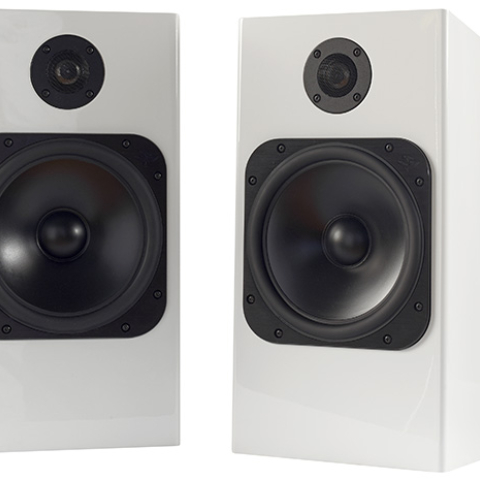
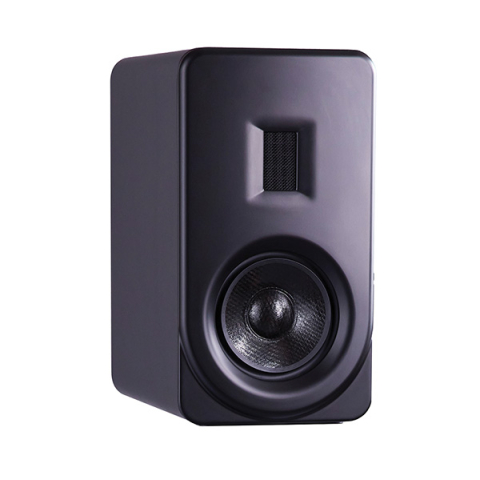
The Alón Li'l Rascal Mk.II is a two-way minimonitor with its magnetically shielded drivers mounted in a front-ported 16-liter enclosure. The 6.5" bass/midrange driver uses a paper cone treated with a proprietary layer. The high frequencies are handled by a 1" silk-dome tweeter. The crossover features air-core linear inductors, polypropylene capacitors, and hand-wired circuit boards. The Mk.II's drivers are unchanged from the original design; the upgrade comprises the proprietary crossover topology. When I pressed Marchisotto a third time for more details about the crossover, he replied, "I don't gotta show no leg." The Rascal Mk.II's MDF cabinet of MDF has rounded corners to optimize diffraction. Other colors besides the standard black, which is attractive but not imposing, are available on special order. I tested the speakers using metal Celestion Si stands loaded with lead shot and sand. Although Acarian Systems recommends using the Li'l Rascals with their grilles removed, I tested them both ways. Leaving the grilles on resulted in slightly reduced detail and transparency but no change in tonal balance. The Listening
I fired up the Li'l Rascals, wondering if I'd catch a glimpse of the dynamic performance I'd heard from the Exotica Grand References at HE2001. After the first listening session, I was convinced that I had, as the Rascal had three strengths unusual in a bookshelf speaker of this size and price: 1) lifelike dynamic contrasts, from the subtlest soft passages through the most bombastic fortissimos; 2) detail resolution, transparency, and natural transient articulation akin to what I'd expect from a more expensive speaker; and 3) a linear and uncolored mid/upper bass region realistic not only in timbre, but also in its ability to breathe and bloom as live music does.
But such accolades would be meaningless if the Rascal didn't get the midrange right, which it did. Robert Taub's interpretation of Milton Babbitt's Piano Works (CD, Harmonia Mundi HMC 5160) puts the piano through a wide range of tonal and dynamic colors. With the Li'l Rascal, I was drawn to Taub's virtuosic playing in the lower middle register of the instrument, and was able to follow his signature bombastic yet delicate style on his rich and resonant instrument. I have never heard this region of the piano keyboard reproduced more naturally by a small speaker.
Similarly, male and female vocals were naturally portrayed and with great dimensional body. Madeline Peyroux's highly individualistic channeling of Billie Holiday on "Hey Sweet Man," from Dreamland (CD, Atlantic 82946-2), was rich, resonant, and uncolored, the Rascal revealing every subtlety of her phrasing. I did, however, notice that sibilants were rather prominent on this recording.
After auditioning a wide range of program material, I concluded that the Rascal had a crisp presentation of frequencies in the upper-midrange/lower-high-frequency range that tended to highlight instruments with significant energy in this region. It wasn't a brightness, harshness, or brittleness, but certain instruments, such as Fender Stratocasters (Mighty Sam McClain's Give It Up to Love CD, JVC JVCXR 0012-2) or dobros (Mark Ribot's work on the Peyroux disc), sounded as if they'd been turned up a jot in the mix. Vocalists such as Peyroux, although sounding natural, appeared to have been very closely miked. The crispness in this range was more noticeable with my Creek 5350SE integrated amplifier than with my Audio Valve/Audio Research tube combo.
My tastes—and those of my bank account and my wife's decorator—still run in the direction of three-way dynamic systems, however. Still, I'm a fan of certain Alón products; I own pairs of the Circe ($12,000/pair) and Alón's original bookshelf design, the Petite ($1000/pair, before being dropped from the line several years ago). But none of the Alóns I've owned or reviewed over the years could come close to approaching the dynamic realism of the Exotica Grand References at Home Eentertainment 2001. From the subtlest pianissimos to fortissimo blasts, the music ebbed and flowed continuously, as it does in a live performance.
A conversation with Marchisotto revealed that the dynamic magic I was hearing at HE2001 stemmed largely from Alón's new proprietary crossover topology, employed only in the Exotica. He was uncharacteristically secretive about this "magic black crossover box," which intrigued me even more. Since that launch two years ago, Marchisotto has trickled down this crossover topology to other designs, and now every Alón speaker in the $4000-$12,000/pair range includes the new technology.
What does all this bumpf have to do with all the tea in China—or, more to the point, my quest for the ultimate budget speaker? Well, two years before that show, in 1999, Alón had launched its first sub-$1000 two-channel speaker, the Li'l Rascal, a $500/pair bookshelf design. I'd been approached to review it, but had declined—my dance card was already full. Early this year, Marchisotto called me again: "We've incorporated the Exotica Grand Reference crossover topology in a new version of the Li'l Rascal, which I think you'll like better than your Petites. But we had to raise the price to 600 bucks."
The Alón Li'l Rascal Mk.II is a two-way minimonitor with its magnetically shielded drivers mounted in a front-ported 16-liter enclosure. The 6.5" bass/midrange driver uses a paper cone treated with a proprietary layer. The high frequencies are handled by a 1" silk-dome tweeter. The crossover features air-core linear inductors, polypropylene capacitors, and hand-wired circuit boards. The Mk.II's drivers are unchanged from the original design; the upgrade comprises the proprietary crossover topology. When I pressed Marchisotto a third time for more details about the crossover, he replied, "I don't gotta show no leg." The Rascal Mk.II's MDF cabinet of MDF has rounded corners to optimize diffraction. Other colors besides the standard black, which is attractive but not imposing, are available on special order. I tested the speakers using metal Celestion Si stands loaded with lead shot and sand. Although Acarian Systems recommends using the Li'l Rascals with their grilles removed, I tested them both ways. Leaving the grilles on resulted in slightly reduced detail and transparency but no change in tonal balance. The Listening
I fired up the Li'l Rascals, wondering if I'd catch a glimpse of the dynamic performance I'd heard from the Exotica Grand References at HE2001. After the first listening session, I was convinced that I had, as the Rascal had three strengths unusual in a bookshelf speaker of this size and price: 1) lifelike dynamic contrasts, from the subtlest soft passages through the most bombastic fortissimos; 2) detail resolution, transparency, and natural transient articulation akin to what I'd expect from a more expensive speaker; and 3) a linear and uncolored mid/upper bass region realistic not only in timbre, but also in its ability to breathe and bloom as live music does.