Flip flip flip]...Where the heck is it?...[flip flip flip]...Got it!" What am I looking for? There, in black and white, on p.634 of J. Gordon Holt's Really Reliable Rules for Rookie Reviewers (footnote 1), is the Prime Directive On Loudspeaker Setup: "Never, ever, choose a loudspeaker that has too much bass extension for your room!"
 Time and time again I get letters from readers who have relatively small rooms asking why they can't get an even tonal balance from their [insert brand-name of massive, flat-to-20Hz behemoth here] speakers.
The answer is a no-brainer: If you have only a small room, the "best" loudspeaker will almost always be one with limited low-frequency extension. Not only will this reduce the amount of excitation given the lowest room resonant modes; the effect of the boundaries in a small room will actually increase the amount of bass. In such circumstances, a minimonitor will actually give better, more neutrally balanced low frequencies than a full-range design. The latter will produced an exaggerated LF response that might be seductive in the short term, but over the long term the incessant boom will prove irritating. And in the small room, the need for massive sound-pressure levels does not mandate equally massive loudspeakers.
Which is why in my relatively small room—irregular in shape, it basically measures 19' by 16.5' by 9'—I have used small speakers as my long-term references: Celestion SL600s and '700s, Rogers LS3/5as, Harbeth HL-P3s, Epos ES-14s, Thiel CS2 2s (okay, the Thiels aren't so small), and most recently, B&W John Bowers Silver Signatures (footnote 2). Despite their modest size, the Silver Siggies fill the room with an astonishing amount of low frequencies, flat down to 33Hz or so—as long as you don't play them too loud.
I'm always on the lookout, therefore, for small speakers that will rival the B&Ws in transparency, midrange neutrality, and soundstaging, but that kick big booty when it comes to playing loud and proud.
Acoustic Energy AE2 signature: $5495/pair
Time and time again I get letters from readers who have relatively small rooms asking why they can't get an even tonal balance from their [insert brand-name of massive, flat-to-20Hz behemoth here] speakers.
The answer is a no-brainer: If you have only a small room, the "best" loudspeaker will almost always be one with limited low-frequency extension. Not only will this reduce the amount of excitation given the lowest room resonant modes; the effect of the boundaries in a small room will actually increase the amount of bass. In such circumstances, a minimonitor will actually give better, more neutrally balanced low frequencies than a full-range design. The latter will produced an exaggerated LF response that might be seductive in the short term, but over the long term the incessant boom will prove irritating. And in the small room, the need for massive sound-pressure levels does not mandate equally massive loudspeakers.
Which is why in my relatively small room—irregular in shape, it basically measures 19' by 16.5' by 9'—I have used small speakers as my long-term references: Celestion SL600s and '700s, Rogers LS3/5as, Harbeth HL-P3s, Epos ES-14s, Thiel CS2 2s (okay, the Thiels aren't so small), and most recently, B&W John Bowers Silver Signatures (footnote 2). Despite their modest size, the Silver Siggies fill the room with an astonishing amount of low frequencies, flat down to 33Hz or so—as long as you don't play them too loud.
I'm always on the lookout, therefore, for small speakers that will rival the B&Ws in transparency, midrange neutrality, and soundstaging, but that kick big booty when it comes to playing loud and proud.
Acoustic Energy AE2 signature: $5495/pair
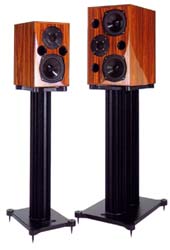
I reviewed the original AE2 loudspeaker in February 1990 (Vol.13 No.2); while I was most impressed with its dynamics and clarity, I was bothered by a forward-balanced, colored midrange. The AE2's designer, Phil Jones, moved on to Boston Acoustics, then founded his own company, Platinum Audio. [in 2007, Phil is the chief engineer for American Acoustic Design and Phil Jones Bass.—Ed.] Meanwhile, Acoustic Energy's Managing Director, Steven Tayler, redesigned the AE2's crossover network and decided to offer the loudspeaker in a premium, "Signature" edition. (The standard "A" version, still available, costs $2195/pair.) The AE2 still features a 1" metal-dome tweeter (anodized black in the Signature edition) and two small metal-cone woofers, these reflex-loaded by three narrow-diameter, 5.5"-deep ports on the front baffle. For the Signature series speaker, the drive-units are matched to close tolerances. As supplied, the tweeter dome is protected by a small wire-mesh grille. This is held in place by the drive-unit magnet and can be easily removed for critical listening. All my auditioning and measurements were performed with the tweeter "nude."
Whereas the original AE2 featured 24dB/octave crossover filters, the current Reference "A" version and the Signature uses first-order, 6dB/octave electrical slopes in order to have the shortest, most direct signal path. High-quality parts are used—polypropylene-dielectric capacitors, vitreous-enamel, wire-wound resistors, high-current, air-core inductors, and 99.99% pure silver, Teflon-insulated internal wiring. The entire crossover is potted in a resin compound to minimize microphony.
The AE2 Signature is a striking-looking speaker. The cabinets of each pair are finished in matched wooden veneers, then sealed and hand-polished with high-gloss clear lacquer. The result is a finish that, particularly when the light strikes it just so, appears to glow translucent. As a finishing touch, on top of each loudspeaker is a Sterling silver nameplate, individually hallmarked by Steven Tayler. A nice finishing touch is the canvas bag wrapped around each speaker to prevent the lacquer from being marred in the shipping container.
The attention to detail and finish is echoed by the Signature series loudspeaker stand. Pricey at $1195/pair, each Acoustic Energy stand features two vertical pillars, each a finned aluminum extrusion some 4" in diameter, inside of which is a polyethylene bag filled with lead shot. These pillars are bolted to cast-aluminum top and bottom plates; a lacquered fascia wooden panel fits down the front column. The stand top plate has four small upward-pointing cones at the corners to make contact with the speaker; the bottom plate is fitted with four carpet-piercing spikes, these adjustable from above with an Allen wrench. Each stand is 26" high with spikes and weighs about 70 lbs once assembled (according to my Health-O-Meter bathroom scales).
Sound
Acoustic Energy recommends setting up the AE2 Signatures with the tweeters on the outsides of the asymmetrical baffles—the speakers are supplied as a mirror-imaged pair—and toed-in so that the listener's line of sight is just down the inside face of each cabinet. The recommended vertical axis is level with the tweeter; on the Signature stands, this is 34" from the floor. My initial impression was of very smooth high frequencies. It wasn't that the treble was excessively rolled-off—though the top octave was a little reticent—but there was an absence of HF grain that made even bright, overcooked recordings like Annie Lennox's Medusa CD (Arista 25717-2) sound acceptable. There was an occasional touch of mid-treble brightness, this very music-dependent, and a slight nasality in the upper mids was noticeable on classical orchestral music. The strings on Elgar's arrangement of the Bach Fantasia & Fugue in c (EMI Studio CDM 63133), for example, sounded just a little bit more "hooded" than they would in real life, while well-recorded female voice—Sara K.'s "History Repeats Itself" on Stereophile's Test CD 3, for example—was slightly "hooty" at times in that occasional notes sounded less well-defined, with a little more overhang, than others.
The bass was leaner than that of the B&W Silver Signatures, but extended somewhat lower in frequency. The 32Hz warble-tone on Test CD 3 was easily audible without any obvious "doubling" (where the presence of high levels of second-harmonic distortion makes the note more audible at the expense of a doubling of perceived pitch). This bass performance enabled the 2 Signatures really to sing on bass guitar and double bass. Check out the low-tolling, open-string, 36Hz-fundamental Ds on the Dean Peer solo bass track on Test CD 3 for an example of the kind of bass sound reproduced without, ahem, peer by the AE2 Signature.
Which brings me to the area where the Acoustic Energy beats out every minimonitor I've heard: dynamics. Whether it was on the macro level (the ability to play loud) or on the micro (the differentiation between very slight loudness changes, such as the different attack Ginger Baker uses for each drumbeat on Going Back Home, his excellent 1994 album with Charlie Haden and Bill Frisell, Atlantic 82652-2), the '2 Signature reinforced the musical message by allowing you to hear what was happening, free from strain or compression.
And boy, could this speaker kick out the jams! Playing "Africa I'm Home," from Stanley Clarke's East River Drive (Epic EK 47489) at an average in-room level of 96–98dB, the 0dBFS kick drum produced puffs of wind from the ports that could be felt 6' away! Yet the overall sound remained clean and dynamic despite reflex winds that could probably blow out candles!
Despite the high wind velocities in the ports, no turbulent noises could be heard. By comparison, the B&Ws sounded staid. And the combination of midbass power and dynamic range had been obtained at the expense of speed or transient clarity. Many reflex speakers produce low frequencies that seem to lag behind the musical beat—this is what is meant by the common oxymoron "slow bass transients," I believe. By contrast, the AE2 boogied like a good 'un, as was revealed when I reached for Stereophile's official test track for loudspeaker Boogielocity, James Brown's classic "Get Up (I Feel Like Being A) Sex Machine" (rereleased as part of the 1991 Polydor Star Time boxed set). Now that's what the "Repeat Track" button on the Levinson's remote control is for! (As I'm sure all you fellow owners of Levinson CD players have already discovered.)
As boogielicious as the Acoustic Energies were reproducing the Father of Funk At His Finest—their clarity allowing me to hear for the first time the kickdrum pedal squeaking on JB's "Super Bad (Part 1)—they were beaten out by the Silver Signatures when it came to soundstage presentation. There was plenty of depth apparent. The awesome Hall of the Grail scene in the Barenboim Parsifal (Teldec 74448-2), where the mighty bells tolling out the consecutive falling fourths of the "Gralsglocken" leitmotif, for example, defined a huge acoustic space with seemingly endless depth. But there wasn't quite the sense of lateral image precision typical of the B&Ws. Images were a little pulled to the sides, giving a U-shaped soundstage. But this is a minor failing, offset by this small speaker's ability to "Say it Loud..." (©The Hardest Working Man in Show Business).
Overall, I preferred the B&Ws—but it was a close-run thing!
Enter the Cary
With the little single-ended Cary 300SEI amp driving the AE2 Signatures, things got a little confusing. Voices became both more tangible and thrown more forward in the mix, while every instrument seemed to become more of an entity unto itself while making more musical sense. Bass guitar, however, acquired a rather detached, "hummy" quality that I quickly tired of, and vocal sibilants sounded occasionally a little too spitchy for comfort. Overall, though, for those who love the sound of human voice and who aren't bass guitarists, the match seemed one made in heaven. The high sensitivity of the Acoustic Energies helped out the voltage-swing–challenged Cary in a big way. Check it out.
Conclusion
At $6690/pair including the excellent stands, Acoustic Energy's AE2 Signature is not intended for those who have to account for every penny. However, it is both a superb-sounding loudspeaker and a superb-looking piece of furniture. It performs equally well on rock and classical musics, and offers a more dynamic sound than the even more expensive B&W Silver Signature. If, like me, you're stuck with a relatively small room, the Signature edition of the AE2 might be all the speaker you're likely to need.
Footnote 1: Published in 190 parts, starting in November 1962. Footnote 2: I use the Silver Signatures with the tweeters on the inside edges of the baffles—ie, away from the sidewalls—and toed-in to the listening position. This, to my ears, gives the smoothest transition through the crossover region. I have also been able to improve their definition in the lower mids by weighing them down with a small bag of lead shot draped over the top rear of the cabinet.
Time and time again I get letters from readers who have relatively small rooms asking why they can't get an even tonal balance from their [insert brand-name of massive, flat-to-20Hz behemoth here] speakers.
The answer is a no-brainer: If you have only a small room, the "best" loudspeaker will almost always be one with limited low-frequency extension. Not only will this reduce the amount of excitation given the lowest room resonant modes; the effect of the boundaries in a small room will actually increase the amount of bass. In such circumstances, a minimonitor will actually give better, more neutrally balanced low frequencies than a full-range design. The latter will produced an exaggerated LF response that might be seductive in the short term, but over the long term the incessant boom will prove irritating. And in the small room, the need for massive sound-pressure levels does not mandate equally massive loudspeakers.
Which is why in my relatively small room—irregular in shape, it basically measures 19' by 16.5' by 9'—I have used small speakers as my long-term references: Celestion SL600s and '700s, Rogers LS3/5as, Harbeth HL-P3s, Epos ES-14s, Thiel CS2 2s (okay, the Thiels aren't so small), and most recently, B&W John Bowers Silver Signatures (footnote 2). Despite their modest size, the Silver Siggies fill the room with an astonishing amount of low frequencies, flat down to 33Hz or so—as long as you don't play them too loud.
I reviewed the original AE2 loudspeaker in February 1990 (Vol.13 No.2); while I was most impressed with its dynamics and clarity, I was bothered by a forward-balanced, colored midrange. The AE2's designer, Phil Jones, moved on to Boston Acoustics, then founded his own company, Platinum Audio. [in 2007, Phil is the chief engineer for American Acoustic Design and Phil Jones Bass.—Ed.] Meanwhile, Acoustic Energy's Managing Director, Steven Tayler, redesigned the AE2's crossover network and decided to offer the loudspeaker in a premium, "Signature" edition. (The standard "A" version, still available, costs $2195/pair.) The AE2 still features a 1" metal-dome tweeter (anodized black in the Signature edition) and two small metal-cone woofers, these reflex-loaded by three narrow-diameter, 5.5"-deep ports on the front baffle. For the Signature series speaker, the drive-units are matched to close tolerances. As supplied, the tweeter dome is protected by a small wire-mesh grille. This is held in place by the drive-unit magnet and can be easily removed for critical listening. All my auditioning and measurements were performed with the tweeter "nude."
Acoustic Energy recommends setting up the AE2 Signatures with the tweeters on the outsides of the asymmetrical baffles—the speakers are supplied as a mirror-imaged pair—and toed-in so that the listener's line of sight is just down the inside face of each cabinet. The recommended vertical axis is level with the tweeter; on the Signature stands, this is 34" from the floor. My initial impression was of very smooth high frequencies. It wasn't that the treble was excessively rolled-off—though the top octave was a little reticent—but there was an absence of HF grain that made even bright, overcooked recordings like Annie Lennox's Medusa CD (Arista 25717-2) sound acceptable. There was an occasional touch of mid-treble brightness, this very music-dependent, and a slight nasality in the upper mids was noticeable on classical orchestral music. The strings on Elgar's arrangement of the Bach Fantasia & Fugue in c (EMI Studio CDM 63133), for example, sounded just a little bit more "hooded" than they would in real life, while well-recorded female voice—Sara K.'s "History Repeats Itself" on Stereophile's Test CD 3, for example—was slightly "hooty" at times in that occasional notes sounded less well-defined, with a little more overhang, than others.
With the little single-ended Cary 300SEI amp driving the AE2 Signatures, things got a little confusing. Voices became both more tangible and thrown more forward in the mix, while every instrument seemed to become more of an entity unto itself while making more musical sense. Bass guitar, however, acquired a rather detached, "hummy" quality that I quickly tired of, and vocal sibilants sounded occasionally a little too spitchy for comfort. Overall, though, for those who love the sound of human voice and who aren't bass guitarists, the match seemed one made in heaven. The high sensitivity of the Acoustic Energies helped out the voltage-swing–challenged Cary in a big way. Check it out.
At $6690/pair including the excellent stands, Acoustic Energy's AE2 Signature is not intended for those who have to account for every penny. However, it is both a superb-sounding loudspeaker and a superb-looking piece of furniture. It performs equally well on rock and classical musics, and offers a more dynamic sound than the even more expensive B&W Silver Signature. If, like me, you're stuck with a relatively small room, the Signature edition of the AE2 might be all the speaker you're likely to need.
Footnote 1: Published in 190 parts, starting in November 1962. Footnote 2: I use the Silver Signatures with the tweeters on the inside edges of the baffles—ie, away from the sidewalls—and toed-in to the listening position. This, to my ears, gives the smoothest transition through the crossover region. I have also been able to improve their definition in the lower mids by weighing them down with a small bag of lead shot draped over the top rear of the cabinet.