Readers often ask how I choose components for review. My method is simple: Ninety percent of what I review is gear that has impressed me at one of our Home Entertainment Shows, or new designs from manufacturers whose products I've liked in the past. The remainder are assigned by John Atkinson.
 This time I tried something different. I contacted three audio retailers whom I trust for their hearing acuity, passion for music, and honesty, and asked each this question: "Which affordable speaker have you heard lately that impressed you?" (My working definition of affordable loudspeaker currently has a ceiling of $1500/pair.) To my surprise, all three had the same answer: a model from Focal's Chorus 800V series.
Designing
This time I tried something different. I contacted three audio retailers whom I trust for their hearing acuity, passion for music, and honesty, and asked each this question: "Which affordable speaker have you heard lately that impressed you?" (My working definition of affordable loudspeaker currently has a ceiling of $1500/pair.) To my surprise, all three had the same answer: a model from Focal's Chorus 800V series.
Designing
The Chorus 800V series is the second from the bottom of the four families of speakers Focal designs for two-channel home audio. (The Utopia Be line is their flagship series, and the Chorus 700V speakers comprise their entry-level line.) The 800V series includes two bookshelf and three floorstanding models that range from $795 to $2995/pair, as well as several home-theater models. I chose the larger of the bookshelf designs, the 807V ($995/pair).
The Chorus 807V is a front-ported, two-way speaker with a 1" TNV aluminum-magnesium inverted-dome tweeter and a 7" Polyglass-cone woofer. Focal America's Daniel Jacques explained to me that the tweeter voice-coil is attached midway along the dome rather than on the periphery, as in most tweeters. He claimed that this improves the driver's pistonic movement, to give greater speed and better control. Jacques also claimed that Focal doesn't believe in ferrofluid cooling: "How fast can you walk when you are in a pool?"
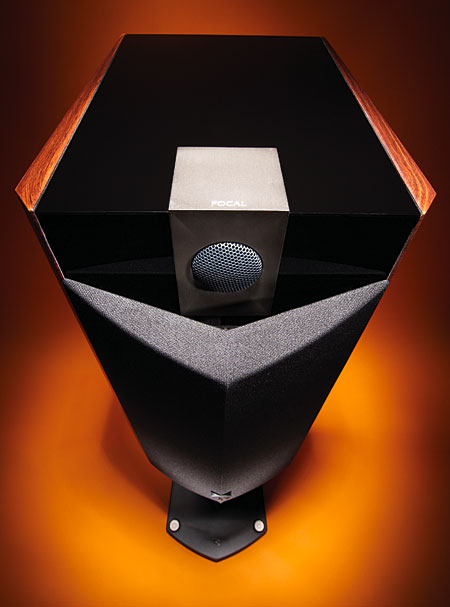
The 807V looks stunning. Focal employed the Parisian design house of Pineau & Le Porcher to develop the attractive "V" look, which combines polished, acrylic-covered ebony with a highly figured finish of moka wood. I set the speakers on my trusty, 24"-high Celestion Si stands, which were loaded with sand and lead shot. I noticed no difference in their performance with their grilles on or off, so I left them on—the V-shaped grille is a key part of the speaker's appearance. The Chorus 807V is not magnetically shielded.
Listening
I was immediately struck, with every recording I tried, by the natural, detailed, organic, and holographic midrange of the Chorus 807V. All vocal recordings were stunning. I mined my collection for the best-sounding vocals, which meant hitting the vinyl stacks as well. The title track of Doris Day's Cutting Capers (LP, Columbia C 11232) reveals her voice in its 1950s prime, in all its golden, silky, breathy glory—as if she's bathed in light against a backdrop of delicate, natural orchestral textures. I'm also a fan of the early Joan Baez; her rendition of Bob Dylan's "It Ain't Me Babe," from Joan Baez 5 (LP, Vanguard VSD 79160), with that seductive, birdlike vibrato in her high register, was arresting through the 807V. The speaker's capabilities of subtle, low-level dynamic articulation almost let me hear Baez's head and throat as two distinct point sources.
The most captivating aspect of the Chorus 807V was its high-frequency performance. Its resolution of detail, speed, and extension of the highs told me that this speaker has one remarkable tweeter. When I played Tiger Okoshi's Two Sides to Every Story (CD, JVC JVCXR-0004-2), his trumpet's blatty bite had the attack, spit, and golden glow of a live trumpeter in my living room. Nor was his a sweet-sounding horn; on every track it was in my face, dominating the mix, exactly as it would had Okoshi been standing there in my living room.
Derek Bailey uses unorthodox picking and plucking techniques on both acoustic and electric guitar to create the remarkable improvisations on his Solo Guitar Vol. 1 (CD, Incus CD10). To hear Bailey's unique dynamic phrasings properly, it's essential that a speaker's tweeter be able to unravel every subtle nuance of his playing. I listened to the entire CD through the 807Vs and was reminded of a time in the 1980s when I sat 10' from Bailey at a live performance.
On certain recordings, however, the extreme high frequencies seemed a bit emphasized. The sibilants of all closely miked female vocalists on familiar recordings—such as "Hey, Sweet Man," from Madeline' Peyroux's Dreamland (CD, Atlantic 82946-2)—seemed a bit more prominent than I remembered hearing them through other speakers. The Focal's tweeter was also very revealing of less than pure high-frequency content. In the title track of Hole's Celebrity Skin (CD, Geffen DGCD-25164), the high frequencies are a bit hashy and trashy. With most speakers I've tried, this has not deterred me from cranking up this tune to live rock-concert levels and dancing around the room. But the Chorus 807V so laid bare the recording's distorted, compressed highs that I ended up uninterested in hearing the rest of the disc.
The Chorus 807V's bass was extended and forceful for a "bookshelf" speaker. With all recordings the bass was fairly clean, tight, and uncolored, though I found the lower range of electric bass guitars (eg, Chad Watson's on Janis Ian's Breaking Silence CD, Analogue Productions CAPP 027) and string basses (eg, Ray Brown's solo on "I'm an Old Cowhand," from the CD of Sonny Rollins' Way Out West, JVC VICJ 60088) to be a touch warm and supple, while still sounding natural. This wasn't, however, noticeable with electronic rock recordings; the synth bass and drum machine on Sade's Love Deluxe (CD, Epic EK 53178) were clean, tight, and powerful. Moreover, the 807V's superb resolution of detail made it simple to pick out all the electronic processing effects on this recording.
This time I tried something different. I contacted three audio retailers whom I trust for their hearing acuity, passion for music, and honesty, and asked each this question: "Which affordable speaker have you heard lately that impressed you?" (My working definition of affordable loudspeaker currently has a ceiling of $1500/pair.) To my surprise, all three had the same answer: a model from Focal's Chorus 800V series.
Designing
The Chorus 800V series is the second from the bottom of the four families of speakers Focal designs for two-channel home audio. (The Utopia Be line is their flagship series, and the Chorus 700V speakers comprise their entry-level line.) The 800V series includes two bookshelf and three floorstanding models that range from $795 to $2995/pair, as well as several home-theater models. I chose the larger of the bookshelf designs, the 807V ($995/pair).
I was immediately struck, with every recording I tried, by the natural, detailed, organic, and holographic midrange of the Chorus 807V. All vocal recordings were stunning. I mined my collection for the best-sounding vocals, which meant hitting the vinyl stacks as well. The title track of Doris Day's Cutting Capers (LP, Columbia C 11232) reveals her voice in its 1950s prime, in all its golden, silky, breathy glory—as if she's bathed in light against a backdrop of delicate, natural orchestral textures. I'm also a fan of the early Joan Baez; her rendition of Bob Dylan's "It Ain't Me Babe," from Joan Baez 5 (LP, Vanguard VSD 79160), with that seductive, birdlike vibrato in her high register, was arresting through the 807V. The speaker's capabilities of subtle, low-level dynamic articulation almost let me hear Baez's head and throat as two distinct point sources.