Tone controls? I ripped them out of my Dyna PAS-3! And that was the last time I had tone controls. As a card-carrying audiophile, I wanted just what the engineer had inscribed on the recording, with as little change as possible (read: high fidelity). 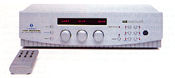 But such purism has left me unarmed against boomy or screechy recordings of wonderful music. The only choices have been to endure or abjure such recordings because analog frequency shapers (tone controls, equalizers, filters, etc.) add phase-shifts, noise, and distortion. At the same time, mid-fi and home-theater systems (and recording studios) incorporate sophisticated and complex frequency-shaping, modifying tonal, decay, and reverberation characteristics with digital signal processing (DSP) to superimpose a chosen aural ambience on the sound source. Few of us on the other side of the track, who have taken the more ascetic route, would deny that these effects can be impressive. Now, the time has come for DSP to give the audiophile some powerful tools to tailor frequency response and to correct faults in the recording. Both the Z-Systems rdp-1 and the NAD 118 are designed to use digital signal processing to effect changes in the shape of the frequency response without introducing any side effects into the audible signal. Both products rely on powerful general-purpose DSP chips, have memory modes for the storage and recovery of settings, and can be operated from their front panels or from their remote controls. Aside from those common points, they differ in terms of capabilities, intended applications, and user interface because the designers of these two devices chose different models to emulate. The NAD emulates a line-level preamp/controller with tone and separation/blend controls. The Z-systems rdp-1 emulates a controller/parametric equalizer. Each, however, is much more capable than its ancestors.
Z-Systems rdp-1: A Professional Tool
But such purism has left me unarmed against boomy or screechy recordings of wonderful music. The only choices have been to endure or abjure such recordings because analog frequency shapers (tone controls, equalizers, filters, etc.) add phase-shifts, noise, and distortion. At the same time, mid-fi and home-theater systems (and recording studios) incorporate sophisticated and complex frequency-shaping, modifying tonal, decay, and reverberation characteristics with digital signal processing (DSP) to superimpose a chosen aural ambience on the sound source. Few of us on the other side of the track, who have taken the more ascetic route, would deny that these effects can be impressive. Now, the time has come for DSP to give the audiophile some powerful tools to tailor frequency response and to correct faults in the recording. Both the Z-Systems rdp-1 and the NAD 118 are designed to use digital signal processing to effect changes in the shape of the frequency response without introducing any side effects into the audible signal. Both products rely on powerful general-purpose DSP chips, have memory modes for the storage and recovery of settings, and can be operated from their front panels or from their remote controls. Aside from those common points, they differ in terms of capabilities, intended applications, and user interface because the designers of these two devices chose different models to emulate. The NAD emulates a line-level preamp/controller with tone and separation/blend controls. The Z-systems rdp-1 emulates a controller/parametric equalizer. Each, however, is much more capable than its ancestors.
Z-Systems rdp-1: A Professional Tool
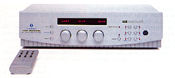
The Z-Systems rdp-1 is a serious tone-bender whose heritage is the recording studio. Glen Zelniker, President of Z-Systems, has taken the principles of a studio parametric digital EQ and adapted them to work in home systems as a "Transparent Tone Control." In fact, the rdp-1 (Reference Digital Preamp One) is derived from recording/mastering studio devices that Z-Systems has been making for a number of years. Zelniker has developed and incorporated sophisticated DSP algorithms that minimize noise and phase shift even at low frequencies and with large boost/cut settings. The consumer rdp-1 is a completely digital device without ADC or DAC (Z-Systems offers a reasonably priced 24-bit ADC as an accessory), and it is both more potent and more complex to operate than the very user-friendly NAD 118. Basically, and in addition to input selection and gain/balance, the rdp-1 consists of four independent parametric stages and low- and high-frequency shelf controls. The adjustments are not as intuitive as with bass and treble controls; the potential for abuse looms if they are not used with care. On the other hand, the rdp-1's precise adjustments can effectively remaster your recordings. The rdp-1 uses the industry-standard Crystal Semiconductor CS8412/CS8402 chips and quality Scientific Conversions signal transformers for input/output with up to 24-bit/48kHz precision. (An 88.2/96kHz upgrade is available.) The DSP engine is a 32-bit TI TMS320C31, which does its computations in 40-bit floating-point arithmetic. All front-panel controls are duplicated on the rdp-1's remote handset so that adjustments and mode selections can be made from the preferred listening position. I did have some problems adjusting the controls. Both the front-panel knobs and the corresponding buttons on the remote were often too efficient, each touch moving the control two or three steps instead of just one. I had to develop a light, careful touch to get only the change I wanted.
But such purism has left me unarmed against boomy or screechy recordings of wonderful music. The only choices have been to endure or abjure such recordings because analog frequency shapers (tone controls, equalizers, filters, etc.) add phase-shifts, noise, and distortion. At the same time, mid-fi and home-theater systems (and recording studios) incorporate sophisticated and complex frequency-shaping, modifying tonal, decay, and reverberation characteristics with digital signal processing (DSP) to superimpose a chosen aural ambience on the sound source. Few of us on the other side of the track, who have taken the more ascetic route, would deny that these effects can be impressive. Now, the time has come for DSP to give the audiophile some powerful tools to tailor frequency response and to correct faults in the recording. Both the Z-Systems rdp-1 and the NAD 118 are designed to use digital signal processing to effect changes in the shape of the frequency response without introducing any side effects into the audible signal. Both products rely on powerful general-purpose DSP chips, have memory modes for the storage and recovery of settings, and can be operated from their front panels or from their remote controls. Aside from those common points, they differ in terms of capabilities, intended applications, and user interface because the designers of these two devices chose different models to emulate. The NAD emulates a line-level preamp/controller with tone and separation/blend controls. The Z-systems rdp-1 emulates a controller/parametric equalizer. Each, however, is much more capable than its ancestors. The Z-Systems rdp-1 is a serious tone-bender whose heritage is the recording studio. Glen Zelniker, President of Z-Systems, has taken the principles of a studio parametric digital EQ and adapted them to work in home systems as a "Transparent Tone Control." In fact, the rdp-1 (Reference Digital Preamp One) is derived from recording/mastering studio devices that Z-Systems has been making for a number of years. Zelniker has developed and incorporated sophisticated DSP algorithms that minimize noise and phase shift even at low frequencies and with large boost/cut settings. The consumer rdp-1 is a completely digital device without ADC or DAC (Z-Systems offers a reasonably priced 24-bit ADC as an accessory), and it is both more potent and more complex to operate than the very user-friendly NAD 118. Basically, and in addition to input selection and gain/balance, the rdp-1 consists of four independent parametric stages and low- and high-frequency shelf controls. The adjustments are not as intuitive as with bass and treble controls; the potential for abuse looms if they are not used with care. On the other hand, the rdp-1's precise adjustments can effectively remaster your recordings. The rdp-1 uses the industry-standard Crystal Semiconductor CS8412/CS8402 chips and quality Scientific Conversions signal transformers for input/output with up to 24-bit/48kHz precision. (An 88.2/96kHz upgrade is available.) The DSP engine is a 32-bit TI TMS320C31, which does its computations in 40-bit floating-point arithmetic. All front-panel controls are duplicated on the rdp-1's remote handset so that adjustments and mode selections can be made from the preferred listening position. I did have some problems adjusting the controls. Both the front-panel knobs and the corresponding buttons on the remote were often too efficient, each touch moving the control two or three steps instead of just one. I had to develop a light, careful touch to get only the change I wanted.