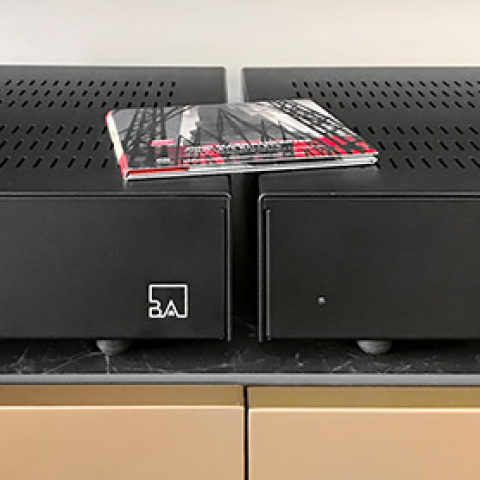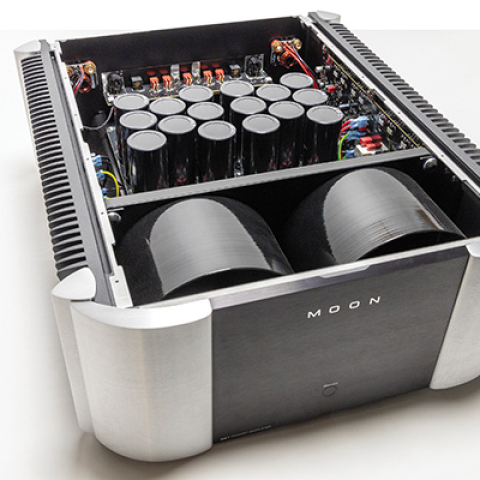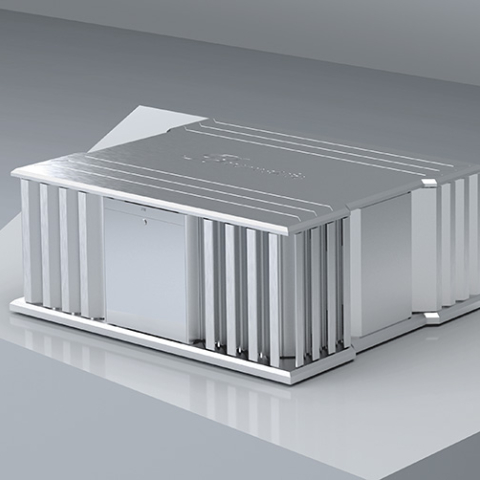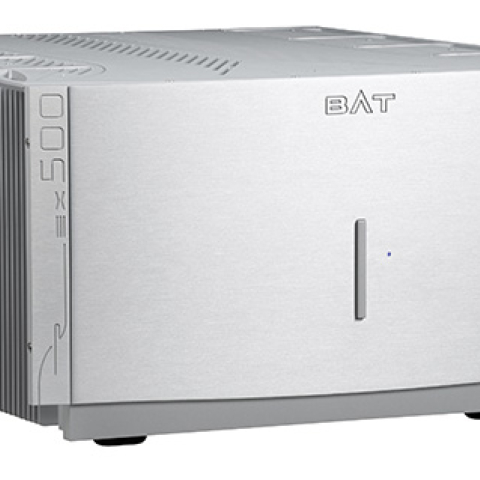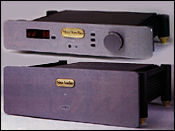
I first saw and heard SimAudio's Moon amp and preamp at WCES two years back, and something about their aesthetics appealed to me: Canadian ruggedness coupled with a decidedly French panache. I remember that those attributes also characterized the demo's sound, although I can't recall the speakers or the sources involved. At succeeding shows, it gradually dawned on me that the Moon components were the fixed elements in a succession of impressive demos.  SimAudio projects the Moon series as their ambitious first foray into top-end electronics. While the series incorporates a number of innovations, these have grown out of the company's accumulated experience with their successful Celeste line. Based on SimAudio's proprietary "Advanced Renaissance" technology, there is no overall negative feedback and no DC-blocking caps in either of these components, and each is powered by custom toroidal power transformers. The P-5 preamp uses Sim's RBG gain control (derived from a NASA development), which places only two resistors in the signal path. Still, the P-5 is a full-function, remote-controlled line preamplifier. Jean Poulin, designer and company president, emphasized that the P-5 not only had to sound great, but had to have good manners as well: no clicks or pops under any conditions, even at power-on and -off—not so easy to maintain in a DC-referenced circuit without blocking capacitors in the signal path. The W-5 power amplifier is dual-mono and fully balanced and sports balanced dual-coax inputs in addition to the more usual balanced XLR and single-ended coax inputs. It, too, behaved admirably throughout the component switching necessitated by the review/comparison process.
The first of the Moon units to arrive was the power amplifier, fresh from another reviewer. It sounded pretty good, but there were discrepancies between the labeling on the back panel and the instructions in the manual. I shipped it back to SimAudio, from which it returned a few weeks later with no visible changes. The preamp arrived a few months later and functioned flawlessly from the get-go. After I'd lived with this pair for several months, Poulin visited and made two changes. First, he felt the power amp was running too cool, and adjusted the bias. Second, the original preamp (serial number 971001) was swapped for a newer one, which, Poulin asserted, better corrected for input offsets, and thereby better minimized switching transients when selecting among inputs. Throughout all these events, the sound of the P-5/W-5 combination was consistent; my comments apply to both preamps, and all auditions of the power amp.
SimAudio projects the Moon series as their ambitious first foray into top-end electronics. While the series incorporates a number of innovations, these have grown out of the company's accumulated experience with their successful Celeste line. Based on SimAudio's proprietary "Advanced Renaissance" technology, there is no overall negative feedback and no DC-blocking caps in either of these components, and each is powered by custom toroidal power transformers. The P-5 preamp uses Sim's RBG gain control (derived from a NASA development), which places only two resistors in the signal path. Still, the P-5 is a full-function, remote-controlled line preamplifier. Jean Poulin, designer and company president, emphasized that the P-5 not only had to sound great, but had to have good manners as well: no clicks or pops under any conditions, even at power-on and -off—not so easy to maintain in a DC-referenced circuit without blocking capacitors in the signal path. The W-5 power amplifier is dual-mono and fully balanced and sports balanced dual-coax inputs in addition to the more usual balanced XLR and single-ended coax inputs. It, too, behaved admirably throughout the component switching necessitated by the review/comparison process.
The first of the Moon units to arrive was the power amplifier, fresh from another reviewer. It sounded pretty good, but there were discrepancies between the labeling on the back panel and the instructions in the manual. I shipped it back to SimAudio, from which it returned a few weeks later with no visible changes. The preamp arrived a few months later and functioned flawlessly from the get-go. After I'd lived with this pair for several months, Poulin visited and made two changes. First, he felt the power amp was running too cool, and adjusted the bias. Second, the original preamp (serial number 971001) was swapped for a newer one, which, Poulin asserted, better corrected for input offsets, and thereby better minimized switching transients when selecting among inputs. Throughout all these events, the sound of the P-5/W-5 combination was consistent; my comments apply to both preamps, and all auditions of the power amp.
SimAudio projects the Moon series as their ambitious first foray into top-end electronics. While the series incorporates a number of innovations, these have grown out of the company's accumulated experience with their successful Celeste line. Based on SimAudio's proprietary "Advanced Renaissance" technology, there is no overall negative feedback and no DC-blocking caps in either of these components, and each is powered by custom toroidal power transformers. The P-5 preamp uses Sim's RBG gain control (derived from a NASA development), which places only two resistors in the signal path. Still, the P-5 is a full-function, remote-controlled line preamplifier. Jean Poulin, designer and company president, emphasized that the P-5 not only had to sound great, but had to have good manners as well: no clicks or pops under any conditions, even at power-on and -off—not so easy to maintain in a DC-referenced circuit without blocking capacitors in the signal path. The W-5 power amplifier is dual-mono and fully balanced and sports balanced dual-coax inputs in addition to the more usual balanced XLR and single-ended coax inputs. It, too, behaved admirably throughout the component switching necessitated by the review/comparison process.