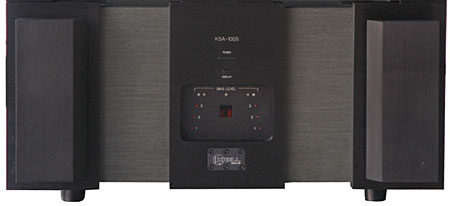
The Federal Express delivery man was having a hard time carrying the box containing the Krell KSA-100S up the front steps.
"What's in here, anyway?"
"It's an audio amplifier."
"You're kidding! I didn't know they made them that heavy."
"Well, this model is only second from the bottom in a line of four. The top model weighs 185 lbs."
"I sure hope you're not getting one of those, too!"
Mr. Fed-Ex need not have worried. With a shipping weight approaching 100 lbs, the KSA-100S is about as heavy an amplifier as I can manage. Given the rave the KSA-300S received from Tom Norton in the January '94 Stereophile (Vol.17 No.1, p.92), I'd like to have had one on hand to compare with the KSA-100S—but I just couldn't consider the prospect of schlepping around an amplifier that weighs more than I do. (As it turned out, a later visit to TJN's listening room allowed me to make the KSA-100S vs KSA-300S comparison without the risk of back injury.)
 At $5500, the KSA-100S is expensive as well as weighty; although, again, it's only second from the bottom in the Krell universe—you could buy six of them for the price of the Krell Audio Standard. It's also every inch a Krell, from the custom-extruded anodized handles to the gold-plated, laser-engraved binding posts. Fit'n'finish are of the highest quality.
Like both the '300S and '200S, the KSA-100S uses the Sustained Plateau Bias technology introduced in the Krell Audio Standard. This is a variation on the "sliding bias" idea, except that bias is changed in four discrete steps rather than continuously. A so-called "anticipator circuit" at the amplifier's input responds very quickly to an increase in signal level, so that, by the time the signal reaches that output stage, the output will be biased to class-A.
Once the bias has been increased to a certain level, that level will be sustained for 20–30 seconds, dropping to the next lower level if the signal level itself decreases consistently. As Tom Norton pointed out in his review of the KSA-300S, you'd need supernatural precognitive ability (or a delay system) to be certain that a signal peak wouldn't come along just as you're lowering the amplifier's bias, but the anticipator circuit's speed is such that the amplifier is unlikely to be caught with its bias down. (If there's any kind of hiccup in operation, the amplifier will presumably function in class-AB for a fraction of a second. Tsk, tsk.)
The main advantages of the Sustained Plateau Bias approach over "pure" class-A are: savings in electrical power consumption (a sort of "Green class-A"), and cooler running. The S-series amplifiers have four sets of LEDs, one for each bias plateau; these provide a way of checking the amount of power being used. They're also quite distracting—the way all power meters are—so, once I found out that I would have to listen at an uncomfortably high level to trigger the top set of LEDs, I turned the monitoring off for all normal listening. One Krell dealer told me that he thought the amps sound better with the LED display turned off, but I couldn't hear a difference.
Like the KSA-300S, the '100S has balanced as well as single-ended inputs, and two sets of binding posts (which accept only spade lugs, not banana plugs), making it ideal for bi-wiring. Also, like its fellow S-series amps, the KSA-100S has a take-no-prisoners power supply, with power that doubles down to 1 ohm, putting out 800Wpc into that impedance. There's protection circuitry to deal with all sorts of potential problems, and I know it works: the KSA-100S shut down at one point, and, checking the connections, I found that the pair of spade lugs at the speaker end had touched, producing a short. I corrected the problem and pressed the Power-On button, but the amplifier still wouldn't come on, presumably because the temperature of the heatsinks was too high. However, after a few minutes' wait, everything was back to normal, and the KSA-100S was gracious enough not to make any recriminations about my indiscretion.
Listening preliminaries
At $5500, the KSA-100S is expensive as well as weighty; although, again, it's only second from the bottom in the Krell universe—you could buy six of them for the price of the Krell Audio Standard. It's also every inch a Krell, from the custom-extruded anodized handles to the gold-plated, laser-engraved binding posts. Fit'n'finish are of the highest quality.
Like both the '300S and '200S, the KSA-100S uses the Sustained Plateau Bias technology introduced in the Krell Audio Standard. This is a variation on the "sliding bias" idea, except that bias is changed in four discrete steps rather than continuously. A so-called "anticipator circuit" at the amplifier's input responds very quickly to an increase in signal level, so that, by the time the signal reaches that output stage, the output will be biased to class-A.
Once the bias has been increased to a certain level, that level will be sustained for 20–30 seconds, dropping to the next lower level if the signal level itself decreases consistently. As Tom Norton pointed out in his review of the KSA-300S, you'd need supernatural precognitive ability (or a delay system) to be certain that a signal peak wouldn't come along just as you're lowering the amplifier's bias, but the anticipator circuit's speed is such that the amplifier is unlikely to be caught with its bias down. (If there's any kind of hiccup in operation, the amplifier will presumably function in class-AB for a fraction of a second. Tsk, tsk.)
The main advantages of the Sustained Plateau Bias approach over "pure" class-A are: savings in electrical power consumption (a sort of "Green class-A"), and cooler running. The S-series amplifiers have four sets of LEDs, one for each bias plateau; these provide a way of checking the amount of power being used. They're also quite distracting—the way all power meters are—so, once I found out that I would have to listen at an uncomfortably high level to trigger the top set of LEDs, I turned the monitoring off for all normal listening. One Krell dealer told me that he thought the amps sound better with the LED display turned off, but I couldn't hear a difference.
Like the KSA-300S, the '100S has balanced as well as single-ended inputs, and two sets of binding posts (which accept only spade lugs, not banana plugs), making it ideal for bi-wiring. Also, like its fellow S-series amps, the KSA-100S has a take-no-prisoners power supply, with power that doubles down to 1 ohm, putting out 800Wpc into that impedance. There's protection circuitry to deal with all sorts of potential problems, and I know it works: the KSA-100S shut down at one point, and, checking the connections, I found that the pair of spade lugs at the speaker end had touched, producing a short. I corrected the problem and pressed the Power-On button, but the amplifier still wouldn't come on, presumably because the temperature of the heatsinks was too high. However, after a few minutes' wait, everything was back to normal, and the KSA-100S was gracious enough not to make any recriminations about my indiscretion.
Listening preliminaries
To me, the process of audio-component evaluation has three phases: First, the "getting acquainted" phase, where the new component—eg, a loudspeaker or an amplifier—is dropped into the audio system, followed by a period of days or weeks of relatively informal listening. During this period, I try to suspend judgment, keeping in mind that what I'm hearing may not represent the product at its best. Of course, it's impossible not to form some impressions of the component, but these become merely hypotheses for later exploration.
The second phase of evaluation is devoted to system optimization and/or tweaking. It may be, for example, that the original system had a particularly synergistic combination of components, and changing one of the components upsets the synergy, even if the new component is, overall, superior. If there's reason to suspect that any of the system's components are unsuitable matches for the product under evaluation, a reviewer will routinely try—within practical limits—to re-optimize the system. To this end, different interconnects and speaker cables may be tried, and if the manufacturer has strong feelings about recommended associated equipment, the reviewer will try—again, within reason—to comply.
Once the reviewer is satisfied that the component is performing as the manufacturer intended, the more in-depth, analytical listening begins. At this stage, comparisons may be made with competing and/or reference products, some of the comparisons being made at matched levels. And then, of course, the reviewer commits to paper his or her thoughts about the component, based on personal whim and the desire to be controversial. (Just kidding!)
The Krell KSA-100S breezed through the "getting acquainted" phase of evaluation. Its sonic personality was recognizably solid-state, with the sort of bass response that seems to be outside the capability of tube amplifiers, but blissfully avoiding the hard, gritty sound that afflicts so many solid-state products, especially before they're fully broken-in and warmed-up (footnote 1). So far, so good.
Unlike speakers or cartridges, amplifiers don't lend themselves to easy tweaking. I installed a set of Krell's custom spikes, called Acoustic Mass Dampers, replacing the amplifier's rubber feet. This allowed the amplifier chassis to be well clear of my listening room's thick carpet. In the course of shifting the amplifier about, I noticed that the chassis's top plate emitted a fairly loud "ping" when tapped, as did the heatsinks. I put a VPI brick on the top plate (making sure not to block the vents), which reduced the resonance considerably. (It had no effect on the resonance of the heatsinks.) If one accepts the claims of manufacturers like YBA and Convergent Audio Technology—and I do—mechanical resonance is a subtle but important source of distortion in amplifiers and preamplifiers; so, if I were a KSA-100S owner, I'd look further into this area of tweaking. (In case you're wondering, the VPI brick did slightly improve clarity.)
Footnote 1: This sample of the KSA-100S had been previously used by Jack English for his review of the Merlin Excalibur II (Vol.16 No.12, p.180). I left both the KSA-100S and the Bryston 7Bs on continuously during my listening tests.
At $5500, the KSA-100S is expensive as well as weighty; although, again, it's only second from the bottom in the Krell universe—you could buy six of them for the price of the Krell Audio Standard. It's also every inch a Krell, from the custom-extruded anodized handles to the gold-plated, laser-engraved binding posts. Fit'n'finish are of the highest quality.
Like both the '300S and '200S, the KSA-100S uses the Sustained Plateau Bias technology introduced in the Krell Audio Standard. This is a variation on the "sliding bias" idea, except that bias is changed in four discrete steps rather than continuously. A so-called "anticipator circuit" at the amplifier's input responds very quickly to an increase in signal level, so that, by the time the signal reaches that output stage, the output will be biased to class-A.
Once the bias has been increased to a certain level, that level will be sustained for 20–30 seconds, dropping to the next lower level if the signal level itself decreases consistently. As Tom Norton pointed out in his review of the KSA-300S, you'd need supernatural precognitive ability (or a delay system) to be certain that a signal peak wouldn't come along just as you're lowering the amplifier's bias, but the anticipator circuit's speed is such that the amplifier is unlikely to be caught with its bias down. (If there's any kind of hiccup in operation, the amplifier will presumably function in class-AB for a fraction of a second. Tsk, tsk.)
To me, the process of audio-component evaluation has three phases: First, the "getting acquainted" phase, where the new component—eg, a loudspeaker or an amplifier—is dropped into the audio system, followed by a period of days or weeks of relatively informal listening. During this period, I try to suspend judgment, keeping in mind that what I'm hearing may not represent the product at its best. Of course, it's impossible not to form some impressions of the component, but these become merely hypotheses for later exploration.
Footnote 1: This sample of the KSA-100S had been previously used by Jack English for his review of the Merlin Excalibur II (Vol.16 No.12, p.180). I left both the KSA-100S and the Bryston 7Bs on continuously during my listening tests.