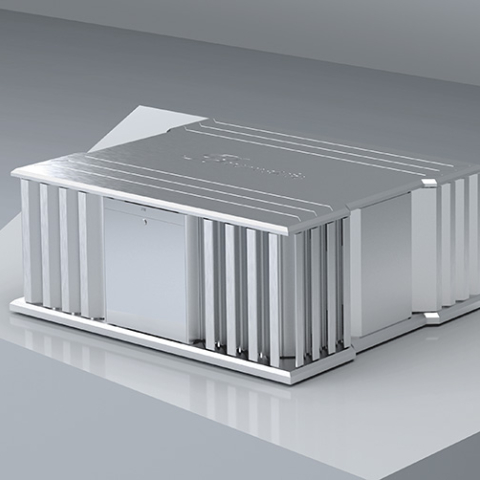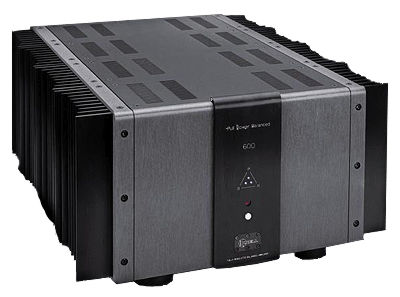
Latest and largest in Krell's current range of power amplifiers, the 600Wpc, $12,500 Full Power Balanced 600 joins the 300Wpc FPB 300 ($9000) and the 200Wpc (originally 150Wpc) FPB 200 ($5900). All are single-box stereo chassis and are specified as "Full Power Balanced"—I think to distinguish the essence of these designs from ordinary stereo amplifiers operated in balanced-bridged mode, usually with impaired performance. The FPB 600's speaker output is balanced; ie, neither "positive" or negative" terminals are connected to ground or the amplifier chassis. (Note that no speaker switches or headphone adaptors, which often have joined channel grounds, may be used, as they will short the outputs.) The output terminals are electrically at 0V, but float above the chassis ground. 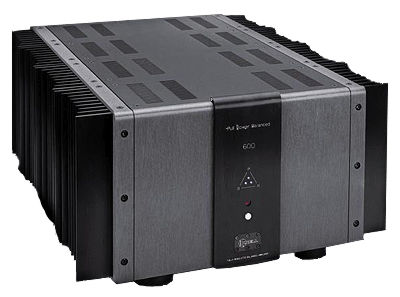 Only a serious weightlifter would want to pick up a '600—even without its shipping carton, it's a serious two-man lift. Once it's in place, you won't move it in a hurry. Can a 600Wpc amplifier be relevant to domestic high fidelity? From an academic viewpoint, it's hard to justify, even if price is not considered. With speakers of average 88dBW sensitivity working in average rooms, it's surprising just how much music can be replayed at a pleasantly loud peak level with a 30Wpc amplifier. As you can see from MK's and JA's comments on this issue's review of the 30Wpc Pass Aleph 3, this will be loud enough, in practice, for all listeners other than headbanging rockers. With the right speaker match, a little more sensitivity, and a personal sense of proportion and restraint, satisfyingly loud sounds can be achieved with 20Wpc or even 10Wpc SE tube amplifiers. Even here, the peak level is rarely used; except for heavily compressed pop material, most music will cruise along at between 0.1W and 1W.
Conversely, the generous dynamic range of a big domestic audio system can be crucial in allowing full expression of music's potential, especially in larger rooms. Power alone, if uncompromised in absolute fidelity, is well recognized as a positive factor in sound quality. It all has to do with a sense of proportion, a scaling of expectation and use. Realistic reproduction of powerful rock music is no easy feat. In the right room, with speakers of greater than 94dBW sensitivity and more than 300Wpc available, you can come close to the sound levels where a stadium rig can still play cleanly. However, when all hell is let loose, a live band winds up to a performance crescendo, and the balance engineer takes the PA rig to its flat-out, 20% compressed limit of sound level, no domestic system can match it. No simple amplifier!
Only a serious weightlifter would want to pick up a '600—even without its shipping carton, it's a serious two-man lift. Once it's in place, you won't move it in a hurry. Can a 600Wpc amplifier be relevant to domestic high fidelity? From an academic viewpoint, it's hard to justify, even if price is not considered. With speakers of average 88dBW sensitivity working in average rooms, it's surprising just how much music can be replayed at a pleasantly loud peak level with a 30Wpc amplifier. As you can see from MK's and JA's comments on this issue's review of the 30Wpc Pass Aleph 3, this will be loud enough, in practice, for all listeners other than headbanging rockers. With the right speaker match, a little more sensitivity, and a personal sense of proportion and restraint, satisfyingly loud sounds can be achieved with 20Wpc or even 10Wpc SE tube amplifiers. Even here, the peak level is rarely used; except for heavily compressed pop material, most music will cruise along at between 0.1W and 1W.
Conversely, the generous dynamic range of a big domestic audio system can be crucial in allowing full expression of music's potential, especially in larger rooms. Power alone, if uncompromised in absolute fidelity, is well recognized as a positive factor in sound quality. It all has to do with a sense of proportion, a scaling of expectation and use. Realistic reproduction of powerful rock music is no easy feat. In the right room, with speakers of greater than 94dBW sensitivity and more than 300Wpc available, you can come close to the sound levels where a stadium rig can still play cleanly. However, when all hell is let loose, a live band winds up to a performance crescendo, and the balance engineer takes the PA rig to its flat-out, 20% compressed limit of sound level, no domestic system can match it. No simple amplifier!
Krell's FPB 600 is no simple amplifier. A number of philosophies and technologies have been brought together in its design. On the assumption that engineering has the potential to make a better-sounding product, consider the following:
The output stages of the FPB 600 have fully regulated power supplies—probably the world's first at this high a power level. Regulation means that there is an active electronic filter/stabilizer isolating the power amplifier proper from the raw, rectified, and capacitor-smoothed power lines. The latter, in addition to suffering from a series of ripple harmonics, carry a proportion of wideband electrical noise from the wall socket supply—hence, undeniably, the wide world outside—plus internal switching noise from the rectifiers. Even under static conditions, an unregulated power supply has some degree of low-frequency wavering due to the demands made by other users. While amplifier circuits are generally designed to be relatively immune to these interferences, some still make it through. A standard unregulated supply will also vary in voltage according to the current demand imposed on the amplifier by the loudspeaker, this property called "regulation." Even with a massive transformer and huge reservoir capacitors, there will be significant loss of regulation. The resulting bounce on the internal power rails can induce additional signal-related, correlated modulations which generally impair subjective aspects such as dynamics and rhythm. In my opinion, it's no coincidence that some of the most rhythmically convincing smaller amplifiers—for example, the Naim NAP250 and its bigger brother, the monoblock NAP135—have fully regulated output stages Adding full regulation to a power amplifier requires almost a doubling of complexity, since the supply regulator needs to be as powerful, as fast, and as "good-sounding" as the amplifier circuit it serves. In a good amplifier, supply regulation has the ability to stabilize all the operating points, and to remove most self-induced noises from the supply and from the other amplifier channel (if present). Ideally, this benefits dynamic truthfulness, clarity, low-level silence, purity, rhythm, and bass neutrality. The amplifier's rated performance will also be maintained regardless of local voltage and frequency variations.
Only a serious weightlifter would want to pick up a '600—even without its shipping carton, it's a serious two-man lift. Once it's in place, you won't move it in a hurry. Can a 600Wpc amplifier be relevant to domestic high fidelity? From an academic viewpoint, it's hard to justify, even if price is not considered. With speakers of average 88dBW sensitivity working in average rooms, it's surprising just how much music can be replayed at a pleasantly loud peak level with a 30Wpc amplifier. As you can see from MK's and JA's comments on this issue's review of the 30Wpc Pass Aleph 3, this will be loud enough, in practice, for all listeners other than headbanging rockers. With the right speaker match, a little more sensitivity, and a personal sense of proportion and restraint, satisfyingly loud sounds can be achieved with 20Wpc or even 10Wpc SE tube amplifiers. Even here, the peak level is rarely used; except for heavily compressed pop material, most music will cruise along at between 0.1W and 1W. Krell's FPB 600 is no simple amplifier. A number of philosophies and technologies have been brought together in its design. On the assumption that engineering has the potential to make a better-sounding product, consider the following: