Modern hi-fi is little more than a way of getting electricity to pretend that it's music. Of course, good source components remain all-important, and even if loudspeakers are imperfect, most of us can find one or two that suit our tastes, if not our rooms and the rest of our gear.  But in between is where the challenge lies, if only because amplifiers really aren't amplifiers at all: They're re-creators. Electricity isn't just their fuel, it's their raw material as well, and rather than make the music on our records louder—which is how the first record players did it—modern amps merely use that information as a serving suggestion, or a blueprint or die (think: Play-Doh Fun Factory). I'm not saying there's anything wrong with all that. But if there is, it's because the electricity supplied to our amplifiers is far from ideal: It's choppy, inconsistent, and shot through with things we don't want. There are smuts in Tom Kitten's pudding, try though he may to pretend they are currants. You could make a better power supply for your amp, to try to smooth out the dough and remove the smuts, but your results will depend on how you define "better." And while some manufacturers have discovered the virtues of minimalist, holistic design, I've seen and heard a great many more amps whose power supplies were designed the way teenage boys approach the subject of automotive performance, which is to say, stupidly. Notwithstanding certain isolated gains in noise reduction, overbuilding a power supply is like bombing for peace: It's inefficient, at least partly counterproductive, and, once you've started, difficult to stop. Why not scrap the household current altogether and use something else—like batteries?
A Japanese company, Final Laboratory, has done just that, the centerpiece of their product line being a whole system's worth of battery-powered electronics: the Music-4 phono preamplifier, Music-5 line-level preamplifier, and Music-6 power amplifier. And when I say "batteries" I'm not talking about big, weird things out of the J.C. Whitney catalog: I'm talking about C and D cells, the likes of which you already have in your flashlights, toys, and personal appliances. What could be simpler? (footnote 1). Description
But in between is where the challenge lies, if only because amplifiers really aren't amplifiers at all: They're re-creators. Electricity isn't just their fuel, it's their raw material as well, and rather than make the music on our records louder—which is how the first record players did it—modern amps merely use that information as a serving suggestion, or a blueprint or die (think: Play-Doh Fun Factory). I'm not saying there's anything wrong with all that. But if there is, it's because the electricity supplied to our amplifiers is far from ideal: It's choppy, inconsistent, and shot through with things we don't want. There are smuts in Tom Kitten's pudding, try though he may to pretend they are currants. You could make a better power supply for your amp, to try to smooth out the dough and remove the smuts, but your results will depend on how you define "better." And while some manufacturers have discovered the virtues of minimalist, holistic design, I've seen and heard a great many more amps whose power supplies were designed the way teenage boys approach the subject of automotive performance, which is to say, stupidly. Notwithstanding certain isolated gains in noise reduction, overbuilding a power supply is like bombing for peace: It's inefficient, at least partly counterproductive, and, once you've started, difficult to stop. Why not scrap the household current altogether and use something else—like batteries?
A Japanese company, Final Laboratory, has done just that, the centerpiece of their product line being a whole system's worth of battery-powered electronics: the Music-4 phono preamplifier, Music-5 line-level preamplifier, and Music-6 power amplifier. And when I say "batteries" I'm not talking about big, weird things out of the J.C. Whitney catalog: I'm talking about C and D cells, the likes of which you already have in your flashlights, toys, and personal appliances. What could be simpler? (footnote 1). Description
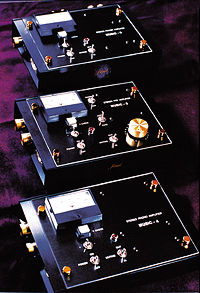
All three Final Music products, which have been on the market in Japan since the late 1990s, are built into small, flat boxes measuring only 6" by 9" by 2", or roughly the size of a hardcover book. Their outboard power supplies are a far sight bigger, but since these are nothing more nor less than battery boxes—albeit stylish and nicely made battery boxes, with fancy umbilicals and sturdy Cannon XLR plugs—they can be tucked out of sight without having to fret over cooling, isolation, or other tweaky concerns. The three Music models also share a common look: contemporary and clean, but with a neat retro touch thanks to their built-in voltmeters, which are needed to keep an eye on battery condition. The chassis are made from black-anodized aluminum alloy and clear acrylic, with nicely knurled brass knobs and matching gold-plated screw caps. The Finals have a chunky, substantial feel, and that—in concert with the fact that they're neither bigger nor smaller than they ought to be—endeared them to me from the first.
And there isn't a tube in sight: The Finals use solid-state devices—specifically, op-amps. That fact alone will rustle some petticoats. The Music-4 phono preamp, which Mikey Fremer wrote about in the January 2002 issue, operates off a total of 28 C cells, arranged in two series-connected banks of 14 each, one bank acting as negative, the other as positive. (Assuming 1.5V per battery, that works out to ±21V per supply.) The importer estimates that, on average, a fresh set of cheapo (manganese) batteries will provide up to six months of use with a Music-4 before needing to be replaced. Importer and manufacturer alike advise against rechargeable batteries, saying they make for lousy sound. The actual amplifying is done by a pair of LF356 J-FET op-amps, a fairly ancient design as these things go; the inevitable voltage supply drift is addressed by a pair of similarly ubiquitous LM305H voltage regulators. The only other active devices in the Music-4 phono preamp are two discrete transistors, but I couldn't figure out what their purpose might be. (Emitter followers? Dunno.) Beyond that, it's just resistors and capacitors, friends, the latter noteworthy only because the slew-conscious folks at Final eschew the use of anything over 0.2µF.
But in between is where the challenge lies, if only because amplifiers really aren't amplifiers at all: They're re-creators. Electricity isn't just their fuel, it's their raw material as well, and rather than make the music on our records louder—which is how the first record players did it—modern amps merely use that information as a serving suggestion, or a blueprint or die (think: Play-Doh Fun Factory). I'm not saying there's anything wrong with all that. But if there is, it's because the electricity supplied to our amplifiers is far from ideal: It's choppy, inconsistent, and shot through with things we don't want. There are smuts in Tom Kitten's pudding, try though he may to pretend they are currants. You could make a better power supply for your amp, to try to smooth out the dough and remove the smuts, but your results will depend on how you define "better." And while some manufacturers have discovered the virtues of minimalist, holistic design, I've seen and heard a great many more amps whose power supplies were designed the way teenage boys approach the subject of automotive performance, which is to say, stupidly. Notwithstanding certain isolated gains in noise reduction, overbuilding a power supply is like bombing for peace: It's inefficient, at least partly counterproductive, and, once you've started, difficult to stop. Why not scrap the household current altogether and use something else—like batteries? All three Final Music products, which have been on the market in Japan since the late 1990s, are built into small, flat boxes measuring only 6" by 9" by 2", or roughly the size of a hardcover book. Their outboard power supplies are a far sight bigger, but since these are nothing more nor less than battery boxes—albeit stylish and nicely made battery boxes, with fancy umbilicals and sturdy Cannon XLR plugs—they can be tucked out of sight without having to fret over cooling, isolation, or other tweaky concerns. The three Music models also share a common look: contemporary and clean, but with a neat retro touch thanks to their built-in voltmeters, which are needed to keep an eye on battery condition. The chassis are made from black-anodized aluminum alloy and clear acrylic, with nicely knurled brass knobs and matching gold-plated screw caps. The Finals have a chunky, substantial feel, and that—in concert with the fact that they're neither bigger nor smaller than they ought to be—endeared them to me from the first.