On a number of occasions we have commented on the effects of an amplifier's output impedance on a system's performance. A high output impedance—such as is found in many tube amplifiers—will interact with the loudspeaker's impedance in a way which directly affects the combination's frequency response. The Cary CAD-805, for example, has a lower output impedance than most tube amplifiers, and should be less prone to such interaction. Some months back—before the CAD-805 arrived—I investigated this phenomenon in conjunction with measurements for a forthcoming review of the Melos 400 monoblock amplifier. Since the Melos 400 also had a relatively low output impedance for a tube amplifier (at 0.43 ohms at low and mid frequencies, rising to 1.2 ohms at 20kHz, from its 8 ohm tap), I took that opportunity to run some frequency-response measurements using an actual loudspeaker as the load for the amplifier. Figs.1-3 show the results, all measured at the loudspeaker's input terminals. All of the loudspeakers were connected with an 8' run of Symo cable; shorter lengths of ordinary cable didn't significantly change the results. A very low power output—about 10mW—was used to prevent possible damage to the loudspeakers, especially at high frequencies. I tested three popular audiophile loudspeakers: the Vandersteen 2Ce, the Spica Angelus, and the Martin-Logan Aerius. Fig.1 shows the response of the Melos 400 when driving the Aerius from its 1, 2, 4, and 8 ohm taps, respectively. There are no significant differences below 10kHz (note the ±5dB scale on figs.1-4). Figs.2-4 show the results of four different amplifiers driving each of the loudspeakers—one at a time, of course. Note that the two solid-state amplifiers—the Hafler 9500 and the Aragon 4004 Mk.II—produce the flattest responses. The Melos is also respectably flat (taken from the 4 ohm tap for all of these curves). Note, however, the results with the Sonic Frontiers SFS-80, an amplifier with a high (above 3 ohms) output impedance. As expected, this high output impedance results in clear deviations in the frequency response into real loudspeaker loads. This is not to say that the Sonic Frontiers cannot provide excellent performance, but any amplifier with a high output impedance will be prone to this matching sensitivity.
 Fig.1 Melos 400, frequency response at 10mW into Martin-Logan Aerius from (from top to bottom at 20kHz): 1 ohm tap, 2 ohm tap, 4 ohm tap, and 8 ohm tap (1dB/vertical div.).
  Fig.2 Vandersteen 2Ce, frequency response at 10mW at speaker terminals driven by (from top to bottom at 20kHz): Hafler 9500, Aragon 4004 Mk.II, Melos 400 (4 ohm tap), and Sonic Frontiers SFS-80 amplifiers (1dB/vertical div.).
  Fig.3 Spica Angelus, frequency response at 10mW at speaker terminals driven by (from top to bottom at 20kHz): Hafler 9500, Aragon 4004 Mk.II, Melos 400 (4 ohm tap), and Sonic Frontiers SFS-80 amplifiers (1dB/vertical div.).
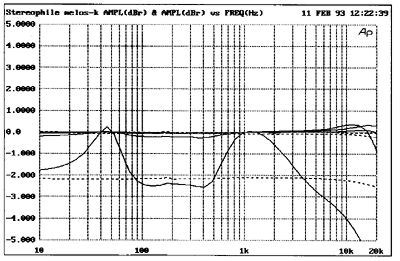 Fig.4 Martin-Logan Aerius, frequency response at 10mW at speaker terminals driven by (from top to bottom at 20kHz): Hafler 9500, Aragon 4004 Mk.II, Melos 400 (4 ohm tap), and Sonic Frontiers SFS-80 amplifiers (1dB/vertical div.). Figs.5-7 show the measured impedances of the 2Ce, Angelus, and Aerius. Note that the Sonic Frontiers' frequency-response deviations when driving these loudspeakers show the same general trends as the impedance magnitudes of each respective loudspeaker. That is, the peaks and dips in the responses correspond closely to the peaks and dips in the impedance plots. The impedance plot therefore gives a general indication as to just how a given loudspeaker's response will change when used with an amplifier having a high output impedance.—Thomas J. Norton
  Fig.5 Vandersteen 2Ce, electrical impedance (solid) and phase (dashed) (2 ohms/vertical div.).
  Fig.6 Spica Angelus, electrical impedance (solid) and phase (dashed) (2 ohms/vertical div.).
 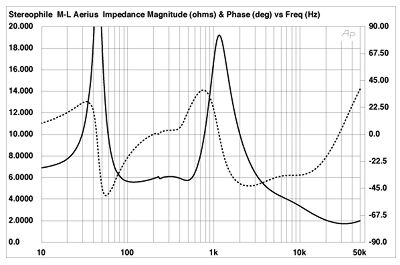 Fig.7 Martin-Logan Aerius, electrical impedance (solid) and phase (dashed) (2 ohms/vertical div.).
Fig.1 Melos 400, frequency response at 10mW into Martin-Logan Aerius from (from top to bottom at 20kHz): 1 ohm tap, 2 ohm tap, 4 ohm tap, and 8 ohm tap (1dB/vertical div.). Fig.2 Vandersteen 2Ce, frequency response at 10mW at speaker terminals driven by (from top to bottom at 20kHz): Hafler 9500, Aragon 4004 Mk.II, Melos 400 (4 ohm tap), and Sonic Frontiers SFS-80 amplifiers (1dB/vertical div.). Fig.3 Spica Angelus, frequency response at 10mW at speaker terminals driven by (from top to bottom at 20kHz): Hafler 9500, Aragon 4004 Mk.II, Melos 400 (4 ohm tap), and Sonic Frontiers SFS-80 amplifiers (1dB/vertical div.). Fig.4 Martin-Logan Aerius, frequency response at 10mW at speaker terminals driven by (from top to bottom at 20kHz): Hafler 9500, Aragon 4004 Mk.II, Melos 400 (4 ohm tap), and Sonic Frontiers SFS-80 amplifiers (1dB/vertical div.). Figs.5-7 show the measured impedances of the 2Ce, Angelus, and Aerius. Note that the Sonic Frontiers' frequency-response deviations when driving these loudspeakers show the same general trends as the impedance magnitudes of each respective loudspeaker. That is, the peaks and dips in the responses correspond closely to the peaks and dips in the impedance plots. The impedance plot therefore gives a general indication as to just how a given loudspeaker's response will change when used with an amplifier having a high output impedance.—Thomas J. Norton Fig.5 Vandersteen 2Ce, electrical impedance (solid) and phase (dashed) (2 ohms/vertical div.). Fig.6 Spica Angelus, electrical impedance (solid) and phase (dashed) (2 ohms/vertical div.). Fig.7 Martin-Logan Aerius, electrical impedance (solid) and phase (dashed) (2 ohms/vertical div.).