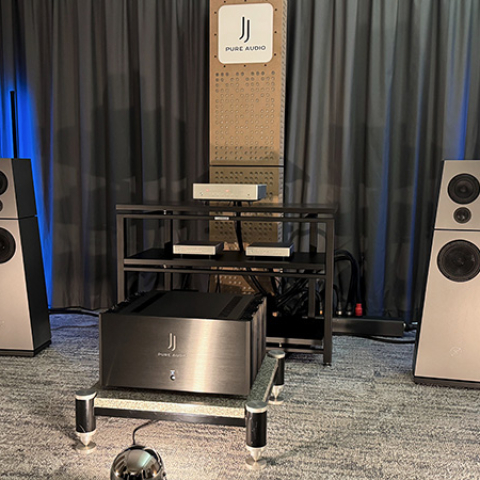
A thorough exploration in a magazine article of such a pervasive and complex topic as vibration control in audio systems is next to impossible; vibration and sound are so intimately bonded that it would be very easy to extend this discussion to just about any area of interest in audio. My intention here is simply to lay a foundation for understanding the basic mechanical forces affecting our quest for improved sonic fidelity, and in the process provide the tools for anyone to achieve good, practical vibration control in his or her system. The plethora of vibration-control products on the market, ranging from the highly effective to some bordering on voodoo, is testament not only to the significant impact "bad vibes" have on our sound systems, but also to the importance of educating ourselves. An informed consumer can make a genuine contribution in the fight against mechanical resonances, while saving time and money over the long term. Knowledge can also help one avoid falling prey to the "tweak-of-the-month" mentality characterized by mistaking tonal manipulation for improved resolution. Room acoustics, an obvious extension of this issue, will not be covered here. I have, however, examined two products in a related review: the Vibraplane distributed by Sounds of Silence, and Townshend Audio's Seismic Sink. Both use air as the isolation element in a pneumatic suspension, and represent what I believe to be a superior method for minimizing the impact of external vibrations on sound quality. Before we jump directly to the vibration issue, I'd like to take a brief look at a few reasons why an in-depth discussion of this issue is timely and worthwhile.
Shakin' All Over
Wrestling with vibration has been a cornerstone of our hobby for years. Its obvious impact on transducing components like turntables and speakers evolved into a recognition of the need to address both gross and subtle resonances throughout a stereo system. Many of the techniques and tweaks employed to meet this demand were spawned through trial and error. Some are very effective when properly applied, and are supported by sound, logical theories. Certain other products can work quite well when used appropriately, despite being accompanied by "white papers" or explanations for their effects that are at odds with both common sense and the laws of physics. The audiophile, left adrift on a sea of half-truths dressed in plausible, appealing concepts, can easily stray off course to land in the limbo of compulsive tweaking---boosting a midrange detail here or bass focus there---while often missing the opportunity for more substantial progress. Such experiences can lead to disillusionment; those so affected may then lump the more effective anti-vibe products or methods (and possibly other high-end pursuits) together with the dubious, and toss the baby out with the bath water. If nothing else, I hope that this article will provide a road map around the hype so that consumers will be more confident in their own decisions when developing strategies best suited for their own systems and budgets. Something else that has increased interest in vibration is the realization that control of phase distortion---improved time-domain performance---and the need to better understand its relationship to energy storage in the form of electrical or mechanical resonances in components, is necessary to push the edge of the performance envelope.
These investigations have led to a growing awareness of the potential impact of "spectral contamination distortion" (Footnote 1) as an aid in helping us better correlate what we can measure with what we hear. Much study remains to be done before accurate relationships can be drawn between specific spectral contamination measurements and subjective experience, but the possibilities are fascinating. I hope to examine this issue in more detail in a future article.
Footnote 1: Spectral contamination distortion refers to a distortion process present in any real-world system as it processes a complex signal such as music. It occurs as ultrasonic harmonics due to undamped high-frequency resonances stimulating a broad band of low-level, intermodulation distortion byproducts in the presence of a multitone signal. Originating influences can range from a 50kHz cartridge resonance or the effects of RFI/EMI to a wide range of digital artifacts. This mechanism may be partly responsible for midrange and treble glare and harshness heard in components that otherwise measure well with traditional techniques. Peter W. Mitchell discussed this topic in his "Ground Floor" article in the December 1994 Stereophile, pp.102-103. Interested readers will also find an excellent article in "Spectral Contamination Measurement," by Gary Sokolich and the late Deane Jensen, pre-print #2725, the 85th AES convention, 1988.
Wrestling with vibration has been a cornerstone of our hobby for years. Its obvious impact on transducing components like turntables and speakers evolved into a recognition of the need to address both gross and subtle resonances throughout a stereo system. Many of the techniques and tweaks employed to meet this demand were spawned through trial and error. Some are very effective when properly applied, and are supported by sound, logical theories. Certain other products can work quite well when used appropriately, despite being accompanied by "white papers" or explanations for their effects that are at odds with both common sense and the laws of physics. The audiophile, left adrift on a sea of half-truths dressed in plausible, appealing concepts, can easily stray off course to land in the limbo of compulsive tweaking---boosting a midrange detail here or bass focus there---while often missing the opportunity for more substantial progress. Such experiences can lead to disillusionment; those so affected may then lump the more effective anti-vibe products or methods (and possibly other high-end pursuits) together with the dubious, and toss the baby out with the bath water. If nothing else, I hope that this article will provide a road map around the hype so that consumers will be more confident in their own decisions when developing strategies best suited for their own systems and budgets. Something else that has increased interest in vibration is the realization that control of phase distortion---improved time-domain performance---and the need to better understand its relationship to energy storage in the form of electrical or mechanical resonances in components, is necessary to push the edge of the performance envelope.
Footnote 1: Spectral contamination distortion refers to a distortion process present in any real-world system as it processes a complex signal such as music. It occurs as ultrasonic harmonics due to undamped high-frequency resonances stimulating a broad band of low-level, intermodulation distortion byproducts in the presence of a multitone signal. Originating influences can range from a 50kHz cartridge resonance or the effects of RFI/EMI to a wide range of digital artifacts. This mechanism may be partly responsible for midrange and treble glare and harshness heard in components that otherwise measure well with traditional techniques. Peter W. Mitchell discussed this topic in his "Ground Floor" article in the December 1994 Stereophile, pp.102-103. Interested readers will also find an excellent article in "Spectral Contamination Measurement," by Gary Sokolich and the late Deane Jensen, pre-print #2725, the 85th AES convention, 1988.