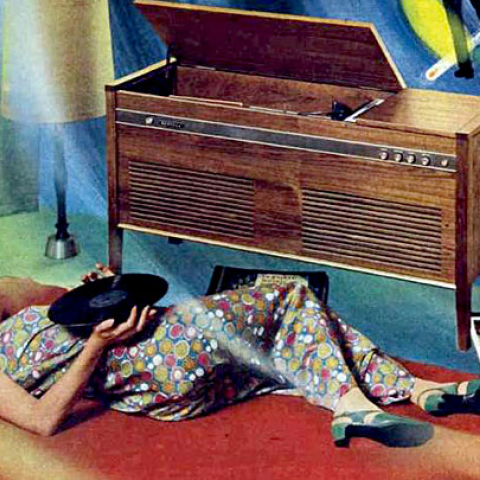
While the LP-vs-CD debate continues unabated among high-end audiophiles, the rest of the world has already closed the book on the venerable LP. All but a few specialized classical record companies (footnote 1)(and some weird magazines) have ceased releasing new LPs, few record stores sell them any more, and consumers who wouldn't be caught dead owning something that wasn't trendy have long ago dumped their LP collections for cents on the pound. Apart from considerations of sound quality, a major reason audio perfectionists have resisted the blandishments of CD is because its hardware is too cut-and-dried. Unless you have the scratch to try mixing-and-matching different decks with different D/A converters, what you buy is what you get. With a CD player, there's nothing to adjust, nothing to tweak for a small improvement here and there (footnote 2). But an analog record player is a tweaker's delight. More than any other system component, the record player's performance depends on how carefully it is set up and optimized for the characteristics of its three basic parts. The initial installation is relatively quick and easy, but the sound of such a player is likely to be raw and unappealing, like that of any preassembled phono unit you might purchase from your friendly dealer. But for the serious tweaker, the three assembled pieces are only the starting point. It may take months of adjusting this and trying that before a record player finally sounds the way he or she wants it to, but when it does, it's not only because of the time invested that he or she develops deep feelings of pride about its performance; it's also because its sound is an expression of his (footnote 3) creative self, like a work of art. He took the raw materials and shaped from them a device capable of producing sounds of true musicality, and if that isn't an act of artistic creation, then what is?
If you're one of those analog stalwarts who have decided not to turn your back on the LP's 42-year musical heritage, you've probably been thinking about buying your ultimate record player. If you haven't, you should be, because time is running out. Mid-fi record players have virtually disappeared from dealer showrooms, and high-end phono equipment is becoming increasingly scarce and more expensive. If you wait a year, your choices may diminish to the point where you have practically no choice at all, and will have to buy what's available rather than what best suits your needs. Your next record player will almost certainly be your last—the one you will have to live with for the rest of your life (or that of your LPs, whichever comes first)—but there are compelling reasons why it should also be your best. For instance, you may not realize that the life expectancy of your record collection depends a lot on how good your record player sounds. This is because most LP reproduction problems result from conflicts between what the vinyl grooves are trying to make the stylus do, and what the stylus is inclined to do. In any such confrontation, one must yield to the other, and it is usually the vinyl that yields. The result is a permanent indentation in the groove wall—one that becomes deeper each time the disc is replayed. Even such a seemingly benign flaw as a small resonant peak in the cartridge will damage grooves, because some of that stored energy gets dumped back into the groove wall as additional contact-pressure impulses. The peak becomes, literally, engraved in vinyl.
Buying the ultimate phono unit not only assures you the best sound you're ever going to get from your LPs, it also confers upon them the longest possible life. $20,000 may seem like a maniacal amount of money to spend on a phono unit, but for someone who has invested 30 years and almost $30,000 in irreplaceable and often beloved LPs (that's about 3000 records), it may well be a very wise investment. The ideal record player
I won't reiterate here what has been stated many times in these pages about the ideal record player, but will list instead (in order of importance) the things I believe it should embody. First, minimal tonearm friction. Because a cartridge's optimal contact force against each groove wall (assuming an elliptical stylus profile) is on the order of 3/4 of a gram, plus or minus about 0.1gm, it is essential that the arm bearings have the lowest possible friction. Air bearings are the best in this respect.
Footnote 1: And, it should be noted, many nonclassical record companies.—JAFootnote 2: This isn't quite true. Some inexpensive modifications (like edge-greening and Armor All cleaning) do seem to make a difference, although no one knows why they should. That doesn't mean they won't continue guessing.Footnote 3: From this moment on, gentle readers, take it that "he" refers to both sexes.—JA
I won't reiterate here what has been stated many times in these pages about the ideal record player, but will list instead (in order of importance) the things I believe it should embody. First, minimal tonearm friction. Because a cartridge's optimal contact force against each groove wall (assuming an elliptical stylus profile) is on the order of 3/4 of a gram, plus or minus about 0.1gm, it is essential that the arm bearings have the lowest possible friction. Air bearings are the best in this respect.
Footnote 1: And, it should be noted, many nonclassical record companies.—JAFootnote 2: This isn't quite true. Some inexpensive modifications (like edge-greening and Armor All cleaning) do seem to make a difference, although no one knows why they should. That doesn't mean they won't continue guessing.Footnote 3: From this moment on, gentle readers, take it that "he" refers to both sexes.—JA