|
Recent Additions
Budget Components Audacious Audio
Loudspeakers
Amplification
Digital Sources
Analog Sources
Accessories Listening / Art Dudley The Fifth Element / John Marks Music in the Round / Kal Rubinson Fine Tunes / Jonathan Scull Special Features Reference Interviews Think Pieces Historical Recording of the Month Records 2 Die 4 Music/Recordings Stephen Mejias Robert Baird Fred Kaplan Wes Phillips Audio News Past eNewsletters RMAF 2008 FSI 2008 CES 2008 RMAF 2007 CEDIA 2007 HE 2007 FSI 2007 CES 2007 China 2006 RMAF 2006 HFN 2006 CEDIA 2006 HE 2006 FSI 2006 CES 2006 Forums Galleries Vote Previous Votes Dealer Locator AV Links Audiophile Societies Contact Us Customer Service New Subscription Digital Subscription Renew Give a Gift Sub Services Recordings Backissues More . . . Phono Preamp Hi-Fi Phono Cartridge Amplifiers Stereo Speakers |
Getting the Best from Your Loudspeakers
Because loudspeakers interact with the acoustics of the room in which they are used, optimizing their positions within that room pays major dividends. Inexpensive speakers, optimally set up, may well outperform more expensive models just plonked down willy-nilly.
Note that I make no distinction between floorstanding "tower" speakers and so-called "bookshelf" designsthe worst place to put a bookshelf speaker is on a bookshelf. With very few exceptions, all loudspeakers work best out in the room, away from room boundaries. The only real difference between tower and bookshelf models is that the latter need to be placed on stands, though that does give you some extra flexibility when it comes to optimizing placement. Also note that in this article I have completely ignored the issue of domestic compatibility and blissif the optimal speaker positions conflict with the need for a harmonious relationship with your partner, I must leave that sort of resolution to you.
Triangles and Phase
Tracks 1 and 2 of Editor's Choice allow you to check that everything is hunky-dory in these respects, just by listening from your centrally placed chair. Using track 1 is self-explanatory: the sound of my Fender bass guitar should come from first the left channel, then the right. If this doesn't happen, the solution is obvious. Using track 2 is a little more subtle: The first selection in track 2 was recorded out of phase. The image of the out-of-phase bass guitar should not be centered; in fact, it should generally be diffuse and vague, and it should be hard for you to point to where it's coming from, coupled perhaps with a "buzzing" sensation. In addition, the instrument should sound thin in the bass compared with how it sounded in track 1. The second selection in track 2 was recorded with the bass guitar in phase. You should now hear the image of the instrument occupying a very narrow space centered between the speakers, and the bass frequencies should sound full. If you don't hear these clear distinctions between the in- and out-of-phase selections, or if the distinctions are consistently the opposite of what I've just described for each track, then one of the speakers has its connections reversedthe two speakers are out of phase. Invert the connection to one of your speakers and listen to track 2 again. Now you should clearly hear the difference between 1) the out-of-phase bass guitar and 2) the in-phase bass guitar.
Reflections and the Golden Ratio
Placing a speaker next to a surfaceon the floor, or on a bookshelf next to a wallboosts the bass at the expense of the lower midrange. Placing it next to two surfaceson the floor next to a wall, or on a shelf in a cornerraises the bass level yet again, while the maximum bass boost is obtained by placing the speaker next to three surfaces; ie, in a corner. What you need to arrange, therefore, is that the interactions between the sound coming from the woofer and its reflection from each boundary, which is what cause these boosts and dips in the response, occur at different frequencies. That way, they will be spread out across the bass region, with the maximum evenness. By contrast, the worst placement is when the woofer is the same distance from the floor, the sidewall, and the wall behind the speaker. The boosts and dips will then occur at the same frequency, and reinforce each other to give a lumpy, ill-defined low-frequency balance. You don't need to listen yet. To get the largest differences between the distances of the woofer from the floor and walls, you can use the Golden Ratio, which is approximately 1.618:1. Measure the distance from the center of the woofer to the floor. Let's say it's 20". Multiplying that distance by the Golden Ratio gives a distance of 32"; multiplying that distance again by the Golden Ratio gives a distance of 52". So if you move each speaker to make the distance between its woofer and the sidewall 32", and that between the woofer and the wall behind the speaker 52" (or vice versa, doing the same for both speakers to keep the distances to the listening chair the same), you will, in theory at least, end up with the smoothest low-frequency performance.
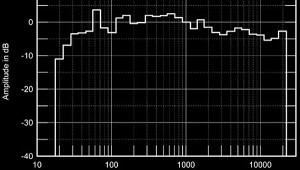
Track 21 of Editor's Choice comprises a descending series of warble tones, each 1/3-octave wide and with center frequencies of first 200Hz, then 160, 125, 100, 80, 63, 50, 40, 31.5, 25, and 20Hz. The 200100Hz bands can be considered the upper bass, 8040Hz the midbass, and the remaining bands the low bass. If these bass warbles sound uneven, with some either sticking out more than others or missing in action, then try moving each of the speakers or your listening chair, perhaps by as little as 2" at a time. The object is to get the tones to sound as even as possible. These tones can also give you an idea of your loudspeakers' subjective bass extension, either by listening to them or by using one of the inexpensive sound-level meters from RadioShack. Set a reference playback level with the 1kHz tone (track 20), then note either when you can't hear the warble tone anymore, or by how much the sound level drops with each successive tone.
Tone Bursts and Stethoscopes
With small speakers, it's possible that you won't hear the lowest notes. Otherwise, the scale should sound even, without some notes sounding louder or softer than others. If you do hear something wrong, note where it stands in relation to the marker Cs mentioned above in the other channel. You'll then have a rough idea of the frequency range affected, and whether it's due to a room resonance (primarily 30300Hz) or a speaker-cabinet resonance (100500Hz). Your initial setup should already have optimized the interaction between the speakers and the room acoustics, but in the case of vibrational resonances in the speaker cabinets, you can zero in on these by playing track 19 and listening to the cabinet walls with a stethoscope (about $20 from any pharmacy). You'll hear a cabinet resonance as an accentuation of the note. If the resonance is particularly severe when you pause the CD player while the affected note is playing, you might even hear it ringing on its own as a kind of echo. If your speakers do have some resonant problems, there are a number of things you can do. If you have bookshelf speakers sitting on stands, sitting the speakers on small pads of Blu-Tack (the tacky material used to stick pictures to walls) works well to damp the speaker cabinets' resonant vibrations. If the cabinets have resonances that don't lie at the frequencies of musical notes, it's possible that they'll have less of a deleterious effect on music. You can adjust the frequency of the resonance by putting a plastic ziplock bag packed with dry sand atop each speaker. This won't look very elegant, but see my note above about domestic harmony. If the speakers or stands are just sitting on the rug, try using carpet-piercing spikes to couple them more securely to the floor beneath. This narrows the frequency range affected by the resonance, which again will make it less likely to be fully excited by conventional music. (If you don't want your floorboards pierced by spikes, place a penny coin under each spike.)
Pink Noise and Stereo Imaging
Track 18 of Editor's Choice consists of what's called pink noise: random noise with equal energy per musical octave, recorded in dual-mono (the left and right channels are fed identical signals), Pink noise ideally sounds like absolutely smooth rushing water, with no band of frequencies sticking out any more than any other. It should not sound hollow or colored in any way, and neither its level nor its tonal character should noticeably change from speaker to speaker. The image of the noise should appear to come from a narrow point midway between the speakers. If the sound "splashes" to the sides at some frequencies, or if the image is broadened at all frequencies, then there is something suspect in your system. If the sound of track 18 fails to meet these criteria, then try sitting higher or lower, closer or farther away, or moving nearby furniture. If there's a coffee table between you and the speakers, for example, the reflections of the sound from its surface will interfere both with the smoothness of the pink noise and the stability of the stereo imaging. Get rid of itremembering my note about domestic harmony, of course. Try experimenting with the degree of speaker toe-in. So far, the speakers have been aimed directly at your listening position. Now try aiming them straight ahead, so you can see the inside side panel of each. Then try aiming them so that their axes cross in front of you. As Stereophile Editor-at-Large Art Dudley wrote in the 2007 Stereophile Buyer's Guide, "In a general sense, aiming your speakers directly at a central listening seat will provide the greatest perceived brightnessfrom which some designs will surely benefit. Quite often, you may find that a gentle degree of toe-in gives a good compromise between realistic high-frequency extension and the kind of spatial performance on stereo recordings that provides both good 'stage' size and image localization." Finally, if all setup has been done with the speakers' grilles in place, try removing them. Them get yourself a glass of your favorite tipple, select one of your favorite recordings, settle back in your chair, and allow the sound of your system to transport you to that special place. Happy Listening!
Article Continues: Further Reading »
|
|
||||||||||||||||||||||||||||||||


Over the years, I have developed a library of test signals that make it easier to set up speakers by ear. I made this suite of signals available on my
Next, you need to make sure that the speakers are wired correctly to your amplifier or receiver, with the left speaker receiving the left signal and the right speaker the right signal. In addition, the red (positive) terminal of your amplifier needs to be connected to the red (positive) terminal of the speaker; likewise for the black (negative) terminals. (It's easy to make a mistake.) When the wires are connected correctly, the speakers are "in phase," which means that the drive-unit diaphragms move in the same direction when fed the same signal. When one speaker is incorrectly wiredred to black instead of red to redthey are "out of phase"; ie, one is pushing while the other pulls.
This, however, will be for a perfect speaker; you can now try some slight adjustments to optimize the placement of your specific speakers.