| Columns Retired Columns & Blogs |

Alastair Robertson-Aikman (1924–2006)
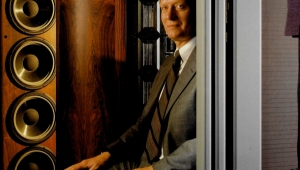
One cliché that never loses its aptness is "end of an era." And it certainly applies to the passing on October 29 of SME’s founder, Alastair Robertson-Aikman. While there remain a handful of survivors from the original "golden age" of audio, few of them were still active in 2006. AR-A, as he was known to friends and staff, wasn’t simply still active: he was still tweaking his sound system and planning new products.
His achievements span nearly the last half-century, his seminal Model 3009 tonearm first making its appearance in 1959. It would stay in production into the 21st century, selling over a million units in its Mk.1 and Mk.2 forms, in both 9" and 12" versions. It became an industry standard, even appearing this year in the sleeve art on a European techno CD.
SME itself pre-dated the arm, AR-A’s original interests centering around model railways and model cars. The Scale Model Equipment Company Ltd. opened its doors in December 1946; sadly, AR-A just missed its 60th anniversary.
An opera lover, Alastair naturally gravitated toward audio in its early days, while his lifelong love for engineering and "work beautifully executed" led him toward a tonearm design for his personal use. In the then-more-closely-knit audio community of England in the late 1950s, word soon spread and, by 1961, the arm was on the market—an immediate hit.
Alastair never strayed far from tonearm manufacture, abandoning a brief flirtation with a digital product, while reaffirming his passion for the LP by introducing his first turntable, the Model 30, in 1991. Although he never confirmed it, one suspects, given his passion for detail, that the model number referred to the span between the commercial launch of the 3009 arm and the arrival of the first record deck.
SME, meanwhile, established itself in other fields, numbering among its clients the medical, military and automotive industries. Its obsession with quality engineering remains undimmed, and the factory was expanded into a second premises in Steyning, Sussex, last year.
In 2006, SME launched a new version of the SME 20, able to carry a 12" arm. Other products were being developed when Alastair finally succumbed to the ailments of age. He never let infirmities get in the way of hi-fi, and I will never forget seeing him a few months ago, on his knees, hunched over a cartridge he was aligning.
Even infirmities inspired him. He found it hilarious that an urban myth formed around his hip replacement; word on the street said that SME made the metal ball joint. His son, Cameron, confirmed that it was only partially a myth: when AR-A learned that he would have the operation, he found out the name of the manufacturer, called the company, and specified the grades of materials to be used.
Even toward the end of his life, Alastair never relented in his quest for perfect sound reproduction. I was among those privileged to visit him regularly, to sit with him in the SME music room, while he tolerated my low-brow tastes and suffered through the playback of some rather unusual discs. Our friendship was sealed when he asked me to find him a copy of an out-of-print Billy Cotton LP, and he was staggered by a Classic Records Miles Davis reissue. And he won't mind my revealing that he also had a soft spot for the singing of Shirley Bassey.
I only wish that more music lovers and vinyl addicts of the current generation could have met Alastair. For this listener, he set the standard, with his modified Quads, perfectly maintained Krell class-A amplifiers, Audio Research tube preamps, and—at the end—a ClearAudio Goldfinger cartridge. But more than that, I will miss a man whose intellect, clarity, generosity, dry humor and, yes, utter precision in the way he dealt with every aspect of life leaves the rest of us wanting.
Stereophile would like to extend its deepest sympathy to the Robertson-Aikman family and the loyal employees of SME.
- Log in or register to post comments












| Loudspeakers Amplification Digital Sources |  |
Analog Sources Accessories Featured | |
Music Columns Retired Columns | |
Show Reports | |
Features Latest News Community | |
Resources Subscriptions |
 © 2024 Stereophile
AVTech Media Americas Inc., USA
All rights reserved