| Columns Retired Columns & Blogs |

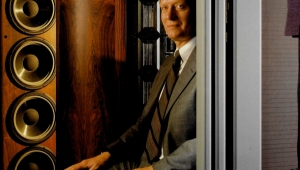
Irving M. Fried: 1920–2005
Just look at the dates and you'll see a legacy that essentially spans the entire history of electrical music reproduction. That's fitting. In his career—or more properly, many careers—Irving M. ("Bud") Fried all but embodied that era.
Fried, the legend goes, fell in love with reproduced music when he heard Stokowski leading the Philadelphia Orchestra over the big corner horn speakers in his father's movie theater in 1928 ("the year that the movies learned to speak"). The importance of music reproduction to Fried was made paramount during his service in WWII, where he encountered fellow music lovers listening to Mozart in the South Pacific and Armed Forces transcription discs of Koussevitsky, Toscanini, and Stokowski in Morocco.
In 1957, Victor Brociner, co-founder of Fisher Radio, suggested that Fried become the official importer of the Lowther corner horns. In 1958, he began importing the newly introduced Quad electrostatic loudspeaker.
At Saul Marantz's suggestion, Fried registered the IMF brand in 1961 and, over the years, many influential and revolutionary products were imported by the company, including London and Goldring cartridges; SME, Gould, and Design cartridges; Quad and Custom Series amplifiers; and Lowther, Quad, Celestion, Bowers and Wilkins, and Barker loudspeakers, among others.
His eye (or perhaps we should say, ear) for a classic audio product would have established Fried's name among audio luminaries, but it was his advocacy of the series-crossover and transmission-line loudspeaker that truly marked him as legendary. In 1968, Fried established a British branch of IMF, and that Anglo-American partnership released the now classic IMF Monitor, a transmission-line design that was a direct evolution of the pioneering work of Stromberg Carlson in the 1930s and A. R. Bailey in the mid-'60s. The Monitor was an immediate hit, and many are still being used today.
In 1975, the English and American divisions of IMF parted ways and Fried released speakers using the name "Fried." Among the speaker innovations under his name were the Model H system, said to be the first modern satellite/subwoofer system; the Model M, the first satellite/transmission-line subwoofer contained in a single unit; and the Super Monitor update of the IMF original.
In 2004, Fried Products announced new loudspeakers based on "the culmination of everything that Fried learned in over 30 years of loudspeaker production and development." Reports from audio shows were positive.
Fried was an active, frequently contentious audio commentator. He wrote for a variety of publications, including Stereophile, and he was quite free with his opinions on audio forums and at hi-fi shows. He certainly wasn't wishy-washy and was not shy about alerting his auditors to his true opinion—on anything. Whether this was a feature or a bug probably depended on whether or not his pointed criticisms were pointed at you, as many of the writers at Stereophile can attest first-hand.
Ultimately, that's the real measure of the man. Whether or not anyone else agreed with him, Bud Fried was convinced that he always proceeded from a position "based on the inexorable laws of physics." He didn't care what anyone else thought, and life around him was certainly never boring.
Neither were the audio products he championed. As a result, he has left the audio world a richer place for his part in it—and a poorer one for his passing. It's safe to say we won't see his like again.
- Log in or register to post comments









| Loudspeakers Amplification Digital Sources |  |
Analog Sources Accessories Featured | |
Music Columns Retired Columns | |
Show Reports | |
Features Latest News Community | |
Resources Subscriptions |
 © 2024 Stereophile
AVTech Media Americas Inc., USA
All rights reserved