|
Recent Additions
Budget Components Audacious Audio
Loudspeakers
Amplification
Digital Sources
Analog Sources
Accessories Listening / Art Dudley The Fifth Element / John Marks Music in the Round / Kal Rubinson Fine Tunes / Jonathan Scull Special Features Reference Interviews Think Pieces Historical Recording of the Month Records 2 Die 4 Music/Recordings Stephen Mejias Robert Baird Fred Kaplan Wes Phillips Audio News Past eNewsletters RMAF 2008 FSI 2008 CES 2008 RMAF 2007 CEDIA 2007 HE 2007 FSI 2007 CES 2007 China 2006 RMAF 2006 HFN 2006 CEDIA 2006 HE 2006 FSI 2006 CES 2006 Forums Galleries Vote Previous Votes Dealer Locator AV Links Audiophile Societies Contact Us Customer Service New Subscription Digital Subscription Renew Give a Gift Sub Services Recordings Backissues More . . . Phono Preamp Hi-Fi Phono Cartridge Amplifiers Stereo Speakers |
Slim Devices Transporter network music player
Is a high-end music server the audio equivalent of polishing a turd? I've been hearing this put-down since I first became an advocate for digitally stored audio almost five years ago. At first, the argument was that computers had no place in a listening room. Wireless music servers took care of that argument. Then the bigand validconcern was lossy-compressed formats, but ever-cheaper digital storage made uncompressed and losslessly compressed storage a slam dunk.
Well, said the still-unconverted, you can't argue that high-end DACs don't perform better than the cents-per-thousand mass-market chips included in players and server stations. A good point, but one quickly overcome by companies like Sonos and Slim Devices, who added digital outputs to their offerings. But when I'd mention how good my combo of Slim Devices Squeezebox and Musical Fidelity X-DACV3 sounded playing my Apple Lossless Compression (ALC) files, several of my audiopals would still demure. "Surely you're not suggesting that a $300 front-end can sound as good as your Ayre C-5xe universal player?" Well, perhaps notbut near enough to clearly be high-end, and more than enough to offer hours of listening pleasure. I must not have been the only one hearing such comments, because Slim Devices has now conjured up the Transporter, which it bills as "streaming digital music with sound quality that surpasses even the most exotic compact disc players." Everything about the Transporter has been designed to pacify audiophiles, from a hard-anodized chassis of "aircraft-grade aluminum" (per Slim Devices) to its backlit remote control to its component parts and, yes, DAC. I guess some folks will still argue that a digital file, no matter how pristinely transferred and handled, is still a turd, but I guess it's all in the ear of the beholder. After all, I have a pair of cufflinks made from coprolite: dinosaur droppings that have, through the ages, become fossilized and quite beautiful, especially when treated as semiprecious stones. In short, you can polish a turd. Properly processed, even the most unpromising material can become a thing of beauty.
The tourist transports his own values
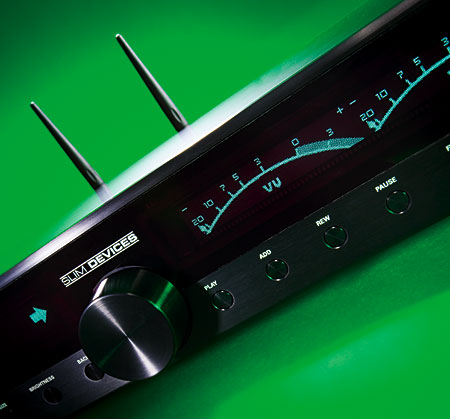
The Transporter's CPU is a 325MIPS, eight-way, multi-threaded device with an 8MB audio buffer and SlimDSP, a software-based digital signal processor (DSP) that resides in flash memory and is loaded into fast static memory "dynamically"; ie, as needed. This isn't conventional DSP of the sort you'd find in an A/V receiver; rather, it's designed to decode compressed files on the fly so it can transmit uncompressed 24-bit PCM over the network's WiFi link. The Transporter has single-ended (RCA) and balanced (XLR) analog outputs, as well as coaxial, TosLink, BNC S/PDIF, and AES/EBU digital outputs. Ethernet and RS-232 inputs are also included. Analog and digital signal paths are kept separate. The balanced output remains consistent, but volume can be controlled through the single-ended outputs using a combination of digital attenuation and a set of resistor jumpers mounted on the circuit board: You set the approximate maximum volume with the jumpers and fine-tune with the digital attenuation. If you don't need to tweak it much with the digital control, you should be able to vary the volume without significant data loss. (Because I was using the Transporter with several high-end preamps, I kept the digital attenuation off during my audition, but it's there if you need it.) One of the slickest features of the Transporter is its huge, two-part display, which is nigh on infinitely configurable. I generally used the left side to monitor whatever data were playing, and dedicated the right side to the nifty faux-analog VU meters to monitor the output. It was cool, if perhaps a little pointless. On the other hand, I had no need to scroll RSS feeds, weather data, sports scores, or other information across the display, so some harmless retro-visuals certainly didn't hurt. Smack dab in the middle of the front panel is a large control knob, the TransNav, which employs dynamic tactile feedback to rapidly scroll through and choose from tons of information, including even the longest playlist. If you don't want to operate the TransNav up close and personal, the remote control offers an equal level of domination, though it lacks the same wow factor.
What hours of transport we shall spend
Also working for Slim Devices is an unusually attentive and thorough customer-service staff. Although I had already downloaded and was running the SlimServer program on my Mac for my SB3, I had a small problem getting the Transporter to shake hands with my WiFi network. Dan of customer service talked me through it with good humor and patience. Late in the review, my Transporter refused to power on when I moved it downstairs for a final once-over. I called the help line again without identifying myself. Dan and I quickly tried a hard-power-on and a software-enabled power-up, and when both proved unsuccessful, he immediately said, "Let's get that bad boy back in here, so you can have it back before next weekend." I was impressed and a little sheepishI'd suddenly recalled an epic cat battle that had sent the Transporter crashing to the floor a few weeks earlier. It worked after that, but I'm betting that something was loosened enough to finally lose contact when I moved the unit downstairs. My bad. Well, Huckleberry's probably, but I'm a bad cat owner for not better securing the Transporter.
Three dollars and it only transports matter?
It's not a matter of audio snobbery, it's merely facing reality: If your digital library isn't hi-rez, you don't need a Transporter. For this reason, I wasn't particularly disturbed that the Transporter couldn't play the few files I've downloaded from Apple's iTunes Music Store. It's true that I couldn't play them because of Apple's use of Digital Rights Management, but their 128kbps quality would have eliminated them even if the crippleware "protection" of DRM hadn't already done so. The same is also true of just about any other DRM'd download I can think ofthe Transporter won't play 'em and I wouldn't have wanted to.
Dreams transport us through the underside of our days
Forgotten, too, were such problems as searching a multiroom, multifloor warren of music rooms for the recording I wanted to play (or refileas if I ever worried too much about that one). If I had the recording on my music library's hard drive, it was only a quick twist of the TransNav (or a few remote button presses away. And because I could search by artist name, album or song title, or genre, I could even find things I only vaguely remembered having, which made for a constant voyage of discovery through my own music collection. I thrilled to the mutual pleasure that the Grateful Dead got out of their 12-zillionth for-the-first-time-ever exploration of "Dark Star," on Hundred Year Hall (CD, Grateful Dead GDCD 40202). I marveled at the fluidity of Glenn Gould's traversals of J.S. Bach's Goldberg Variations (CD, Sony Classical/Legacy S3K 87703) late in the evening. The first thing in the morning, I had my eyes opened by Robert Silverman's incisive account of Beethoven's Diabelli Variations (CD, Stereophile STPH017-2). And yes, beyond the effortless musicality, I was completely satisfied with the Transporter's sound. The bass was taut, the midrange unforced, the top end smooth and extended. The Transporter wasn't simply "good for what it was"; it was good.
Article Continues: Page 2 »
|
|
||||||||||||||||||||||||||||||||||||||||||||||