| Columns Retired Columns & Blogs |

Ayre AX-7 integrated amplifier
Dating was murder, especially in the months just before I met my wife. I knew some nice women back then, many of whom were good-hearted and others of whom were beautiful. One was both, and talented, too: She gave me presents for no reason and wrote tender things in cards with pictures of sweet meadows or the sea: My love goes on and on, they said. But for whatever reason, I just couldn't love her back, and Oh! how the shit hit the fan the day I told her so. I meant it as a respectful act of honesty and forthrightness; she took it as a cowardly act of rejection, and responded in a manner that would forever remind me of Maggie bouncing the rolling pin off Jiggs's head while calling him an insect. That day, I learned two things: 1) women are unlearnable; and, 2) honesty, while an unassailably good thing in and of itself, makes a poor tool, mostly because it lacks a safety handle.
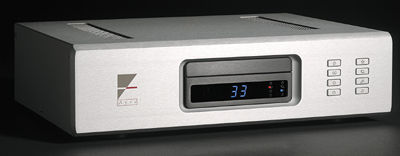
I'm reminded of my sketchy love life when I consider my relationship with the new "affordable" integrated amplifier from Ayre, a product I admired from the start for its superb design, good construction, and even for its impressive sound—yet which required more time and effort than usual before we moved beyond casual friendship. For the longest time, the AX-7 and I simply didn't click.
What's inside?
The AX-7 did some clicking on its own, though, thanks to its offbeat volume control: a longish metal bar fastened to a thin piece of sheet metal inside the front of the amp, itself rigidly fixed to the chassis at midpoint. That point is the fulcrum about which the two ends of the control bar have some degree of movement, and behind those ends are the two FET switches that raise or lower volume through a resistive ladder, chosen for greater clarity and transparency than a traditional volume pot. I don't doubt the audible benefits of that approach—the Ayre AX-7's sonic clarity was never short of stunning—but a noiseless circuit deserves a noiseless control, and a $2950 amp deserves a control with a more elegant feel; I wound up making all my volume adjustments with the amp's remote handset...which also let me mute the amp, switch between different sources, and turn off the lighted display from the comfort of my listening seat.
The line-level AX-7 is fully balanced from start to finish, with two single-ended inputs (RCAs) alongside two balanced ones (XLRs). One very nice touch is that each input is labeled with a unique cosmic pictograph—a crescent moon, a shooting star, and so forth—rather than a dull or dated word. The reasoning: Why saddle a poor, innocent amplifier with the words Compact Disc when we might not even be listening to those things 10 or 15 years from now? A pair of fixed-signal output jacks can be used for a tape deck, although there are no variable-level preamp-out jacks for, say, a subwoofer.
A reason for the absence of preamp-out jacks may be the absence of a preamp: The Ayre integrated is a solid-state power amp mated with passive gain control and source selection. Whether or not that also explains the absence of tone controls (grr), mono switch (grrrr), or a balance control (grrrrrr) is anyone's guess. All remaining signal-switching chores are controlled by a central microprocessor, which comes out of sleep mode in response to user input via the remote handset or the front-panel controls, thus keeping the signal path as clear and clean as technology allows.
The AX-7, which operates without feedback, uses a combination of ICs (for voltage gain) and discrete transistors (for current gain at output), the latter mounted to dual banks of heatsinks. Discrete devices also appear to be used for power-supply regulation just after the transformer's secondaries, and these, like the trannie itself, are mounted directly to the bottom of the chassis. Apart from those and the logic board for digital switching, most other power-supply and amplifying components are mounted to a single, neat circuit board. This class-A/B amp becomes moderately warm to the touch during use, but, as I discovered, a major portion of that comes from the very large frame-type transformer.
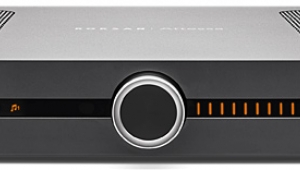
Construction and parts quality are both fine, the latter including a clever one-knob speaker connector from Cardas that seems to have been optimized for spade lugs, although bananas and bare wire can be accommodated, too. The enclosure is made from stainless steel and aluminum alloy, both brushed. I liked the styling, especially the unorthodox and rather adventurous pairing of old-style touches (the screen mesh vents on top) with contemporary design elements (the numeric display for volume settings). As to the latter, it was fun to leave the Ayre turned on at night, its display lit up in the darkened room and the volume turned down to "00." The numbers are big, blue, and italicized, and in the dark the effect was like having a pair of cartoon eyes in the room with me. (Think: Woody Woodpecker.)
A pretty face
For the most part I relied on my usual source components, none of which is balanced, yet all of which I know well: a Sony SCD-777ES SACD/CD player, and a variety of moving-coil cartridges driving a Linn Linto phono preamplifier. I listened to the AX-7 through my Quad ESL-989 loudspeakers, and while I also tried pairing it with my high-efficiency Lowther horns, I came away thinking the experience wasn't terribly germane: The Ayre seems to do its best nearer to redline than to idle, for whatever that's worth. I also tried a fairly wide variety of speaker cables, about which I'll have more to say later.
NEXT: Page 2 »
 | |||||||||||

|
|
| |||||||||
- Log in or register to post comments










| Loudspeakers Amplification Digital Sources | |
Analog Sources Accessories Featured | |
Music Columns Retired Columns | |
Show Reports | |
Features Latest News Community | |
Resources Subscriptions |
 © 2024 Stereophile
AVTech Media Americas Inc., USA
All rights reserved