| Columns Retired Columns & Blogs |

Onkyo A-9555 integrated amplifier
"Onkyo Returns to its Stereo Roots to Debut New Digital Amplifier Technology." This heading of the press release for Onkyo's A-9555 digital integrated amplifier was surely intended to warm the cockles of the two-channel audiophile's heart. Some of us remember the Onkyo Grand Integra amplifiers of the 1980s, which were considered competitive with the big Krells and Mark Levinsons of the day. To refresh my memory, I looked through my Stereophile archives and found the December 1985 issue (Vol.8 No.8), which included Larry Greenhill's review of the Grand Integra M-510, a 300Wpc power amplifier covered in lacquered persimmon wood, weighing 139 lbs, and costing $4200 (about $8000 in 2007 dollars). Larry was most impressed with the M-510, describing it as "a very powerful amplifier with outstanding sonics across the board—power with delicacy."

But that was then. The A-9555 is an 85Wpc integrated amplifier with a suggested list price of $699 and routinely sells for $599. And while Onkyo claims all kinds of wonderful things for its design and construction, at that price, how good could it be?
Description and design
Although there's no lacquered persimmon to be found anywhere on the A-9555, it's a quite nice-looking piece of equipment. The front panel—made of brushed, anodized aluminum—makes a classy impression, and is refreshingly uncluttered for a product with so many features. There's a large Volume knob with a discreet blue light indicating the level it's set at, which flashes when the sound is muted (there is, naturally, a Mute button), and flashes more rapidly if any of the speakers are disconnected. The input knob selects from among seven sources, including phono. The active source is indicated by a small orange panel light. Another knob deals with speaker selection: A, B, A+B, and Off. There's also a headphone jack.
In contrast to integrated amplifiers from the smaller, more strictly audiophile-oriented companies, the A-9555 sports Bass and Treble controls, even a Loudness button, but, curiously, no Balance knob. The most important thing to note about these tone controls is that they can be bypassed with a press of the Pure Direct button so that, as the instruction manual states, "you can enjoy a pure sound."
The A-9555 comes with a remote control via which other Onkyo components can be operated— eg, the DX-7555 CD player (review to come)—and, in combination with an Onkyo Remote Interactive Dock and special cables (not supplied), will enable more complex control of matching associated equipment, including an Apple iPod. The A-9555's remote is a model of what such a device should be: although it has many functions, the buttons have distinctive shapes and are laid out in a logical manner that makes it easy to find specific ones. I particularly liked the fact that the Volume Up and Down controls are right in the middle, and can't be mistaken for any other buttons. The Mute control is next to Volume Down, right where it belongs.
On the rear are the usual RCA input jacks, an IR remote jack, and two sets of speaker terminals. The phono input jacks come installed with shorting plugs; these have the dual function of alerting the user not to plug a high-level source into the phono jacks, and act to prevent RF pickup by the phono section's open input, which could cross-bleed to other inputs. The speaker terminals accept banana plugs or bare wire, but, alas, aren't friendly to spade lugs. The A-9555 has an IEC power connector, and comes supplied with a power cord that's considerably more heavy-duty than is typical with equipment at this price level. (To maintain comparability with my previous amplifier reviews, I used a PS Audio xStream AC cord.)
The A-9555 is claimed to include several innovations and desirable design features. (Onkyo describes the technology in some detail on their website.) It uses what Onkyo calls Wide Range Amplifier Technology (WRAT), which features low negative feedback, closed ground-loop circuits (to eliminate noise), and high instantaneous current capability, courtesy a large power transformer. The amplifier section operates in class-D, which presents designers a challenge in the handling of the class-D technology's inherent switching noise. Onkyo's proprietary Vector Linear (VL) digital technology is said to reduce switching noise by generating an inverted analog signal and using the inverted switching pulses to "cancel out" the switching pulses in the original signal. The A-9555's preamp section features something called Optimum Gain Volume Circuitry, which, rather than merely attenuating the signal, adjusts the amplifier's gain, a method of controlling volume that's said to produce less noise.
According to Onkyo, the A-9555 has a thick, low-impedance bus plate; a highly rigid, anti-resonant chassis; audiophile-grade capacitors; and all-discrete output circuitry. Nor has the phono section been neglected: it has a discrete equalizer circuit for better high-frequency transient response.
Sound
Readers familiar with my recent amplifier reviews may recall that, with any new amplifier introduced into the system, I usually have to try various grounding arrangements and AC hookups before I'm able to arrive at a setup that's sufficiently quiet with my high-sensitivity Avantgarde Acoustic Uno 3.0 speakers. It's always with some trepidation that I turn on the system after installing a new amplifier, expecting to hear some sort of buzz or hum.
Having made all the connections, I pressed the A-9555's Power button for the first time. All I heard was a small click, from what I assumed was a relay. The speakers were silent. Is it working? I put in a CD and, yes, I heard music. I pressed Stop on the CD player's remote, and the speakers were once again silent—no noise. Hallelujah!
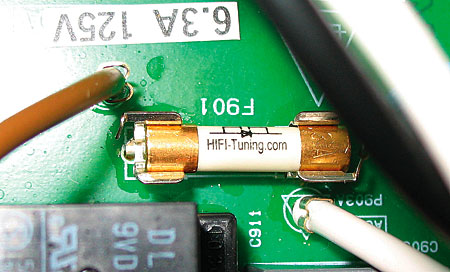
While the A-9555 sounded just fine with its stock fuse, when I replaced that fuse with a HiFi-Tuning fuse of the same rating (6.3A, slow-blow), the sound became clearer and more precise, with crisper transients but without any of that "overetched" character that I dislike. (To access the fuse, you have to remove the A-9555's cover, which is held down by screws, and unplug the AC cord. I also waited at least an hour after unplugging the amp before I would touch anything on the circuit board, to prevent the possibility of getting a shock from a capacitor that hadn't fully discharged.) The following comments refer to the A-9555's sound with the HiFi-Tuning fuse installed.
Apart from the lack of noise, the A-9555's most notable sonic asset was its smooth, easy-on-the-ear character, and its avoidance of the electronic-sounding artifacts that lead to listening fatigue. In this respect, the A-9555 was the polar opposite of the Flying Mole CA-S10 integrated amplifier, which I still had on hand. In direct comparisons, the Flying Mole sounded more detailed, with sharper focus on the instruments, but its sound had an overetched, clinical quality that made me more aware of the equipment than the music being reproduced.
In my review of the CA-S10 in the June issue, I said that, while I found things to admire in its sound, musical is not the first word that would occur to me to describe it. Well, musical is indeed a word that I can use to describe the sound of the Onkyo A-9555. With the A-9555 in the system, I was more content just to listen to the music rather than pay attention to the minutiae of the sound. And, to use another audiophile point of reference, I can also describe the sound of the A-9555 as being "tube-like." (But keep in mind that while some solid-state amplifiers may sound tube-like, if you really want the sound of tubes, you have to buy a component that uses...tubes.)
The A-9555's tonal balance was close to neutral—no part of the spectrum was unduly emphasized or neglected. There was perhaps just a touch of warmth to the sound (hence the descriptor tube-like), and the highs were slightly on the soft side (more so when the stock rather than the HiFi-Tuning fuse was installed). The highs didn't sound obviously rolled off; it's just that there was a bit less "air" in the extreme high frequencies. That slightly subdued treble may have been a clever design choice, given that the A-9555 is likely to be paired with relatively inexpensive speakers, which tend to have a forward, treble-emphasized sound.
Phono
Yes, folks, the A-9555 has a phono section. It's designed to accommodate moving-magnet rather than moving-coil cartridges, and the cartridge in my phono setup is a low-output MC, so I couldn't plug it in directly. However, I still had a Bryston TF-1 step-up transformer that I'd bought many years before, and this combination worked well—in fact, although my intention was to only briefly check the sound quality, I ended up listening to several LPs that I hadn't heard for some time. The sound was well balanced from top to bottom, with a nice "open" quality. Interested in Onkyo's claim that the A-9555's phono section has been designed to optimize high-frequency transient response, I paid particular attention to its reproduction of vocal sibilants, which tend to reveal problems in this area. I heard nothing untoward: the highs were smooth and extended, with no sibilant harshness.
If your phono source consists of a Continuum Audio Labs Caliburn turntable and Clearaudio Goldfinger cartridge, you probably won't be looking at the Onkyo A-9555—but I found the A-9555's phono section far better than is to be expected at the price.
Comparo time
PS Audio's GCC-100 integrated amplifier—or, as PSA calls it, "variable gain power amplifier"—is rated at 100Wpc (see my review in the January 2006 Stereophile, Vol.29 No.1). It's in Class A of "Recommended Components," and costs $2795 without phono stage. Like the Onkyo A-9555, its output operates in class-D. Putting aside the price difference, it was the closest thing I had on hand for comparison. (As is my practice, I matched levels as closely as possible, using the "over-and-under" method to compensate for any level difference that was still present.) Both amplifiers were fitted with HiFi-Tuning fuses, and both were plugged into the PS Audio P500 AC regenerator, which was set to 60Hz. Everything else in the system (cables, etc.) was the same.
My first impression of the GCC-100 was that its sound was quite similar to what I'd been hearing from the A-9555. Going back and forth between the amps while playing highly familiar CDs—the first Chesky Jazz Sampler & Audiophile Test Compact Disc Vol.1 (Chesky JD37), Sylvia McNair's Sure Thing: The Jerome Kern Songbook (Philips 442 129-2), Mickey Hart's Planet Drum (Rykodisc RCD-10206), etc.—I found that there were some sonic differences, but I had to switch my mind to analytic mode to identify them. The GCC-100 gave the impression of greater transparency: more immediate transients, better focus on instruments, extreme highs a bit more present (but not overemphasized). Bass seemed tighter and more extended, and on some recordings (Planet Drum being one) dynamics were superior and the soundstage a bit wider. Keep in mind, however, that while I believe these differences were real, their magnitude was relatively small; I had to listen closely to hear them. The PS Audio GCC-100 is one of my favorite amplifiers; the fact that, at less than a quarter the price, the Onkyo A-9555 came so close is, in my view, a remarkable achievement.
Who should buy the Onkyo A-9555?
To say that I was impressed with this product would be an understatement. However, rather than recount the A-9555's many virtues, I'll end by suggesting that you should seriously consider buying one if you:
1) Have limited funds—say, around $2000—to spend on an entire audio system, and want the best possible quality for the price. Combined with a pair of loudspeakers listed in Class C of "Recommended Components" and a reasonably priced CD player (eg, the Music Hall cd25.2 or Onkyo's own DX-7555), the A-9555 can be the heart of an audio system that is both accurate and capable of providing musical pleasure. And if you can expand your budget a bit to include a turntable, the A-9555 can accommodate that as well.
2) Own a megabuck audio system and want to set up a second system in another room, but don't want that second system to involve a big drop in sound quality. A system such as the one described above would be just the thing.
3) Have set your heart on buying a certain expensive pair of speakers or state-of-the-art digital separates, even if doing so would leave less than $1000 for the rest of the system. The A-9555 is good enough that you won't feel you've made a major compromise in a most important component. If you want significantly better sound, be prepared to spend much more.
Yup, I was impressed.
NEXT: Specifications »
 | |||||||||||

|
|
| |||||||||
- Log in or register to post comments
COMMENTS
will they drive 6 ohms OK?
Submitted by Alec in San Fra... on May 17, 2012 - 2:05pm
Hi, I own an A-9555 that I've been very happy with. I've been driving 8-ohm B&Ws with it, but I've been thinking of buying a pair of 6-ohm Monitor Audio speakers. I'm not technically savvy enough to understand more of this writeup that a harmonic appearing with 4 ohms and the general conclusion that the amp is more comfortable with higher impedances. In your opinion, would it be comfortable at 6 ohms?

Re: will they drive 6 ohms OK?
Submitted by John Atkinson on May 19, 2012 - 7:09am
Shouldn't be a problem, Alec.
John Atkinson
Editor, Stereophile
Thanks, John! I really
Submitted by Alec in San Fra... on May 22, 2012 - 2:32pm
Thanks, John! I really appreciate the reply.
Is this a good match for my Bose AcOustimasS?
Submitted by Madmax on May 22, 2012 - 12:43pm
Or can you recommend other amps in that price range that would be a good match? Thanks in advance!!
broken part
Submitted by Edgar on October 9, 2017 - 6:03am
Hi there,Got a problem with it,take it to service center and guess what? the part is broken is not available any more. (((
It is 1B093508-1B
Can anybody help to direct where i can find it or any other replacement that is possible?Any help will be appreciated.
Thank you
Best Regards
Edgar








| Loudspeakers Amplification Digital Sources | |
Analog Sources Accessories Featured | |
Music Columns Retired Columns | |
Show Reports | |
Features Latest News Community | |
Resources Subscriptions |
 © 2024 Stereophile
AVTech Media Americas Inc., USA
All rights reserved