Over the years, I have used and enjoyed in my audio system large, single-purpose components. Each of these chassis has had but one role: preamplifier, amplifier, digital-to-audio converter (DAC), etc. I guess I've been just a little suspicious of products with multiple functions crammed into a single small chassis; I've figured that the designer may have cut a corner that could affect the sound.
Which brings me to the topic of this review, the Bryston B100-DA SST, which is three separate components in one slim chassis: a DAC, a preamplifier, and a 100Wpc power amplifier. (An MM phono module is also available.) Has serving all of these different functions compromised its sound?
There was another reason I was curious about the B100-DA SST. Its optional DAC made it very easy to use with a new type of audio component: the networked music player. Such devices—Slim Devices' Squeezebox and Roku's Soundbridge 1000, for examples—can stream digital music from the excellent Internet radio stations praised by Sam Tellig and Wes Phillips, or to a centralized digital music library, as extolled by John Atkinson. The B100-DA SST also avoids the need to use the often mediocre DACs found in some network players, and eliminates from the analog signal path the extra jacks, plugs, and connectors required when using an external DAC.
Internal components
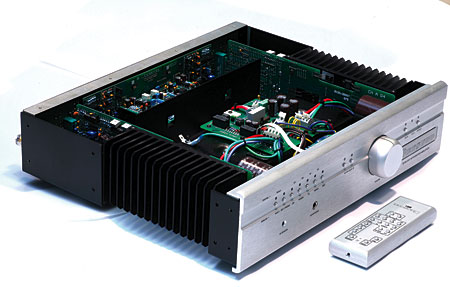
The power-amplifier section of the B100-DA SST ($4395 as reviewed; I didn't specify the phono option) is based on the 2B-SST, Bryston's 100W basic two-channel power amp. It offers dual-mono architecture with two 250VA toroidal transformers; a third, smaller toroidal helps power the B100-DA's digital module. The amp contains over a dozen regulated or stabilized voltage supplies. Removing the B100-DA's top panel revealed excellent build quality: minimal point-to-point wiring, high-quality resistors and capacitors, and thick, double-sided, glass-epoxy printed-circuit boards with clear markings. The B100-DA's analog preamplifier uses multiple-pole relays to switch sources, and an integrated resistance network is used to control the unit's volume. All analog signal circuits are fully discrete and Bryston uses 0.1% metal-film resistors, polystyrene capacitors, and selects and matches transistors by hand to keep noise and distortion to absolute minimums. The B100-DA's DAC is described in an article written by one of the company's customers, Jeff Switzer, that appeared in Vol.8 No.3 of the company's online newsletter . A digital signal input through the S/PDIF jacks on the B100-DA's rear panel is fed via impedance-matching transformers to a Cirrus Logic C58420 digital interface chip. This reduces jitter and upsamples the data from 16-bit/44.1kHz to 24/96. As Switzer states, "the upsampling process doesn't add any new data to that which came off the CD but it puts the data in a form which can better be used by the DAC." Another advantage is that a "new clock signal is applied which causes a significant reduction in jitter."
The D/A conversion is handled by a Crystal CS43122 chip. A digital low-pass filter is applied to the signal before its conversion to analog, and an analog filter afterward. The DAC's performance is tightly regulated by a separate filtered analog power supply with carefully routed grounds. The same circuitry can be found in Bryston's SP 2, the five-channel preamplifier and digital processor reviewed by Kalman Rubinson in his "Music in the Round" column in September 2006 (Vol.29 No.9). The only difference is that the B100-DA's DAC reclocks and resamples the digital input.
The B100-DA is built to last. Each unit must survive a 100-hour factory burn-in in which a squarewave input signal drives the amplifier into a load capacitor at slightly under clipping for one hour, followed by one hour off, and so on. This load is designed to draw the amplifier's maximum current delivery on the squarewave's rising leg. Unlike a resistive load, which dissipates all the energy as heat, the capacitor feeds back the entire signal into the amplifier, which puts maximal stress on the output stages. This heats the amplifier, cools it, and heats it again. This expansion and contraction exposes any loose connections or devices subject to early failure. After burn-in, each B100-DA is bench-tested, and those results are shipped with the unit.
Such overengineering, extensive burn-in, and building to the stringent, constant-use demands of professionals allow Bryston to offer its unique warranty program: Bryston will pay parts and labor costs, plus shipping one way, for the first 20 years of ownership (except for the digital circuits, which are warranted for five years, parts and labor).
Rear-panel connections, front-panel controls
At each end of the B100-DA's rear panel are pairs of speaker terminals. Between them are 10 unbalanced analog RCA input jacks per channel, configured in two rows of five each for each side. There is also rear-panel access to the drive circuits for outboard infrared LEDs, and a bidirectional RS-232 data connector for downloading from Bryston's website. Below this is a 12V remote trigger output, and next to it an IEC 320 AC power inlet. A single Connected/Separate switch next to each channel's input bank lets the user internally connect or disconnect the preamp to/from the power-amp section. Digital streaming music up to 24/96 can be fed to the B100-DA's S/PDIF coaxial inputs or TosLink optical inputs, which are found near the center of the rear panel. The innermost bottom RCA jacks are designated D1 (S/PDIF coax 2 among the left-channel sockets) and D2 (S/PDIF coax 2 among the right). In the middle of the rear panel are two TosLink optical input jacks, designated D3 and D4.
On the B100-DA's front panel one finds, on the left, a row of seven pushbuttons, above each an LED. These 7 buttons are labeled along the bottom, from left to right: Aux 2, Aux 1/Phono, CD, Tuner, TV, Video, Rec. Pressing the leftmost pushbutton, Aux 2, activates the B100-DA/s internal DAC, causing its LED to turn green. When the LEDs of D1 (S/PDIF 1 source), D2 (S/PDIF source), D3 (TosLink 1 source), or D4 (TosLink 2 also glow green, this indicates that a PCM digital bitstream is present. If no bitstream is available, or if the bitstream is incorrect (ie, not PCM), the LED will turn red. Pushing Aux 2 again toggles its light off and puts the B100-DA in analog mode. This means that only one source LED of the remaining six input-selector buttons will be illuminated, indicating the exact analog source. The large, anodized, motorized master volume knob can be operated via the remote control in both analog and digital modes. Also on the front panel are the headphone jack, IR sensor, and pushbuttons for Balance, Mute, Clip, and Power.
Bryston offers the B100-DA's remote control as a $400 option. Although I grumbled at the thought of having to pay for a remote, I changed my tune when I held this full-function example in my hand: it's very well made, its brushed aluminum is highly attractive, and it controls everything: selection of any source, volume up/down, mute, balance, power off/on, and discrete code entry. Its backlighting is even triggered by a motion detector—it lights up as soon as you pick it up. This is the most attractive and cleverly designed remote control I've seen for a high-end audio product. If you buy a B100-DA, definitely get the remote as well.
Music Serving
Digital streaming music up to 24/96 can be fed to the B100-DA's S/PDIF coaxial inputs or TosLink optical inputs, which are found near the center of the rear panel. The innermost bottom RCA jacks are designated D1 (S/PDIF coax 2 among the left-channel sockets) and D2 (S/PDIF coax 2 among the right). In the middle of the rear panel are two TosLink optical input jacks, designated D3 and D4.
On the B100-DA's front panel one finds, on the left, a row of seven pushbuttons, above each an LED. These 7 buttons are labeled along the bottom, from left to right: Aux 2, Aux 1/Phono, CD, Tuner, TV, Video, Rec. Pressing the leftmost pushbutton, Aux 2, activates the B100-DA/s internal DAC, causing its LED to turn green. When the LEDs of D1 (S/PDIF 1 source), D2 (S/PDIF source), D3 (TosLink 1 source), or D4 (TosLink 2 also glow green, this indicates that a PCM digital bitstream is present. If no bitstream is available, or if the bitstream is incorrect (ie, not PCM), the LED will turn red. Pushing Aux 2 again toggles its light off and puts the B100-DA in analog mode. This means that only one source LED of the remaining six input-selector buttons will be illuminated, indicating the exact analog source. The large, anodized, motorized master volume knob can be operated via the remote control in both analog and digital modes. Also on the front panel are the headphone jack, IR sensor, and pushbuttons for Balance, Mute, Clip, and Power.
Bryston offers the B100-DA's remote control as a $400 option. Although I grumbled at the thought of having to pay for a remote, I changed my tune when I held this full-function example in my hand: it's very well made, its brushed aluminum is highly attractive, and it controls everything: selection of any source, volume up/down, mute, balance, power off/on, and discrete code entry. Its backlighting is even triggered by a motion detector—it lights up as soon as you pick it up. This is the most attractive and cleverly designed remote control I've seen for a high-end audio product. If you buy a B100-DA, definitely get the remote as well.
Music Serving
As I said, I chose to review the DAC-equipped B100 so I could use it with my network music player. I use a Slim Devices Squeezebox network player ($299) placed atop my Krell KRC-28 CD player, connected via a WiFi link to the D-Link DW 624 router sitting in the kitchen, about 20' away. The music is stored on a IBM X-30 laptop, which sits one floor below in my office, which is also connected wirelessly to my WiFi network. (I use a DWL G800 AP D-Link signal booster.) I connected the Squeezebox's S/PDIF output to the B100-DA's D1 S/PDIF input, using a 1.5m length of Wireworld Starlight digital coaxial cable. I then installed the Slimserver software on my laptop and used Windows Media Player v.10 to rip tracks from my favorite music CDs as Windows Media Audio (WMA) Lossless files— ie, the best sound quality, which requires 206–411MB of hard-drive space per CD. The Slimserver software (v.6.5.0, downloaded from Slim Devices' website) allowed me to gather these lossless music files into a playlist I titled "Stereophile Music CD Test Program." For the listening tests, I also downloaded Beethoven's Symphony 9, with Wyn Morris conducting the London Symphony, from the iTunes website (footnote 1).
The power-amplifier section of the B100-DA SST ($4395 as reviewed; I didn't specify the phono option) is based on the 2B-SST, Bryston's 100W basic two-channel power amp. It offers dual-mono architecture with two 250VA toroidal transformers; a third, smaller toroidal helps power the B100-DA's digital module. The amp contains over a dozen regulated or stabilized voltage supplies. Removing the B100-DA's top panel revealed excellent build quality: minimal point-to-point wiring, high-quality resistors and capacitors, and thick, double-sided, glass-epoxy printed-circuit boards with clear markings. The B100-DA's analog preamplifier uses multiple-pole relays to switch sources, and an integrated resistance network is used to control the unit's volume. All analog signal circuits are fully discrete and Bryston uses 0.1% metal-film resistors, polystyrene capacitors, and selects and matches transistors by hand to keep noise and distortion to absolute minimums. The B100-DA's DAC is described in an article written by one of the company's customers, Jeff Switzer, that appeared in Vol.8 No.3 of the company's online newsletter . A digital signal input through the S/PDIF jacks on the B100-DA's rear panel is fed via impedance-matching transformers to a Cirrus Logic C58420 digital interface chip. This reduces jitter and upsamples the data from 16-bit/44.1kHz to 24/96. As Switzer states, "the upsampling process doesn't add any new data to that which came off the CD but it puts the data in a form which can better be used by the DAC." Another advantage is that a "new clock signal is applied which causes a significant reduction in jitter."
At each end of the B100-DA's rear panel are pairs of speaker terminals. Between them are 10 unbalanced analog RCA input jacks per channel, configured in two rows of five each for each side. There is also rear-panel access to the drive circuits for outboard infrared LEDs, and a bidirectional RS-232 data connector for downloading from Bryston's website. Below this is a 12V remote trigger output, and next to it an IEC 320 AC power inlet. A single Connected/Separate switch next to each channel's input bank lets the user internally connect or disconnect the preamp to/from the power-amp section.
Digital streaming music up to 24/96 can be fed to the B100-DA's S/PDIF coaxial inputs or TosLink optical inputs, which are found near the center of the rear panel. The innermost bottom RCA jacks are designated D1 (S/PDIF coax 2 among the left-channel sockets) and D2 (S/PDIF coax 2 among the right). In the middle of the rear panel are two TosLink optical input jacks, designated D3 and D4.
On the B100-DA's front panel one finds, on the left, a row of seven pushbuttons, above each an LED. These 7 buttons are labeled along the bottom, from left to right: Aux 2, Aux 1/Phono, CD, Tuner, TV, Video, Rec. Pressing the leftmost pushbutton, Aux 2, activates the B100-DA/s internal DAC, causing its LED to turn green. When the LEDs of D1 (S/PDIF 1 source), D2 (S/PDIF source), D3 (TosLink 1 source), or D4 (TosLink 2 also glow green, this indicates that a PCM digital bitstream is present. If no bitstream is available, or if the bitstream is incorrect (ie, not PCM), the LED will turn red. Pushing Aux 2 again toggles its light off and puts the B100-DA in analog mode. This means that only one source LED of the remaining six input-selector buttons will be illuminated, indicating the exact analog source. The large, anodized, motorized master volume knob can be operated via the remote control in both analog and digital modes. Also on the front panel are the headphone jack, IR sensor, and pushbuttons for Balance, Mute, Clip, and Power.
As I said, I chose to review the DAC-equipped B100 so I could use it with my network music player. I use a Slim Devices Squeezebox network player ($299) placed atop my Krell KRC-28 CD player, connected via a WiFi link to the D-Link DW 624 router sitting in the kitchen, about 20' away. The music is stored on a IBM X-30 laptop, which sits one floor below in my office, which is also connected wirelessly to my WiFi network. (I use a DWL G800 AP D-Link signal booster.) I connected the Squeezebox's S/PDIF output to the B100-DA's D1 S/PDIF input, using a 1.5m length of Wireworld Starlight digital coaxial cable. I then installed the Slimserver software on my laptop and used Windows Media Player v.10 to rip tracks from my favorite music CDs as Windows Media Audio (WMA) Lossless files— ie, the best sound quality, which requires 206–411MB of hard-drive space per CD. The Slimserver software (v.6.5.0, downloaded from Slim Devices' website) allowed me to gather these lossless music files into a playlist I titled "Stereophile Music CD Test Program." For the listening tests, I also downloaded Beethoven's Symphony 9, with Wyn Morris conducting the London Symphony, from the iTunes website (footnote 1).