| Columns Retired Columns & Blogs |

Manley Laboratories Stingray integrated amplifier
There's an aesthetic dimension to the Manley Laboratories Stingray that transcends high-end audio and borders on modern sculpture—not unlike the E.A.R. V20, which I auditioned in the October issue. Still, the Stingray is by no means an exercise in gimmickry. Form has clearly followed function at every step in the design process, the ultimate goal of which was to fashion a vacuum-tube integrated amplifier with real-world power that defined the outer limits of high-end performance in a functional, affordable, bare-bones package...with a touch of style.
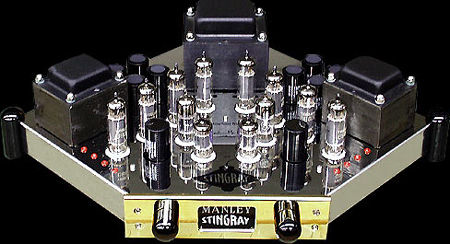
Still, while the Stingray's aural charms ultimately proved quite engaging, I was initially captivated by its radical styling. To see the Stingray aglow in a darkened listening room is an oddly evocative experience—as if the Muppets, hired by Bayreuth to stage a Wagner opera, had decided to use a chorus of vacuum tubes in place of the usual sopranos, altos, tenors, and basses. And if the E.A.R. V20 reflected its maker's fascination with high-performance European sports cars, the Stingray is like a visitor from some distant galaxy as seen through the retro-futuristic strip-mall prism of 1950s SoCal pop culture. Like, radical, man.
In fact, when EveAnna Manley sketched her hexagonal work in progress—on a bar napkin during a pause for the cause at HI-FI '98 in Los Angeles—for erstwhile Stereophile Pooh-Bah J. Gordon Holt, that venerable sage remarked dryly, between sips of his even drier martini, "It looks like a stingray."
Of such moments are legends born. In honor of JGH, this souped-up, highly evolved descendant of the venerable Manley 50W monoblocks was dubbed the Stingray. The fish is illuminated on the 24K-gold front panel in a manner befitting the trailer for a William Castle/Vincent Price mondo sci-fi epic. ("No audiophiles will be seated during the final 15 minutes of this demo! Please don't reveal the surprise ending to your friends!")
It takes a village to nurture an amp
My wife, quite taken by the unconventional appearance of this curious new denizen of our audio menagerie, was pleased to learn that its overall design was the vision of a female audiophile. "It looks like a little village," she concluded. But while the essential vision was indeed that of Manley Labs' guiding light, it took a village of dedicated audiophiles, or at least Manley Labs' dedicated team, to raise such a child.
It's tempting to characterize the Stingray as an extension of EveAnna Manley's own personality: bright, brassy, forward, good-natured, in your face—in a word, dude, rock'n'roll.
"Well, I can't admit to consciously trying to inflict my personality on the sound of this gear, but I will admit to listening to a lot of rock'n'roll music," Manley laughs. "Music has such a powerful associative property for me—it's emotional. True enough, I played saxes and clarinets and a little trumpet in high school and college bands and orchestras, and even got a degree in Music, so yeah, I know my music theory and I do know what real instruments sound like.
"Now, because we build all of this pro recording equipment, I find myself in a lot of recording studios and mastering rooms, and, this being the music industry, most of it is pop or rock'n'roll music, so that becomes my reference. But you know what? A lot of the evaluative listening process is a relative thing, whether you're involved with acoustic purist music or multitrack recordings—once you know anything rather well, relative listening comes into play. Can you hear the detail of the beads on the shaker, the tone of the guitar, the decay of that hall, the solidity of the bass attack?
"Hey, Robert Plant's voice was once an acoustic instrument, just the same as that trombone was. They were both floating through the air until some microphone picked up the sound to convert that air movement into some little volts to be made into some bigger volts to get moved through a bunch of gear onto a storage medium, which we can later buy and do the reverse to."
While the Manley Stingray has only one power transformer, it is essentially a fixed-bias, dual-monoblock configuration on a single stainless-steel chassis. It has sets of separate left and right line inputs (gold-plated brass with Teflon dielectric) positioned to either side of the chassis and adjacent to their own output transformers, a four-position silver-contact input selector switch, and screw-down-style binding posts.
Ideally suited to accept spades or bare wire, these old-fashioned-looking posts are positioned close enough to the back of the output transformers that using a pair of pliers is a tight squeeze. Nor was I able to piggyback a second set of speaker cables with WBT expanding bananas for a biwire setup, as I had with the more versatile vertical binding posts of the Mesa Audio Tigris and the E.A.R. V20. My handy-dandy Dynaclear Postman (with its ½" and 7/16" slots) didn't work here, making it a bit clumsy to change cables. If I'd had an adjustable wrench or a 3/8" nut driver, I'd have been cool.
The Stingray's hexagonal shape—essentially a square with the front and back corners cut off—evolved from Manley's desire to keep signal paths and connections as short and direct as possible so as to employ a passive preamp instead of a gain-stage device. Which is why a pair of bullet-shaped aluminum pillars serve to conceal and gussy up the left and right corners, and double as the conical feet on which the amplifier rests.
And so, in detail after detail of the Stingray, form follows function. Thus the decision to employ, for exceptional transparency, a passive preamp and high-quality passive Noble volume and balance controls.
"The main functions of preamps these days are switching and volume," Manley explains. "When you have to drive only a few inches of wire, as in the Stingray, and all your sources are a couple of volts output, as they mostly all are these days, a passive preamp works great. Some guys, thinking less is more, get in trouble with passive preamps trying to use a 50k ohm potentiometer to drive 12' of whatever capacitance in the cable. Whoops? Where did the balls and high frequencies go? Gotta get down to some low impedance to drive cable properly without loss.
"Another way that the form followed function was having the power switch next to the IEC connector. If I had run the power switch up at the front panel, then the mains would have had to flow right under the input circuitry. By keeping the power switch at the back, where it's easily accessible, wiring—and thus labor—are greatly simplified, and all the AC is kept furthest away from the sensitive input stages."
The most remarkable thing about the Stingray is the amount of gain and dynamic range Manley and her design team managed to elicit from four little EL84 output tubes per channel—not exactly a tube that springs to mind when envisioning a 50W amp of low global feedback (only 4dB) operating in ultralinear mode. All sparkly, quick, and open, the EL84 has never been synonymous with prodigious bass, but the Manley team reasoned that perhaps this was not the tube's fault. Because Manley Labs winds its own transformers, "Hutch" Hutchison was able to define a new series of parameters, Michael Hunter could wind some prototypes, and, in short order, Paul Fargo would have one hooked up to an amplifier on the test bench for measurements and A/B listening tests with the old designs.
As Manley describes it, " 'Sorry, boys,' I'd tell them. 'Your numbers are way better with the new designs, but we're still not there sonically. Try again.' So what actually ended up happening was a balance of numbers and ears. The bass sound I was looking for came from the right amount of inductance combined with a slight introduction of saturation. 'Oh, the horror!' you say. Nope, numbers ain't everything...as you may have heard. The other place we found we were losing a little bass was in the old input stage we'd been using for the past 15 years. So Paul Fargo developed a new input design that really did the trick. And it suited us well, with the Stingray's passive volume and balance control, to score a little extra gain there anyway. And Mr. 12AT7 takes care of that job."
Bright lights, fast city
In high-end audio, the name of the game is system synergy. As taken as I was with the Stingray's sound, I set out to audition it in a variety of applications, with different combinations of tweaks and gear. I tried both short-wall, nearfield settings (with a variety of stand-mounted speakers)—in which, I anticipated, some Stereophile readers might use the amp—and full-range floorstanders in my customary long-wall space. (See "Associated Equipment.") I also did a fair amount of comparative listening with a pair of similarly priced integrated amps that were visiting for the summer: the 6V6/EL84-equipped Mesa Tigris and the EL34-configured Conrad-Johnson CAV-50.
NEXT: Page 2 »
 | |||||||||||

|
|
| |||||||||
- Log in or register to post comments












| Loudspeakers Amplification Digital Sources | |
Analog Sources Accessories Featured | |
Music Columns Retired Columns | |
Show Reports | |
Features Latest News Community | |
Resources Subscriptions |
 © 2024 Stereophile
AVTech Media Americas Inc., USA
All rights reserved