| Columns Retired Columns & Blogs |

Sony SCD-XA9000ES SACD player
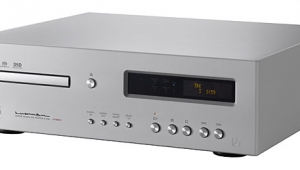
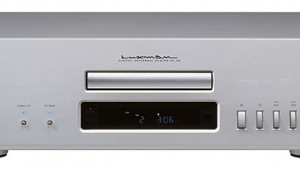
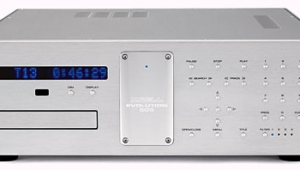
Sony's first flagship Super Audio CD player was the two-channel SCD-1, reviewed by Jonathan Scull in November 1999. (The $5000 SCD-1 had balanced outputs; the cosmetically different but otherwise identical $3500 SCD-777ES had unbalanced outputs and was reviewed by Chip Stern in April 2001.) Sony's second-generation flagship player, the $3000 SCD-XA777ES, was reviewed by Kalman Rubinson in January 2002, and added multichannel capability with channel-level adjustment and bass management. Sony's third-generation flagship is the SCD-XA9000ES, also priced at $3000, which adds time-delay adjustment for its multichannel analog outputs and is presented in a smart new styling that Sony calls "Silver Cascade." The disc drawer and the most frequently used controls are on the angled top half of the brushed-aluminum front panel; in the lower half are the display, the headphone jack and its volume control, and the multifunction control knob.
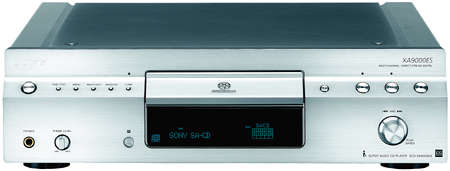
The most important new feature of the XA9000 is indicated by the rightmost of the four small buttons to the left of the drawer. Marked "i.Link," this button, when pressed, turns off the player's analog outputs and sends six channels of multichannel DSD data down an IEEE1394 (FireWire) cable to outboard D/A processors and other components. An external digital output for SACD has been a much-longed-for feature, and according to Sony's White Paper on the XA9000's design, implementing a variable-bit-rate interface that can handle six channels of data sampled at 2.8224MHz with low jitter was far from trivial. So far, the only component available that can accept the i.Link data is Sony's new STR-DA9000ES multichannel receiver. But as the encrypted data format conforms to an industry standard—Digital Transmission Content Protection—I see no reason why, for example, the dCS Elgar Plus's FireWire data input could not be adapted to work with it. Obviously, there is more to be reported on this subject.
The interior of the XA9000's sturdy frame-and-beam chassis is jam-packed. Center-front is the dual-laser transport; above it is a circuit board containing the DSD decoder. Behind the transport and to its left are the massive power supply, with two R-core transformers, while at the rear right is the analog output circuitry in its own screened sub-enclosure. The two-channel outputs are carried on a horizontal motherboard, the six multichannel outputs on three vertical boards plugged into the motherboard. Parts used appear to be of audiophile quality, including polypropylene and Nichicon caps; the analog section has its own power supply.
Functionally, the SCD-XA9000ES is almost identical to the SCD-XA777ES; I refer readers to Kalman Rubinson's review for a full description. The XA9000 appears to use the same multilevel DACs as the XA777, fed directly by digitally filtered DSD data for SACD playback, or by CD data first transformed to 24-bit words by an 8x-oversampling filter, then upsampled to 2.8824MHz/1-bit data. Two DACs are used per channel in multichannel playback; for two-channel operation, six DACS are summed to minimize noise.
About the only letdown I experienced with the XA9000 was with its remote, which is Sony's familiar plastic wand. Something chunkier would have been more in line with the player's techno styling.
Sound
From the first notes of the first Super Audio CD I put on—the Pentatone reissue of the Academy of St. Martin-in-the-Fields' 1974 recording of Famous Overtures by Rossini (PTC 5186 106)—it was obvious that Sony's new flagship is a player to be reckoned with. There was a wealth of detail apparent, yet without that detail being thrust forward at the listener. There was a big sweep of sound, which was quite enveloping despite my experiencing two- rather than multichannel sound. (This review concerns the Sony's performance as a conventional two-channel player; Kal Rubinson will comment on its surround capability in a Follow-Up.)
The Rossini was mastered from analog tapes; next up was an SACD of orchestral tone poems from Debussy and Turina, with Jesús López-Cobos and the Cinncinatti Symphony (Telarc SACD-60574), which had been recorded in DSD. Again, there was a big sweep of sound, but with delicate instrumental details—such as the castanets and the tambourine rolls in the first section of Debussy's Ibéria—clearly delineated against the orchestral backdrop.
NEXT: Page 2 »
 | |||||||||||

|
|
| |||||||||
- Log in or register to post comments







| Loudspeakers Amplification Digital Sources | |
Analog Sources Accessories Featured | |
Music Columns Retired Columns | |
Show Reports | |
Features Latest News Community | |
Resources Subscriptions |
 © 2024 Stereophile
AVTech Media Americas Inc., USA
All rights reserved