| Columns Retired Columns & Blogs |

Ultimate Ears UE-5c in-ear headphones
"You need to keep still."
Footnote 1: Ultimate Ears also sent a pair of their top-of-the-line UE-10 Pro headphones, which use a dual low-frequency armature for added bass headroom. I will review the '10 Pro in a future issue.
I didn't think I was wriggling, but the liquid silicone being injected into my ear canals was cold. Cold. And I was having to bite on to a plastic block to keep my mouth open wide, which is what the audiologist taking an impression of my inner ears deemed essential.
 I was being subjected to this ritual because, following my review of the $179 Shure E3c in-ear headphones last May (Vol.27 No.5, p.113), I had agreed to review a competing product from Ultimate Ears. Not the nickname of a famed audio reviewer, Nevada-based Ultimate Ears was established by sound engineer Jerry Harvey to provide more effective foldback monitoring for live musicians and singers, replacing those bulky wedge floor monitors you occasionally still see at the front of the stage with in-the-ear headphones. Not only do these not interfere with the back-line sound, they can also provide useful acoustic isolation.
Ultimate Ears, I am told, has a 70% market share of the live sound business, with customers such as the Rolling Stones and Linkin Park using their products. In 2004, the company moved into the domestic audio business with in-ear 'phones ranging in price from $550 to $900. (A Soft Material option, which uses a more compliant material for areas that come in contact with the ear, adds $50 to these prices.) I asked for review samples of the $550 UE-5c Ear Monitors (footnote 1).
A fitting subject
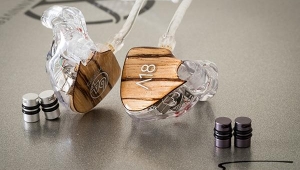
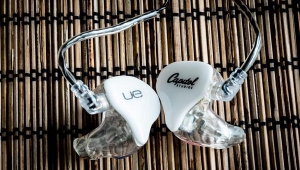
All the Ultimate Ears headphones use custom-fitted, molded earpieces, so it's important to have a mold correctly made for each of your ears. Instructions for how to have an "open-mouth impression" taken by a local hearing-aid center or audiologist can be found at the Ultimate Ears website. Ultimate Ears says that, depending on where you live, you may pay as little as $10 for impressions and never more than $50, unless you ask for the work to be done somewhere other than in the audiologist's clinic.
Ultimate Ears offers a range of colors for the molds, even clear. I chose black for the appropriate Goth look as I commuted on the subway.
Listening
The Ultimate Ears 'phones use a dual-armature design, one handling the low frequencies, the other the highs, with a passive crossover. LF extension will depend on the effectiveness of the seal, which is why taking care to have the optimal molds taken is so important. At the other end of the spectrum, Jerry Harvey explained to me, it takes a lot of attention to detail to get extension above 10kHz or so. The graphs provided on the Ultimate Ears website for the UE-5c show extension up to 16kHz.
The first time I plugged the rather unwieldy-looking Ultimate Ears into my ear canals, with the body of the earpiece occupying my outer ears, it took a bit of twiddling to get right. Removal was even more problematic. But, like most initially daunting tasks, inserting the earpieces quickly became second nature: offer up the earpiece to the ear just so; twist a quarter turn; and push to seal. Removing them was as easy: twist slightly to break the seal, then rotate and pull. The thin cables are replaceable, a useful point for something as prone to being stressed in use. However, while the short, 46" lead was perfect for portable use and for sitting in front of my laptop, it was a little too short for home use.
Once the earpieces were in place, I found them easily comfortable enough for long listening sessions, even without the soft mold option. Isolation from external sounds was excellent. Ultimate claims 26dB for a correctly fitting mold, which I have no way of confirming, but the figure seems in the right ballpark.
But comfort always takes second place to sound, and the sound of the UE-5cs was first-rate. After the Shure E3cs, the Ultimate Ears were more mellow, with a considerably fatter bass. This was a consistent impression throughout all my auditioning, whether I drove the UE-5Cs straight from my Apple iPod, buffered with the HeadRoom Total BitHead amplifier that Mikey Fremer reviews elsewhere in this issue (footnote 2), or from my laptop in my listening room, using a Metric Halo MIO2882 to give an AES/EBU feed to the Benchmark DAC 1. The Ultimate Ears delivered big bass. The pumping synth bass line and punctuating kick drum in Annie Lennox's reading of Bob Marley's "Waiting in Vain" (an ALC file ripped from the Medusa CD, Arista 25717-2) were satisfyingly plump, with the descending scale passage at the end of the bridge rich and full. And the UE-5c's mellow highs tamed this recording's overcooked treble.
Now I know audiophiles are supposed to worship neutrality—all I'm saying is that larger-than-life bass is not necessarily a bad thing. Go to any live rock concert and you'll see that the front-of-house balance engineer has the kick drum dominating the mix. The trick is to apply just enough EQ that the music's drive is amplified and its tonal foundation reinforced, without the sound descending into a muddy mess.
Overall, I think the Ultimate Ears pulled off what my friend Martin Colloms once referred to as "the JBL Effect." Going back to the Shures gave a balance that had considerably more mid-treble energy, but even with the largest, tightest-fitting foam sleeves, the E3cs didn't have either the amount of bass or the LF extension offered by the Ultimates. And I missed it.
Ultimately, however, it was the smoothness of the UE-5c's midrange and high frequencies that impressed me the most. I used the Ultimate Ears to check my mixes of Cantus's new Christmas CD, Comfort and Joy, Vol.1 (Cantus CTS1204; see "Industry Update," p.15), and I could hear into the mixes in a very informative way.
As I wrote in my November review of the Echo Indigo IO soundcard, I used this card, fitted to my Apple TiBook, to drive the Ultimate Ears when I listened to each day's 24-bit/88.2kHz session files when I recorded Beethoven's Diabelli Variations, Op.80, with Ray Kimber's IsoMike array last August (footnote 3). Yes, pianist Robert Silverman's 9' Steinway had rather more upper-bass majesty than it did in real life, and its upper frequencies sounded mellower than they did through my reference Sennheiser HD600s. But as reproduced by the EU-5cs, there was a verisimilitude to the piano's presentation that sent chills down my spine.
Measurements
Without a dummy head, I could not make meaningful frequency-response measurements. However, I did examine the impedance of the UE-5c with the earpieces inserted in my ears (fig.1). (Some low-order distortion was evident below 200Hz, but the swept tone I used was very loud. I imagine that the twin LF armatures of the UE-10 will produce more linear bass at high levels.) The impedance in the bass averages 22 ohms, with then a midrange maximum of 42 ohms and a minimum value of 9 ohms in the low treble. This might stress some inadequate headphone stages, but because the UE-5c's sensitivity is so high—the armatures fire straight at the eardrum from a fraction of an inch away—I doubt that there will be drive problems in normal use.

Fig.1 Ultimate Ears UE-5c, electrical impedance (solid) and phase (dashed). (5 ohms/vertical div.)
Summing up
They aren't inexpensive, and the fact that they're custom-made to fit each customer's inner ears means you can't sell them on eBay if you don't like what they do. But I doubt that that option will occur to those who buy Ultimate Ears' UE-5c. The smooth midrange and highs and the powerful low frequencies are addictive. Yes, the UE-5c could have done with a tad more ultimate dynamic range in the bass, but that minor fault, I would imagine, is solved by Ultimate Ears' UE-10 Pro. Recommended. Highly recommended.
Footnote 1: Ultimate Ears also sent a pair of their top-of-the-line UE-10 Pro headphones, which use a dual low-frequency armature for added bass headroom. I will review the '10 Pro in a future issue.
Footnote 2: It is possible that the DC on this amp's output restricts the headphones' dynamic range.
Footnote 3: My plan is to release the CD in April 2005, followed, I hope, in the summer by a hybrid SACD carrying both stereo and surround mixes. A DVD-Audio version is also a possibility. The program will be the monumental Op.80 Diabellis and the less-well-known C-Minor Variations (WoO.80).
NEXT: Specifications »
 | |||||||||||

|
|
| |||||||||
- Log in or register to post comments











| Loudspeakers Amplification Digital Sources | |
Analog Sources Accessories Featured | |
Music Columns Retired Columns | |
Show Reports | |
Features Latest News Community | |
Resources Subscriptions |
 © 2024 Stereophile
AVTech Media Americas Inc., USA
All rights reserved