On a very special Saturday night in early September—late winter in Australia—I was deeply moved by hearing Brahms' Symphony 1 in the concert hall of the Sydney Opera House complex. Perhaps it was Marek Janowski's fiery, inspired conducting, but I keep recalling the hall itself. Earlier that day, I had photographed—first from my hotel room, later from a ferry—the huge, nesting sail-like roofs, covered with a million white ceramic tiles, that enclose an opera theater, concert hall, and restaurant. Twenty-five years in construction and costing over $107 million, the Sydney Opera House is described in my Fodor's '98 Australia guide as "the most widely recognized landmark of urban Australia." Attending the concert that night—all 2679 seats were occupied—I found the acoustics lovely, dark, and rich. 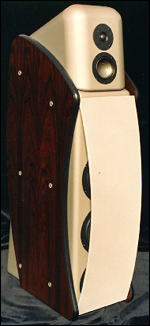 Which brings me to the Revel Salon loudspeaker. Before I ever heard this large, floorstanding dynamic loudspeaker, its appearance caught my attention. Like the huge concrete sails covering the Sydney Opera House, the Salon's curved rosewood side panels and bowed grille screen are gracefully pleasing to the eye. Both concert hall and loudspeaker please several senses at once. Description
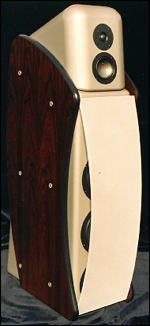
The Revel Salon is a four-way system with seven drive-units: two tweeters (1.1" on the front and 0.75" on the back), one 4" midrange, one 6.5" midbass, and three 8" woofers. These are set into a two-part cabinet more than a foot wide, more than two feet deep, and over four feet tall. The bottom section houses the midbass unit and the three woofers with their mica- and carbon-filled copolymer domes, all hidden behind the flying front grille. The woofers are reflex-aligned with a port tunnel 16" long and 4" wide, which flares to a 6"-diameter opening on the Salon's rear panel, just below the rear tweeter. Kevin Voecks, the Salon's designer, claims this multiple driver system better handles large dynamic bass peaks, dissipating heat buildup before it can cause compression. The large, flaring port was designed to not make "chuffing" sounds when the Salon is driven at high levels. Besides the reflex port and second tweeter, the rear panel features four gold-plated speaker terminals for biwiring, a low-frequency compensation control that gives ±2dB adjustment at 43.9Hz, and separate level controls for the front and rear tweeters.
The upper section houses the tweeters and the midrange unit, and protrudes above the side panels and cants backward, placing the tweeter 48" above the floor. The front tweeter, a 1.1" aluminum-alloy metal dome, replaces the Salon prototype's soft-dome fabric tweeter, now used in Revel's Ultima Gem loudspeaker. The combination of aluminum voice-coil, the optimized magnet structure, the specially formulated anodizing of the 28mm aluminum dome, the damping plug, the inductance and flux-modulation rings, and the stray-flux cancellation magnets are said to allow this transducer to operate in a pistonic manner out to 30kHz, its dome's first breakup mode. The tweeter's off-axis response is optimized by the top enclosure's smoothly curved baffle. Not being able to find a suitable OEM midrange driver, Revel designed and manufactured for the Salon its own 4" (102mm) concave titanium-diaphragm transducer. It employs an unusually large (1.5", or 38mm) voice-coil, optimized high-flux neodymium motor, and co-injected fluoroelastimer rubber surround, with a Faraday ring on the pole-piece to reduce magnetic distortion. This large motor structure allows the midrange to play at high levels without suffering from heat buildup and the resulting compression. The crossover uses fourth-order slopes, the drivers operated in their optimal range to yield the flattest off-axis and first-reflection responses. Each major section—tweeter, midrange, midbass, woofers—has its own crossover board populated with high-quality individual components. The crossover elements of each Salon are individually trimmed and matched to within 0.5dB of a design reference.
The Salon's fit'n'finish are the best I've come across. The rosewood side panels on my review samples had a luster and sheen that far exceed those of the fine furniture cabinets I have in my living room. The quality of the samples' Gray Heather high-gloss paint matched or surpassed finishes on loudspeakers costing two to three times as much. Hardware and connections are sturdy, gold-plated, easily accessible, and look like they'll last a lifetime.
Which brings me to the Revel Salon loudspeaker. Before I ever heard this large, floorstanding dynamic loudspeaker, its appearance caught my attention. Like the huge concrete sails covering the Sydney Opera House, the Salon's curved rosewood side panels and bowed grille screen are gracefully pleasing to the eye. Both concert hall and loudspeaker please several senses at once. DescriptionThe Revel Salon is a four-way system with seven drive-units: two tweeters (1.1" on the front and 0.75" on the back), one 4" midrange, one 6.5" midbass, and three 8" woofers. These are set into a two-part cabinet more than a foot wide, more than two feet deep, and over four feet tall. The bottom section houses the midbass unit and the three woofers with their mica- and carbon-filled copolymer domes, all hidden behind the flying front grille. The woofers are reflex-aligned with a port tunnel 16" long and 4" wide, which flares to a 6"-diameter opening on the Salon's rear panel, just below the rear tweeter. Kevin Voecks, the Salon's designer, claims this multiple driver system better handles large dynamic bass peaks, dissipating heat buildup before it can cause compression. The large, flaring port was designed to not make "chuffing" sounds when the Salon is driven at high levels. Besides the reflex port and second tweeter, the rear panel features four gold-plated speaker terminals for biwiring, a low-frequency compensation control that gives ±2dB adjustment at 43.9Hz, and separate level controls for the front and rear tweeters.