Although the component that actually produces the sound is obviously the loudspeaker, audiophiles know that everything in the system—digital or analog source, preamplifier, amplifier, cables, room acoustics—has an influence on sound quality. No matter how good the speaker, its performance depends on the quality of the signal, the speaker's acoustical environment, and how the speaker is set up in that environment. I've heard speakers that I knew to be topnotch performers sound dreadful at audio shows and in dealers' listening rooms. 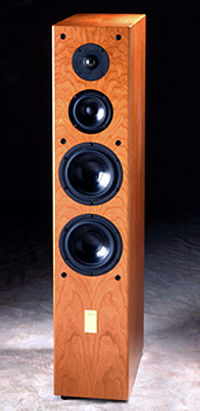 But not the speakers from Aerial Acoustics. I've heard various models at various times—usually at Stereophile HI-FI Shows and CES, but a few times at dealers—and I have literally never heard them sound bad. Sometimes the sound was quite spectacular, at other times it was just okay, but no Aerial Acoustics speaker has ever made me think of how soon I could leave the room without appearing to be rude. There could be several reasons for this. Aerial Acoustics designer Michael Kelly borders on being obsessive when it comes to speaker setup and selection of the right associated equipment for his speakers. He is also very careful in picking suitable demo material. Or maybe it's luck. Or maybe, just maybe, the speakers are simply very good. Description, design, setup
Compared to Aerial's top-of-the line 10T, with its separate molded midrange/tweeter module sitting atop a large bass enclosure, the 7B looks pretty conventional: a slim tower with twin 7" woofers, a 5" midrange, and a 1" tweeter. Nice enough looking, but not a major statement in industrial design. However, examine the 7B more closely and you'll notice ways in which it stands out from the competition.
For its size, this must be one of the heaviest speakers around—nearly 100 lbs each. The weight comes from 2"-thick walls, constrained-layer damping blocks, extensive bracing, and woofers with cast frames and large magnets. The midrange unit, custom-made for Aerial in Germany, is an unshielded version of Aerial's CC3 center-channel driver, and has its own wool-filled chamber within the enclosure. The tweeter, a vented metal-dome unit made exclusively for Aerial, is the same as the one in the 10T. The cabinet's joints are extremely tight, which contributes to the rigidity of the enclosure. The wood veneer (rose walnut on the review samples) has a symmetrical pattern on every side. The rounded edges are inlaid wood that matches the flat surfaces of the enclosure. The finish is impeccable. The 7B's crossover is built on two glass-epoxy circuit boards, and allows for biwiring. Crossover points and slopes are not specified, but Michael Kelly admits that the slopes are higher-order and vary from driver to driver. Wiring is the highest-purity copper, and connections are made with silver solder. The crossover uses air-core coils and polypropylene capacitors. The speaker comes with plastic feet that can be replaced with spikes, or with the optional spiked stand ($400/pair), which provides greater stability and improves bass quality and focus. The dedicated stand is particularly recommended for use on suspended wooden floors. That's what my listening room has, so I asked Aerial to include a pair. The stand is very heavy, and bolts on to the speaker in an extremely rigid manner. Unlike many stands I've seen, this one looks integral with the speaker, not like an add-on. The grille that covers the drivers is easily removed, which is what I did for all my listening. (The speaker looks just fine without the grille.)
By now, I've had enough floorstanding speakers in my listening room that I have a pretty good idea of where they're likely to sound best, give or take a few inches. I plunked the speakers down in approximately the same positions where I've had Audio Physic Tempos, Hales Revelation Threes and Transcendence Fives, as well as my reference Dunlavy SC-IV/As. As per Michael Kelly's recommendation, I tweaked speaker position without the stands being attached, which made moving the speakers much easier. The final position was on the long side of my 16' by 14' by 7.5' listening room, about 39" from the back wall and 32" from the side walls (measured from the center of the tweeter), forming about a 70 degrees angle from the listening seat. The speakers were toed-in a little more than halfway between straight-ahead and pointing-at-the-listener. Two sets of Argent RoomLenses, placed as "wings," formed a 45 degrees angle on the outside of each speaker, with a single RoomLens placed near the middle of the back wall. The 4' by 5' area of the wall behind the listening seat is covered with sound-absorbing material (foam packing with a shag rug over it). This setup gave me a wide soundstage with no hole in the middle. Sound
Applied to music, the term "easy listening" is often used as a put-down. Perhaps as an extension of the "No pain, no gain" principle, it's assumed that if music is easy to listen to, then it's probably not very good.
Some people think much the same way about loudspeakers. If a speaker is easy to listen to, if it doesn't continually remind you of all the deficiencies of recordings and associated equipment, then it must not be a true high-fidelity device. If you want to call yourself a real audiophile, you must be willing to suffer.
But not the speakers from Aerial Acoustics. I've heard various models at various times—usually at Stereophile HI-FI Shows and CES, but a few times at dealers—and I have literally never heard them sound bad. Sometimes the sound was quite spectacular, at other times it was just okay, but no Aerial Acoustics speaker has ever made me think of how soon I could leave the room without appearing to be rude. There could be several reasons for this. Aerial Acoustics designer Michael Kelly borders on being obsessive when it comes to speaker setup and selection of the right associated equipment for his speakers. He is also very careful in picking suitable demo material. Or maybe it's luck. Or maybe, just maybe, the speakers are simply very good. Description, design, setup Compared to Aerial's top-of-the line 10T, with its separate molded midrange/tweeter module sitting atop a large bass enclosure, the 7B looks pretty conventional: a slim tower with twin 7" woofers, a 5" midrange, and a 1" tweeter. Nice enough looking, but not a major statement in industrial design. However, examine the 7B more closely and you'll notice ways in which it stands out from the competition.
Applied to music, the term "easy listening" is often used as a put-down. Perhaps as an extension of the "No pain, no gain" principle, it's assumed that if music is easy to listen to, then it's probably not very good.