When I reviewed JBL's S38 loudspeaker for the June 2001 issue of Stereophile (Vol.24 No.6), I was impressed with the performance of this large, inexpensive ($599/pair) bookshelf speaker. When I received a press announcement at the end of 2005 announcing JBL's new affordable speakers, the Studio L series, which incorporates innovations developed for JBL's recording-studio monitors, I began a discussion with JBL's public-relations firm. They promised many significant design innovations and sonic improvements over the S series.
 The Studio L series includes three bookshelf models (two can be mounted on a wall), two floorstanding towers, two center-channel models, and a powered subwoofer. The line ranges in price from $650 to $1598/pair. When I asked for the Studio L model that JBL thought would provide the greatest bang for the buck, they chose the floorstanding Studio L880 ($1400/pair), one notch below the top of the line.
Design
The Studio L series includes three bookshelf models (two can be mounted on a wall), two floorstanding towers, two center-channel models, and a powered subwoofer. The line ranges in price from $650 to $1598/pair. When I asked for the Studio L model that JBL thought would provide the greatest bang for the buck, they chose the floorstanding Studio L880 ($1400/pair), one notch below the top of the line.
Design
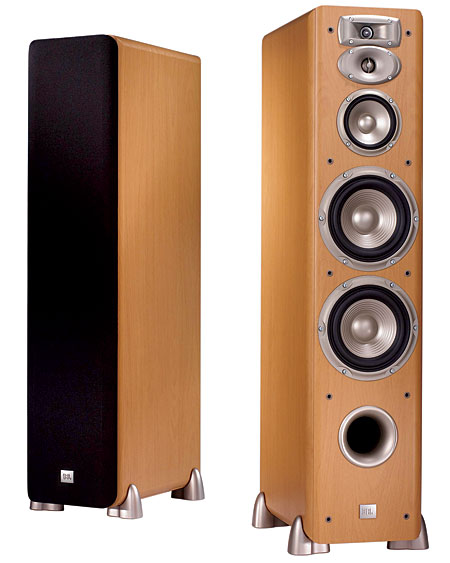
The Studio L880 is a four-way floorstanding array featuring a tweeter, midrange, and two woofers with a single front-loaded port, unusual in that it incorporates a supertweeter. This provides extended frequency response to 40kHz. Its ¾" driver element, which operates in conjunction with a specially designed horn with a 60° by 30° coverage pattern, uses a voice-coil mounted directly to a Mylar diaphragm. The 1" tweeter's dome is formed from a single rigid sheet of titanium with a highly flexible surround, and is housed in an Elliptical Oblate Spheroidal (EOS) waveguide designed to deliver the same response off axis as on. The EOS waveguide is made of aluminum to provide a more rigid surface for wave propagation.
The woofer and midrange cones are made of PolyPlas, a proprietary JBL material made of polymer-coated cellulose fibers, and use voice-coils constructed of oversize Kapton formers for increased efficiency and power handling. The driver frames are cast from aluminum. The woofers employ JBL's proprietary Symmetrical Field Geometry (SFG) circuit, which lowers woofer distortion by maintaining a symmetrical magnetic field. The MDF cabinets are thicker and claimed to be less resonant than previous affordable JBL designs. The L880 is biwirable and magnetically shielded, and is available in black ash, cherry, or beech finishes.
The L880 can be fitted with sharp spikes or soft, nubby feet. Although the spikes are designed for carpets and the feet for wooden floors, I wanted to make sure this speaker was properly anchored, particularly as JBL claims for it bass response down into the bottom octave. So I fitted the L880s with the spikes and the spikes atop quarters, to protect my wooden floor (footnote 1).
I tried the L880s with their grilles on and off. Removing the grilles added a slightly unnatural high-frequency emphasis that detracted from the speaker's overall coherence; I left them on.
Listening
If a speaker has a great midrange, that's what grabs me on first listen, and that was the case with the JBL 880. Jamie Saft's blistering grand-piano pyrotechnics on his Astaroth (CD, Tzadik TZ 7348), which features arrangements for jazz trio of John Zorn's Masada, Book Two, sounded much as this trio did when I saw them in concert earlier this year. The L880 was able to reproduce Saft's lightning-fast transients—reminiscent of a Conlon Nancarrow piano roll, actually—as I'd heard them live, and the speaker's rich lower midrange was sufficiently revealing to tell me that he was playing a particularly good Steinway grand. The dynamic range was astounding for a $1400/pair speaker: from ppp to fff on all well-recorded musical excerpts, the speaker sounded linear, organic, and without compression. Charles Lloyd's tenor sax on his Jumping the Creek (CD, ECM 1911) was vibrant and burnished, with a pleasantly forward midrange presence. Geri Allen's piano on this disc was as natural as Saft's, but I felt I'd heard more detail from this recording through other speakers. My similar reaction to the vibes solo on the Jerome Harris Quintet's cover of Duke Ellington's "The Mooche," from Editor's Choice (CD, Stereophile STPH016-2), led me to believe that the L880 may not be the last word in inner midrange detail. Not that it detracted from the naturalness of the midrange—in fact, the blat and spittiness of the trombone solo on that track sounded as realistic as I've heard it on an affordable speaker. All vocal recordings shone through the JBL. My notes from a listening session with the a cappella "Our Prayer," from Brian Wilson's SMiLE (CD, Nonesuch 79846-2), read: "silky, sumptuous, holographic splendor." The one coloration I noticed, on every recording I played through the L880s, was a slight lower midrange emphasis, though this seemed evenly distributed over a broad frequency band and never sounded hooty, resonant, or uneven. It was very easy to follow the pitches in the rapid double-bass passages of David Chesky's Violin Concerto, from Area 31 (CD layer, Chesky SACD282).
Further down in frequency, however, was where the L880 really strutted its stuff. This is the first affordable speaker I've auditioned that, subjectively at least, did not sacrifice definition or neutrality in reproducing convincing bottom-octave bass. All of the organ-pedal notes in John Rutter's Requiem (CD, Reference RR57-CD) were exactly equal in volume. More often than not when listening to this recording, I hear a slight fade as the organist approaches the bottom of the instrument's range—not this time. In fact, the JBL L880 reproduced the 32Hz C in John Atkinson's chromatic-scale test on Editor's Choice with no reduction in emphasis—a first in my experience of reviewing affordable speakers.
As expected, the combination of the L880's bass definition, dynamics, and transient capabilities turned Kraftwerk's "The Man Machine," from Minimum/Maximum (CD, EMI ASW 60611), into a sonic blockbuster. All synthesizers and electronic percussion were reproduced with lightning-fast transients without edge, and dramatically plunging bass.
Footnote 1: A speaker designer showed me this trick several years ago. When I replaced with quarters some fancy, expensive audiophile "coasters" designed to embrace spikes on wooden floors, I experienced tighter dynamics and less colored bass. The only problem is, my aggressive cleaning lady tends to move the speakers off the quarters, which she then places on my equipment stand. I end up with holes in my floor anyway.
The Studio L series includes three bookshelf models (two can be mounted on a wall), two floorstanding towers, two center-channel models, and a powered subwoofer. The line ranges in price from $650 to $1598/pair. When I asked for the Studio L model that JBL thought would provide the greatest bang for the buck, they chose the floorstanding Studio L880 ($1400/pair), one notch below the top of the line.
Design
The Studio L880 is a four-way floorstanding array featuring a tweeter, midrange, and two woofers with a single front-loaded port, unusual in that it incorporates a supertweeter. This provides extended frequency response to 40kHz. Its ¾" driver element, which operates in conjunction with a specially designed horn with a 60° by 30° coverage pattern, uses a voice-coil mounted directly to a Mylar diaphragm. The 1" tweeter's dome is formed from a single rigid sheet of titanium with a highly flexible surround, and is housed in an Elliptical Oblate Spheroidal (EOS) waveguide designed to deliver the same response off axis as on. The EOS waveguide is made of aluminum to provide a more rigid surface for wave propagation.
If a speaker has a great midrange, that's what grabs me on first listen, and that was the case with the JBL 880. Jamie Saft's blistering grand-piano pyrotechnics on his Astaroth (CD, Tzadik TZ 7348), which features arrangements for jazz trio of John Zorn's Masada, Book Two, sounded much as this trio did when I saw them in concert earlier this year. The L880 was able to reproduce Saft's lightning-fast transients—reminiscent of a Conlon Nancarrow piano roll, actually—as I'd heard them live, and the speaker's rich lower midrange was sufficiently revealing to tell me that he was playing a particularly good Steinway grand. The dynamic range was astounding for a $1400/pair speaker: from ppp to fff on all well-recorded musical excerpts, the speaker sounded linear, organic, and without compression. Charles Lloyd's tenor sax on his Jumping the Creek (CD, ECM 1911) was vibrant and burnished, with a pleasantly forward midrange presence. Geri Allen's piano on this disc was as natural as Saft's, but I felt I'd heard more detail from this recording through other speakers. My similar reaction to the vibes solo on the Jerome Harris Quintet's cover of Duke Ellington's "The Mooche," from Editor's Choice (CD, Stereophile STPH016-2), led me to believe that the L880 may not be the last word in inner midrange detail. Not that it detracted from the naturalness of the midrange—in fact, the blat and spittiness of the trombone solo on that track sounded as realistic as I've heard it on an affordable speaker. All vocal recordings shone through the JBL. My notes from a listening session with the a cappella "Our Prayer," from Brian Wilson's SMiLE (CD, Nonesuch 79846-2), read: "silky, sumptuous, holographic splendor." The one coloration I noticed, on every recording I played through the L880s, was a slight lower midrange emphasis, though this seemed evenly distributed over a broad frequency band and never sounded hooty, resonant, or uneven. It was very easy to follow the pitches in the rapid double-bass passages of David Chesky's Violin Concerto, from Area 31 (CD layer, Chesky SACD282).
Footnote 1: A speaker designer showed me this trick several years ago. When I replaced with quarters some fancy, expensive audiophile "coasters" designed to embrace spikes on wooden floors, I experienced tighter dynamics and less colored bass. The only problem is, my aggressive cleaning lady tends to move the speakers off the quarters, which she then places on my equipment stand. I end up with holes in my floor anyway.