When Wilson Audio Specialties' Peter McGrath offered me a pair of MAXX2 loudspeakers to review, I reminded him of just how small (15' by 21' by 8') my room is, and how close I sit to any speakers in it.
"Not a problem!" he responded confidently.
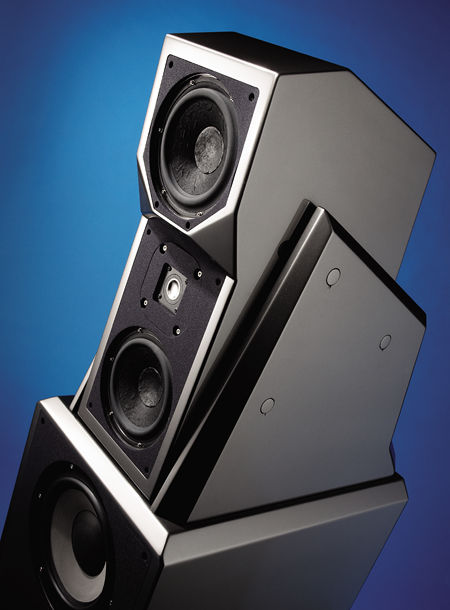
Yet the prospect of sitting only 10' from two looming, praying mantis–like towers almost as tall as I am gave me the willies. The way the Cyclops-like topmost midrange driver protrudes makes it seem as if it's staring at you. How could such an apparition get out of its own way?
 McGrath had already set up the WATT/Puppy 7s in my room, and he knew the MAXX2s and I didn't. Who was I to argue? But a MAXX2 bass box alone is larger than an entire WATT/Puppy 7. I just kept thinking about how, if my room's well-publicized bass-sucking abilities cut the rug out from under the MAXX2's prodigious bottom end, it would look worse for the accuracy of my observations than for Wilson Audio. And what good would such a mismatch do for Stereophile readers interested in knowing how these $45,000/pair speakers actually performed?
The MAXX2s had sounded anemic and blah in the Lamm room at the 2005 Consumer Electronics Show, and they'd overwhelmed the VTL room, where they sounded congested. But in the Audio Research space—wow! If I could get that sound at home, I'd have something. However, I'd been down that road before, with the Aerial 20T—a great speaker with plenty of bottom-end heft that packed an impressive wallop in a large Mirage Hotel suite, but that sounded neutered in my room when driven by the same Musical Fidelity electronics. But hey—if Wilson was willing to go through the considerable effort and expense of shipping me more than half a ton's worth of expensive speaker in three enormous crates, and if McGrath felt the speakers would work in my room, I was willing to give them a shot.
Provo
McGrath had already set up the WATT/Puppy 7s in my room, and he knew the MAXX2s and I didn't. Who was I to argue? But a MAXX2 bass box alone is larger than an entire WATT/Puppy 7. I just kept thinking about how, if my room's well-publicized bass-sucking abilities cut the rug out from under the MAXX2's prodigious bottom end, it would look worse for the accuracy of my observations than for Wilson Audio. And what good would such a mismatch do for Stereophile readers interested in knowing how these $45,000/pair speakers actually performed?
The MAXX2s had sounded anemic and blah in the Lamm room at the 2005 Consumer Electronics Show, and they'd overwhelmed the VTL room, where they sounded congested. But in the Audio Research space—wow! If I could get that sound at home, I'd have something. However, I'd been down that road before, with the Aerial 20T—a great speaker with plenty of bottom-end heft that packed an impressive wallop in a large Mirage Hotel suite, but that sounded neutered in my room when driven by the same Musical Fidelity electronics. But hey—if Wilson was willing to go through the considerable effort and expense of shipping me more than half a ton's worth of expensive speaker in three enormous crates, and if McGrath felt the speakers would work in my room, I was willing to give them a shot.
Provo
A few weeks before delivery, on a trip to Palm Springs to audition the latest Lexus–Mark Levinson car-audio system, I stopped in Provo, Utah, to visit Wilson Audio Specialties and see how they build speakers. Some speaker makers, such as Thiel and B&W (their more expensive products), build everything in-house. Others, like Audio Physic, outsource cabinets and drivers and do only the final assembly themselves, while some, such as Sonus Faber, outsource the drivers and build the cabinets in-house. All of these manufacturing methods are valid. Nor, in my opinion, does it make a whit of difference that some companies use off-the-shelf drivers while others commission custom-built ones from such respected driver makers as Vifa/ScanSpeak, Focal, and other familiar names.
Wilson sources most of its drivers from Focal and ScanSpeak, using either modified stock drivers (eg, the MAXX2's two Focal carbon-fiber/paper composite woofers, one 10.5", one 13"), "remanufactured" drivers (eg, the MAXX2's titanium inverted-dome Focal 1" tweeter, which has an additional magnet and a Wilson-made backwave enclosure), or OEM codeveloped proprietary drivers (eg, the MAXX2's 7" hybrid midrange units, made by ScanSpeak of paper pulp and synthetic carbon fiber).
Like Rockport Technologies and a few others, Wilson goes to heroic efforts to make its speaker cabinets as inert as possible. The value of inertness made itself known to me in my listening room a few years ago, five minutes into hearing the Rockport Antares.
On arriving at the factory, Dave Wilson sat me down and gave me a well-rehearsed dog-and-pony show of samples and resonance measurements of various enclosure materials, including MDF and Wilson's own M and X materials. The MAXX2's mid/high module is made of M, a constrained-layer laminated material that's hard on its outer surfaces, softer in the center, and has more uniform particle size throughout than MDF. The result is a material claimed to be both harder and more effectively damped than MDF. The material is difficult to work; all machining for Wilson speaker cabinets is done in-house.
Dave Wilson claims that X, a phenolic-based composite, is harder than steel and is as inert a material as Dave Wilson has been able to obtain. X is used for the MAXX2 woofer cabinet's top and bottom plates and is even more difficult to machine than M (which makes up the rest of the woofer enclosure). Only Wilson's X2 Alexandria loudspeaker is all-X.
Then we entered the factory, where I saw the two enormous machines that slice and drill these materials to produce cabinet components. The time-consuming hand-sanding of individual parts comes next, followed by assembly using different, carefully chosen adhesives for the MAXX2's different sections. That's followed by pre-paint prep. Finally, the various boxes and pieces go into the paint booth for multiple coats and a final clear coat. For this part of the process, Wilson has built what is essentially an automotive paint shop. The speakers are available in many different standard colors, with custom colors available as options. It takes weeks to finish building and painting a pair of MAXX2s, which is one reason they're back-ordered, as are the more expensive Alexandrias.
As we toured the factory, Wilson and his wife, Sheryl Lee, made sure I knew that their factory workers are provided with full healthcare coverage and matching 401K plans. When you buy a $45,000/pair loudspeaker that's made in America and built in-house, you're also paying for the non–Wal-Mart wages and benefits that Wilson feels are his obligation to his loyal team.
Until you actually see what goes into designing and building a finished, labor-intensive, meticulously built product such as the MAXX2, the WATT/Puppy 7, or any other complex loudspeaker design, it's difficult to understand just how time-consuming and expensive it is to produce. When you buy such a product, you're paying for the raw materials and labor time, of course. And while some cynics stop there when considering the final price of a high-performance audio product and find the difference between their estimation of the costs and the final price simply appalling, there's far more to consider—such as the crating and shipping. It costs more to ship the MAXX2's three crates, which weigh a total of 1100 lbs, than many budget loudspeakers cost to buy.
You're also paying for a portion of what it costs to run a factory, and to pay workers a decent wage and bennies. And, of course, there are the profit margins at wholesale and retail. True, a pair of MAXX2s cost more than some very good cars, but they're not built on an assembly line, and not sold in numbers that allow for economies of scale. If you don't like this capitalist system, build your own pair using "off-the-shelf" drivers. Good luck to ya!
Up front and personal
An update of the original MAXX, introduced in 1998, the MAXX2 features subtle exterior refinements that give it a somewhat more graceful look, as well as many mechanical and electrical changes more difficult to see. The most obvious of the latter is a very small port in the upper unit, which had been a sealed box in the MAXX. New grille-cloth material and a more sophisticated means of attachment help give the MAXX2 a more self-contained, less cluttered appearance. Changes have been made to the drivers (the tweeter is based on Focal's latest) and crossover network as well. There is an update program for owners of the original MAXX (reviewed by Martin Colloms in May 1999, Vol.22 No.5).
Each MAXX2 consists of two sections. The rear-ported bass unit, 3' tall and almost 2' deep, contains modified 13" and 10.5" Focal paper-cone woofers said to be fitted with enormous magnet assemblies and rugged, heavy-duty voice-coils. The complex, multi-angled, mid-/high-frequency head unit weighs about 75 lbs and has two ported, proprietary ScanSpeak 7" midrange drivers made of a hybrid of pulp and carbon fiber, and a 1" modified Focal titanium inverted-dome tweeter. These drivers are in a modified D'Appolito configuration, with the top midrange driver about 2" forward of the lower one and angled slightly down for greater focus. In the woofer cabinet is a potted crossover network, with separate sets of cables for the midrange drivers and tweeter routed through top openings and attached to the upper unit's terminal block, which is fitted with double sets of hefty Wilson binding posts.
The angle at which the mid/high unit fires at the listening position is adjustable via a massive, sliding, 30-position stepped block of brass bolted to the top of the bass cabinet. Measure the distances of your ear (at your listening position) from the mid/high unit and from the ground, and consult the chart in the instruction manual to determine the exact angle and the ideal length of spike needed to achieve the proper rake. Once the mid/high unit is properly angled between the two "wings" attached to the top of the woofer box, you complete the alignment by installing three sets of nylon spacer screws through the wings unit until they make contact with the mid/high unit's sidewalls. The separate upper cabinet's spiked interface offers a degree of decoupling from the woofer box.
All this done, you're looking at an imposing, 5' 3"-tall tower with multiple drivers and a complex radiating pattern that would seem difficult, if not impossible, to integrate into a seamless sonic picture—especially from only 8' away. Having woofers of different size firing in the same cabinet is an unusual design; it can create at the port backwaves that are difficult to predict and control. Fortunately, Wilson had help with the design from staff engineer Vern Credile, who has master's degrees in air turbulence and acoustical engineering, as well as a degree in electrical engineering. Both woofers are run down to their lowest frequency response. The combination is said to offer greater speed from the smaller driver and deeper extension from the larger.
The rear port, machined from solid aluminum, is huge: a foot long and 5" in diameter. Between it, the two massive bass drivers, and the large box, which is well-damped and -braced, the MAXX2's low-end response is said to extend down to 20Hz. The crossover points are not specified, but subtle changes in the speaker's overall tonal balance can be achieved by swapping out resistors placed behind an aluminum panel on the rear of the upper enclosure. Wilson provides an assortment of resistors for this purpose, but they didn't prove necessary in my well-treated, essentially neutral room.
The toughest part of the setup (dealer installation is included in the price) is fitting the bulky, 75-lb upper unit between the wings on top of the woofer cabinet. The process takes good aim and two pairs of strong, steady hands. One slip and you're looking at an ugly expanse of chipped paint. (Your dealer will be very careful.) Positioning the speakers is made easy by large casters. You just roll them around till you're satisfied, then jack up each speaker and install spikes. Wilson Audio supplies the snazziest floor jack you've ever seen. I had a friend help me assemble the speakers, but left their final positioning to Peter McGrath. Even still on wheels and not on their final marks (though the locations I'd chosen were pretty close to McGrath's), the MAXX2s delivered all I could possibly have hoped for. And much more.
Cursing, laughing
Having heard the MAXX2s in many different venues, every one of them larger than my room, I knew what they were capable of achieving. I just didn't expect to get the full effect in my room. Boy, was I surprised. My usual assortment of listening pals, ranging from casual audiophiles to name-brand mastering engineers, all reacted similarly on hearing the MAXX2s reproduce whatever recording they played first: laughing and cursing, cursing and laughing, expletives not deleted.
First of all, the MAXX2 delivered its full rated low-frequency performance in my room without apology. A 20Hz test tone shook the rafters and rattled the windows—and anything else that wasn't screwed down or heavy enough to resist. But forget about test tones. The MAXX delivered the deepest, tightest, most pitch-precise bass I've ever heard in my room—fast, tight, and nonmechanical, with unlimited dynamic expression and never a hint of overloading the room. No excuses, no caveats, no disappointments. Finally, here was the tight-fisted, stomach-crunching bottom-end performance promised by many others but delivered in my room (and elsewhere, as I'd heard for myself) only by the MAXX2.
More impressive was the complete lack of excessive midbass overhang or sloppiness. There was deep, believable extension, not heard as "bass" but as the natural extension of the range of the instrument producing it. The difference between what the MAXX2 and every other speaker I've auditioned here could produce on the bottom could be heard upstairs, where, instead of complaining about how the whole house was shaking and to please turn it down (way down), my wife claimed to have noticed hardly anything. Meanwhile, downstairs in the listening room, I was being pleasantly assaulted in the most positive of ways. How ideal is that?
I listen to a lot of rock music. In terms of its low-frequency extension, speed, suppleness, freedom from obvious coloration, and ability to play just plain LOUD, the MAXX2 was easily the best rock speaker I've ever heard. Nothing in my experience comes close. Drum kit in the room? No problem for the MAXX2s. They created a most convincing drum kit, from the kick to the smallest cymbals, in terms of extension, timbre, texture, dynamics, and spatial perspective. A rock-loving major-label exec who paid a visit to hear the Wilsons concurred.
I heard the same stupendous low-frequency performance in the Audio Research room at CES and at the home of Wilson Audio marketing director John Giolas, but both were much larger rooms than mine. For whatever reasons, the MAXX2 could express its full bottom-octave performance in rooms large or small.
But my friends—audiophile, professional, and novice alike—were reacting to far more than the MAXX2's effortless low-frequency performance, or its ability to play loud, louder, and nauseatingly loudest while maintaining full dynamic expression and composure. There was something almost bizarre about sitting fewer than 8' from these imposing towers and hearing them produce an absolutely seamless, perfectly integrated picture that allowed them to "disappear" without a trace. That's what the MAXX2s did every time—even before Peter McGrath had optimized their setup. In this, they performed very similarly to the Rockport Antares.
McGrath had already set up the WATT/Puppy 7s in my room, and he knew the MAXX2s and I didn't. Who was I to argue? But a MAXX2 bass box alone is larger than an entire WATT/Puppy 7. I just kept thinking about how, if my room's well-publicized bass-sucking abilities cut the rug out from under the MAXX2's prodigious bottom end, it would look worse for the accuracy of my observations than for Wilson Audio. And what good would such a mismatch do for Stereophile readers interested in knowing how these $45,000/pair speakers actually performed?
A few weeks before delivery, on a trip to Palm Springs to audition the latest Lexus–Mark Levinson car-audio system, I stopped in Provo, Utah, to visit Wilson Audio Specialties and see how they build speakers. Some speaker makers, such as Thiel and B&W (their more expensive products), build everything in-house. Others, like Audio Physic, outsource cabinets and drivers and do only the final assembly themselves, while some, such as Sonus Faber, outsource the drivers and build the cabinets in-house. All of these manufacturing methods are valid. Nor, in my opinion, does it make a whit of difference that some companies use off-the-shelf drivers while others commission custom-built ones from such respected driver makers as Vifa/ScanSpeak, Focal, and other familiar names.
An update of the original MAXX, introduced in 1998, the MAXX2 features subtle exterior refinements that give it a somewhat more graceful look, as well as many mechanical and electrical changes more difficult to see. The most obvious of the latter is a very small port in the upper unit, which had been a sealed box in the MAXX. New grille-cloth material and a more sophisticated means of attachment help give the MAXX2 a more self-contained, less cluttered appearance. Changes have been made to the drivers (the tweeter is based on Focal's latest) and crossover network as well. There is an update program for owners of the original MAXX (reviewed by Martin Colloms in May 1999, Vol.22 No.5).
Having heard the MAXX2s in many different venues, every one of them larger than my room, I knew what they were capable of achieving. I just didn't expect to get the full effect in my room. Boy, was I surprised. My usual assortment of listening pals, ranging from casual audiophiles to name-brand mastering engineers, all reacted similarly on hearing the MAXX2s reproduce whatever recording they played first: laughing and cursing, cursing and laughing, expletives not deleted.