I first heard Eugene Gigout's pipe-organ masterpiece, the Grand Chorus in Dialogue, in the Smetana Concert Hall of Prague's Municipal House (Obecnim Dome) on a Saturday evening before the 2002 flood. I recall seeing the delicate, youthful Michele Hradecka sway from side to side to reach the pedals. In response, a massive wall of deep organ chords shook the hall, the magical acoustic blending the delicate, extended highs with the thunderous bass. But this memory mixed the music with the beauty of Prague's soaring church spires, brilliant red terracotta roofs, and lavish palaces. 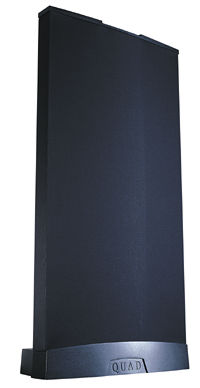 Similarly, Quad's ESL-989 electrostatic loudspeaker caught my visual attention before I ever heard them. I was already strongly attracted to the speaker for its unique place in the history of high-end audio. Just as Prague's historical richness enhanced the classical-music performances I heard, the Quad ESL's unique reputation was appealing on its own. History and Rebirth
The ESL-989 is the fourth version of the longest-surviving consumer-grade electrostatic speaker, which is now approaching its 45th year of sales. Back in 1989, when I last did a full review of a Quad ESL for Stereophile, it was one of only 11 full-range electrostatic systems listed among 1376 loudspeakers in Audio magazine's "Annual Equipment Directory." These 11 models were made by only four of the 257 speaker companies listed. Today, full-range electrostatic speakers are even rarer. The first Quad loudspeaker was the ESL-57 (the number indicates the year of design), which remained in production for 25 years. It employed a "constant charge" feature to distribute electrons across its entire Mylar diaphragm. The speakers' curved rectangular panels imaged beautifully, yielding an extraordinarily lucid midrange, speed, and transparency.
However, owning a pair of ESL-57s required dedication and a generous masochistic streak. The speaker had low power handling, high-frequency beaming, limited bass response, and widely fluctuating impedances. The driving amplifier had to be able to handle the '57's capacitive load, whose impedance fell to 1 ohm at high frequencies. This required an amplifier designed to swing low amounts of voltage while remaining stable; the Quad 303 and the Levinson ML-2 worked the best. Nor was that all. Configured as a gnarly, stubby panel, the speaker was often mistaken for an oversized space heater. Left on, it sucked up dust and grime as its panels filtered the air. Worst of all was the danger of arcing—the flickering blue lights in the panel that signaled diaphragm perforation and destruction. Wilson's Peter McGrath, then running Sound Components in Miami, offered to teach me how to do my own Quad repairs using rolls of Mylar and a hairdryer. Quad designer Peter Walker sought electrical and sonic relief in the next generation, the ESL-63, which premiered at the 1981 CES (footnote 1) and featured two major innovations. The first was the speaker's unique radiating element, which used driver plates that employed a printed circuit board of concentric rings fed by delay lines comprising some 12 miles (!) of wire, which allowed the flat diaphragm to radiate the sound first at the center and last at the periphery, as if it were a radiating sphere—the ideal shape for approximating sound emanating from a point source 12" behind the panels.
The ESL-63's single electrostatic element also eliminated the Venetian-blind, treble-beaming effect found in speakers with multiple panels. This design had near-perfect phase coherence, as shown by Quad's show-stopping demos, in which two squarewaves out of phase with each other were fed to two Quad speakers. A microphone placed between the speakers showed that the two signals canceled each other out completely. The ESL-63's second major innovation was its triac clamping circuit, to protect the speaker from arcing. The circuit operated by limiting voltage at the input. If that failed, the input was shorted by an electrical "crowbar," activated by an RF "sniffer" that detected the ionization of air that occurs just before an electrostatic speaker arcs. Other improvements were on the way. In 1983, Quad changed the ESL's protection circuitry so that the speaker could tolerate higher voltage levels, increased its shutdown time to four seconds, modified the metal grille louvers to reduce resonances, and built a pad into the dustcover to damp a 60Hz resonance (footnote 2). In addition, a brisk aftermarket industry of Quad modifications emerged: stands from Arcici to replace Quad's own Stand and Deliver units, new grillecloths, new AC connections, rewiring internal connections with heavier cables, capacitor bypasses, and replacing the snap-in power-cord terminals.
Footnote 1: See Reg Williamson's detailed description of the Quad ESL-63 in Speaker Builder, February 1982, Vol.3 No.1.Footnote 2: See Anthony Cordesman's review in Stereophile, Vol.7 No.7.
Similarly, Quad's ESL-989 electrostatic loudspeaker caught my visual attention before I ever heard them. I was already strongly attracted to the speaker for its unique place in the history of high-end audio. Just as Prague's historical richness enhanced the classical-music performances I heard, the Quad ESL's unique reputation was appealing on its own. History and Rebirth The ESL-989 is the fourth version of the longest-surviving consumer-grade electrostatic speaker, which is now approaching its 45th year of sales. Back in 1989, when I last did a full review of a Quad ESL for Stereophile, it was one of only 11 full-range electrostatic systems listed among 1376 loudspeakers in Audio magazine's "Annual Equipment Directory." These 11 models were made by only four of the 257 speaker companies listed. Today, full-range electrostatic speakers are even rarer. The first Quad loudspeaker was the ESL-57 (the number indicates the year of design), which remained in production for 25 years. It employed a "constant charge" feature to distribute electrons across its entire Mylar diaphragm. The speakers' curved rectangular panels imaged beautifully, yielding an extraordinarily lucid midrange, speed, and transparency.
Footnote 1: See Reg Williamson's detailed description of the Quad ESL-63 in Speaker Builder, February 1982, Vol.3 No.1.Footnote 2: See Anthony Cordesman's review in Stereophile, Vol.7 No.7.