| Columns Retired Columns & Blogs |

KLH Model Nine loudspeaker
Editor's Note: Although this product has been available for several years, it is being reviewed in considerable detail because it is a strong contender for the title of "Best Available Loudspeaker System, Regardless of Cost," and because we plan to review some of the other contenders for the same title within the next few issues. We feel that since all of these systems represent a considerable outlay of money, prospective buyers should have a thorough understanding of the merits and demerits of each system, so they will know what to expect from them in the way of performyince capabilities and operational requirements.
Footnote 1: Pronounced "boo-clay," according to our office dictionary.
 The following report is longer than usual, simply because the closer a reproducer comes to approaching theoretical perfection, the more it benefits from attention to small details in its installation and use.
In theory, most of the benefits accruing to the electrostatic principle are in the high-frequency range, where smoothness, extended range and good transient response are difficult to achieve in a dynamic speaker. This has prompted most designers to limit their electrostatics to the middle and upper-frequency ranges, while relegating the low end to a conventional cone-type woofer. The KLH Nine is one of the few existing designs which strives to span the entire audio range with electrostatic elements.
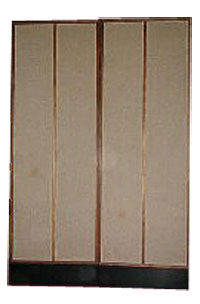
The complete KLH Nine system consists of two large, flat panels, closely resembling decorator-type room-divider screens both in shape and in appearance. Each panel is framed with finely finished wood, and the front surface is covered with boucle fabric (footnote 1). The rear surface is covered with a finely perforated metal screen, and a similar metal screen lies behind each grille cloth, to protect the radiating elements.
Each panel contains a complete two-way, full-range electrostatic system. A small square panel at the middle of one edge serves as a tweeter above about 2kHz, while the entire lower range is handled by eight large strips of diaphragm material that almost completely cover the remaining frame area. The two panels are mirror images of one another; one has the tweeter located at the left, the other at the right.
Each panel has its own polarizing supply (6kV), and hermetically sealed into a heavy metal case that attaches to the rear bottom of the panel and serves as a base to support the panel upright on the floor. Each power supply draws 5W at 115V AC, and 15' AC cords are supplied. The supplies are fully fused.
KLH suggests a choice of two basic setup arrangements: with the speakers side by side in a shallow V configuration, or separated by some distance, for wider stereo spread. Because of their two-sided radiation, however, they should not be located closer than about 4' from any parallel wall surface, as this will inhibit low-end radiation and may cause midrange standing-wave problems.
Listening
For the initial tests on our KLH Nine, we placed the panels together, using the special metal straps that are provided to couple the frames, and located the system near one end of a 20' by 13' by 9' room, in an area that has proven to be satisfactory with other speakers. An oscillator sweep failed to reveal any audible peaks or dips or harmonics, but we did find one spot near the low end where there were loud metallic rattles from the edge of one of the perforated rear screens. For some reason, slight twisting of the panel frame eliminated the rattles, and they have never since recurred.
High-frequency distribution was judged to be quite poor. Each small, flat tweeter panel radiates an increasingly narrow beam with a rising response at frequencies above about 2kHz. At 5kHz, the beam was judged to be about 30° wide, while at 10kHz it was barely more than about 10°. The speakers can be aimed so that neither beam reaches a listening area, and this will offset most of the highend rise, but unless some care is taken to do this, stereo imaging will be quite poor and the sound will be excessively toppish.
The system's overall response, off the tweeter axes, sounded almost perfectly smooth from well beyond audibility (14kHz in our case, and verified to beyond 20kHz with a condenser microphone) to around 40Hz. There was a slight high-end rise above about 3kHz, but for some reason, this did not add any spit or sizzle to the sound; it just seemed to impart an open, airy quality to it. There was no slow rolloff or humped response at the low end; it hit 40Hz and then dropped off very rapidly. (We should point out that, of the other systems that extend significantly below 40Hz, practically all of them have a peak at 40 or above, which acts to exaggerate lows and to mask the audibility of the extreme lows.)
With some experimentation, we were able to place the KLH Nine where its low-end radiation throughout the room extended down to a useful 35Hz, but were unable to elicit much of anything from it below that. There was no low-end fluttering; when it dropped out, it just went silent.
Note that the foregoing observations about the KLH 9's low-end performance apply when the two panels are placed side by side. Unfortunately, this arrangement tends to kill most of the stereo effect except when listening from a distance of 8' or less, and when the panels are separated, to improve the stereo spread, the system's entire low end was noticeably impaired. Instead of linear response to 40Hz and a sharp drop-off below that, the whole bass range below about 70Hz exhibited a slow rolloff. There was still usable output at 40Hz, but it was weak, and there was virtually nothing below it.
Footnote 1: Pronounced "boo-clay," according to our office dictionary.
NEXT: Page 2 »
 | |||||||||||

|
|
| |||||||||
- Log in or register to post comments







| Loudspeakers Amplification Digital Sources | |
Analog Sources Accessories Featured | |
Music Columns Retired Columns | |
Show Reports | |
Features Latest News Community | |
Resources Subscriptions |
 © 2024 Stereophile
AVTech Media Americas Inc., USA
All rights reserved