Got a garage, a router, and a band saw? Poof! You're a speaker designer. How many audiophiles dream of buying some raw drivers, some MDF and veneer, building a baffle, soldering up a computer-designed crossover, and assembling the Shmendrick Audio 2001? Plenty.  The rest of the fantasy goes like this: You book a room at the Consumer Electronics Show and, driving the new speakers with your home stereo system, you wow the journalists, the dealers, and the foreign distributors. Your speaker is the talk of the show. You head home with a half-million dollars in orders and quit your day job. CES veterans have seen the dreamers come and seen them go—and God bless 'em for reaching for the brass tiptoe on the not-so-merry-go-round that is high-end audio. But some survive and prosper. To the casual observer, Aerial Acoustics' Michael Kelly seems to have lived that dream: back in 1991, he showed up at CES with his Model 10T loudspeaker and it was an instant hit. Are You Experienced?
The real story, of course, is far more complicated. Kelly is an industry veteran who worked at a/d/s/ for 12 years designing drivers and loudspeakers. A Kelly design, the a/d/s/ 320i plate loudspeaker, was one of 1980's most highly regarded car speakers. I've had four of them in my Saab 96 for over 15 years; despite the hostile environment and the insane levels at which I play them, they still rock. Kelly also designed the tweeter in the later, equally successful 300i. When he left the company in 1986, Kelly was executive vice president in charge of research and development.
In 1989, armed with his knowledge of driver design, his contacts at the major European speaker manufacturers, his appreciation of the rigors of the bottom line gleaned from more than a decade of corporate culture, and his latest achievement—an MBA—Kelly begin designing his own speakers. Two years later, Aerial Acoustics was incorporated and the 10T was introduced to the public. Another "overnight" success. The Conservative Approach
Instead of coming up with a radical new technology or a flashy-looking design, Kelly took a seemingly more difficult path, designing a speaker with a clear precedent: the 10T appears to be nothing more than a meticulously worked-over, more-bang-for-the-buck, seriously updated version of 1977's precedent-setting KEF R105—a highly regarded, revolutionary loudspeaker that also employed a large woofer in a box topped with a smaller, swiveling composite enclosure containing midrange and high-frequency drivers. What made the 10T an instant and continuing success (footnote 1) is its combination of conceptual conservatism, innovation in material design and use, superb build quality, fanatical attention to every detail, and full-range performance—all at a ridiculously low price by high-end standards. Oh—and it sounds good, too. Turning the 10T on its side, or Audio Physic Virgos on steroids
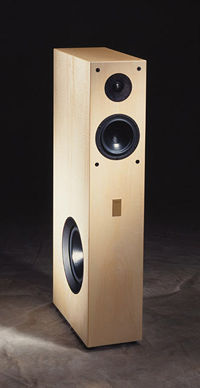
Perhaps, as Kelly told me, he never saw the Audio Physic Virgo when he conceived of and designed the Aerial 8, but the similarities are striking. They're what attracted me to the speaker in the first place, and what had many at their 1997 WCES debut saying they looked like "Virgos on steroids." Like the Virgo, the 8 is a narrow-front-baffle, deep-box design that accommodates a side-firing woofer.
Kelly's goal for the 8 was to design a speaker that would perform like the 10T but use far less floor space and look more graceful. Clearly, home theater was on his mind. Though the 8 was not designed specifically for that market, its cool, smooth appearance and small-width footprint are far more living-room- (and spouse-) friendly than the boxy 10T. The 8's graceful dimensions make it look deceptively small. In fact, it's a fairly large (45" H by 9" W by 20" D), box weighing in at 120 lbs. Starting at the bottom, the 8 duplicates the 10T's bass system: a +10"-diameter woofer incorporating a 2" voice-coil and a large magnet in a 61-liter rear-ported box tuned to 19Hz. The enclosure's resonance point is higher than the driver's operational bandwidth. According to Kelly, the driver "never breaks up or compresses dynamics."
Footnote 1: Wes Phillips enthusiastically reviewed the 10T for Stereophile in April 1996 (Vol.19 No.4). It was subsequently voted Stereophile's Joint Loudspeaker of 1996.—John Atkinson
The rest of the fantasy goes like this: You book a room at the Consumer Electronics Show and, driving the new speakers with your home stereo system, you wow the journalists, the dealers, and the foreign distributors. Your speaker is the talk of the show. You head home with a half-million dollars in orders and quit your day job. CES veterans have seen the dreamers come and seen them go—and God bless 'em for reaching for the brass tiptoe on the not-so-merry-go-round that is high-end audio. But some survive and prosper. To the casual observer, Aerial Acoustics' Michael Kelly seems to have lived that dream: back in 1991, he showed up at CES with his Model 10T loudspeaker and it was an instant hit. Are You Experienced? The real story, of course, is far more complicated. Kelly is an industry veteran who worked at a/d/s/ for 12 years designing drivers and loudspeakers. A Kelly design, the a/d/s/ 320i plate loudspeaker, was one of 1980's most highly regarded car speakers. I've had four of them in my Saab 96 for over 15 years; despite the hostile environment and the insane levels at which I play them, they still rock. Kelly also designed the tweeter in the later, equally successful 300i. When he left the company in 1986, Kelly was executive vice president in charge of research and development.
Instead of coming up with a radical new technology or a flashy-looking design, Kelly took a seemingly more difficult path, designing a speaker with a clear precedent: the 10T appears to be nothing more than a meticulously worked-over, more-bang-for-the-buck, seriously updated version of 1977's precedent-setting KEF R105—a highly regarded, revolutionary loudspeaker that also employed a large woofer in a box topped with a smaller, swiveling composite enclosure containing midrange and high-frequency drivers. What made the 10T an instant and continuing success (footnote 1) is its combination of conceptual conservatism, innovation in material design and use, superb build quality, fanatical attention to every detail, and full-range performance—all at a ridiculously low price by high-end standards. Oh—and it sounds good, too. Turning the 10T on its side, or Audio Physic Virgos on steroids
Perhaps, as Kelly told me, he never saw the Audio Physic Virgo when he conceived of and designed the Aerial 8, but the similarities are striking. They're what attracted me to the speaker in the first place, and what had many at their 1997 WCES debut saying they looked like "Virgos on steroids." Like the Virgo, the 8 is a narrow-front-baffle, deep-box design that accommodates a side-firing woofer.
Footnote 1: Wes Phillips enthusiastically reviewed the 10T for Stereophile in April 1996 (Vol.19 No.4). It was subsequently voted Stereophile's Joint Loudspeaker of 1996.—John Atkinson