"Well, Sam, are there any speakers you are really excited about?"
It was my friend Vladimir, on the phone.
 "Yes, the Rasputin speakers from Petersburg. But in order to sound their best, they need this tube amp—the Balgalvis from Riga, Latvia. They also need Moldavian wire, from a wire factory in Kishiniev, which used to make wire for the Soviet military. It's kind of hard to get the system together nowadays, what with the old Union gone."
Vladimir thought for a minute, then realized I was putting him on. Maybe.
"I have heard of this Moldavian wire."
So I have I. (Really.) But the rest was fiction.
"April Fool," I said to Vladimir.
"But it's February."
"April issue," I said.
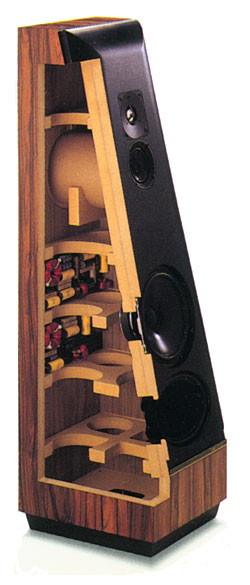
Seriously...I have found a pair of speakers that I can recommend highly without a bunch of ifs, ands, and buts...the Thiel CS2 2s (footnote 1) at a very reasonable $2250/pair.
These are big—well, fairly big—floorstanding speakers. Three-way with passive radiators. You obviously get a lot for your money, including superb fit and cabinet finish. And you'll never need to invest in a pair of expensive stands.
Sound good?
Yes, these speakers are good. So good, in fact, that I can't find anything wrong with them. (Perhaps if I try...)
First, the bass is very good. I'm not talking about deep, deep bass from Down Below—like you get with the Unity Audio Fountainhead Signatures (for more than twice the price). But the bass is deep, even in my listening room. And the bass doesn't boom.
The midrange has the same rightness of timbre and seductive sweetness that I hear with the Spendor S100 and the Celestion 700SE. Anyone who has ever thought that Thiel speakers tend to sound a little cold should hear these. The treble does not go over the top. (If anything, the treble may be a touch rolled off—perhaps not a bad thing.)
What's more, the speakers can play moderately loud, and the imaging—if you get the speakers sited properly—can be very good. I haven't heard that breathtaking "suspended in space" sound that I heard with the early pairs of Scientific Fidelity Teslas—but, on the other hand, I haven't yet heard the Thiels with a pair of first-rate tube amps like the VACs.
I can tell you that the Thiels are very revealing of different amps—and different components generally. The new Meridian 605 monoblock amps are superb with the Thiels—although I may need to change speaker cables to get a bit more life at the top. (I'd be a little wary of tube amps with these 4 ohm speakers. The Music Reference RM9, for instance, equipped with EL34s, did not produce the most satisfying bass.)
Resolution of fine detail is very good—better, I thought, than with the Spendor S100—but not extraordinary. For extraordinary resolution, perhaps you need to spend more money—much more money—for speakers such as the Wilson WATT 3s, the Monitor Audio Studio 20s, the Avalon Eclipses or Ascents, or the Thiel CS5s.
True, too, these Thiels could play louder and go lower. But that's why Thiel makes bigger speakers (for more money). The point is, I can live with the Thiel CS2 2s. They do a lot to satisfy, and nothing to irritate. Even if they cost $3000/pair, I'd have to rate them an excellent buy. At $2250/pair, these Thiels are a steal.
What I admire most about these speakers is the fact that the product is so professionally done. The cabinetry is impeccable. I get the feeling that these speakers are the result of many months, perhaps years, of careful research, engineering, and listening—not something that was rushed to market half-finished, with revisions to follow.
As you've probably gathered, there are very few speakers that I can recommend with great enthusiasm. I'm very keen on these Thiels. Of course, they deserve a thorough write-up by another Stereophile reviewer; but meanwhile, I've asked JA to put them, tentatively, in "Recommended Components," Class B. From me, a solid recommendation.
Footnote 1: The CS2 2 was originally the CS2.2 (two point two), but under the threat of a lawsuit from Bose, who had trademarked several decimal numbers for speakers of their own, including "2.2," Thiel replaced the decimal point with a space. This is curious on two points. First, my reference books imply that simple numbers cannot be trademarked; second, I can't see how anyone would confuse a Bose speaker with one from Jim Thiel. I suspect that in cases like this, the corporation with the larger legal and financial resources is the one liable to get its way.—John Atkinson
"Yes, the Rasputin speakers from Petersburg. But in order to sound their best, they need this tube amp—the Balgalvis from Riga, Latvia. They also need Moldavian wire, from a wire factory in Kishiniev, which used to make wire for the Soviet military. It's kind of hard to get the system together nowadays, what with the old Union gone."
Vladimir thought for a minute, then realized I was putting him on. Maybe.
"I have heard of this Moldavian wire."
So I have I. (Really.) But the rest was fiction.
"April Fool," I said to Vladimir.
"But it's February."
"April issue," I said.
Seriously...I have found a pair of speakers that I can recommend highly without a bunch of ifs, ands, and buts...the Thiel CS2 2s (footnote 1) at a very reasonable $2250/pair.
These are big—well, fairly big—floorstanding speakers. Three-way with passive radiators. You obviously get a lot for your money, including superb fit and cabinet finish. And you'll never need to invest in a pair of expensive stands.
Sound good?
Yes, these speakers are good. So good, in fact, that I can't find anything wrong with them. (Perhaps if I try...)
First, the bass is very good. I'm not talking about deep, deep bass from Down Below—like you get with the Unity Audio Fountainhead Signatures (for more than twice the price). But the bass is deep, even in my listening room. And the bass doesn't boom.
The midrange has the same rightness of timbre and seductive sweetness that I hear with the Spendor S100 and the Celestion 700SE. Anyone who has ever thought that Thiel speakers tend to sound a little cold should hear these. The treble does not go over the top. (If anything, the treble may be a touch rolled off—perhaps not a bad thing.)
What's more, the speakers can play moderately loud, and the imaging—if you get the speakers sited properly—can be very good. I haven't heard that breathtaking "suspended in space" sound that I heard with the early pairs of Scientific Fidelity Teslas—but, on the other hand, I haven't yet heard the Thiels with a pair of first-rate tube amps like the VACs.
I can tell you that the Thiels are very revealing of different amps—and different components generally. The new Meridian 605 monoblock amps are superb with the Thiels—although I may need to change speaker cables to get a bit more life at the top. (I'd be a little wary of tube amps with these 4 ohm speakers. The Music Reference RM9, for instance, equipped with EL34s, did not produce the most satisfying bass.)
Resolution of fine detail is very good—better, I thought, than with the Spendor S100—but not extraordinary. For extraordinary resolution, perhaps you need to spend more money—much more money—for speakers such as the Wilson WATT 3s, the Monitor Audio Studio 20s, the Avalon Eclipses or Ascents, or the Thiel CS5s.
True, too, these Thiels could play louder and go lower. But that's why Thiel makes bigger speakers (for more money). The point is, I can live with the Thiel CS2 2s. They do a lot to satisfy, and nothing to irritate. Even if they cost $3000/pair, I'd have to rate them an excellent buy. At $2250/pair, these Thiels are a steal.
What I admire most about these speakers is the fact that the product is so professionally done. The cabinetry is impeccable. I get the feeling that these speakers are the result of many months, perhaps years, of careful research, engineering, and listening—not something that was rushed to market half-finished, with revisions to follow.
As you've probably gathered, there are very few speakers that I can recommend with great enthusiasm. I'm very keen on these Thiels. Of course, they deserve a thorough write-up by another Stereophile reviewer; but meanwhile, I've asked JA to put them, tentatively, in "Recommended Components," Class B. From me, a solid recommendation.
Footnote 1: The CS2 2 was originally the CS2.2 (two point two), but under the threat of a lawsuit from Bose, who had trademarked several decimal numbers for speakers of their own, including "2.2," Thiel replaced the decimal point with a space. This is curious on two points. First, my reference books imply that simple numbers cannot be trademarked; second, I can't see how anyone would confuse a Bose speaker with one from Jim Thiel. I suspect that in cases like this, the corporation with the larger legal and financial resources is the one liable to get its way.—John Atkinson
"Yes, the Rasputin speakers from Petersburg. But in order to sound their best, they need this tube amp—the Balgalvis from Riga, Latvia. They also need Moldavian wire, from a wire factory in Kishiniev, which used to make wire for the Soviet military. It's kind of hard to get the system together nowadays, what with the old Union gone."
Vladimir thought for a minute, then realized I was putting him on. Maybe.
"I have heard of this Moldavian wire."
So I have I. (Really.) But the rest was fiction.
"April Fool," I said to Vladimir.
"But it's February."
"April issue," I said.
Seriously...I have found a pair of speakers that I can recommend highly without a bunch of ifs, ands, and buts...the Thiel CS2 2s (footnote 1) at a very reasonable $2250/pair.
These are big—well, fairly big—floorstanding speakers. Three-way with passive radiators. You obviously get a lot for your money, including superb fit and cabinet finish. And you'll never need to invest in a pair of expensive stands.
Sound good?
Yes, these speakers are good. So good, in fact, that I can't find anything wrong with them. (Perhaps if I try...)