"Gotta get my hands on these!" Before the 1999 CES, I had never heard of the Soliloquy 5.3, but "this slim, 38"-high obelisk was among the most open- and transparent-sounding speakers at the Show," as I said in my April '99 Show Report. As I slogged from room to room, never able to spend enough time with things (and people) that entertain and inform, and rarely able to avoid exhibits of even minimal interest, it was absolutely wonderful to stumble on something both novel and satisfying. 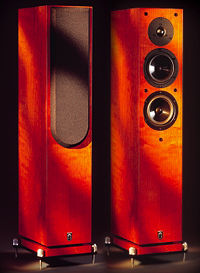 Skimming Soliloquy's website, I learned that Dennis Had of Cary Audio Design put about four years into the development of the original Soliloquy as a labor of love, and in an effort to allow his electronics to fully express their talents. Not wishing to divert focus from his electronics business, Had sold his interest in the design to Bernie Byers, who then established the Soliloquy High Fidelity Loudspeaker Company. I don't know how much of a hand Had had in the 5.3, but its family resemblance to its forebears is clear. Other models on view at the website include the Models 5.2 (stand-mounted, 5" low-mid, 1" silk-dome HF) and 8.2 (floorstander, 8" low-mid, the same HF dome). The 5.3—a floorstander with two 5" midrange/woofers and the 1" dome—seems to be their offspring. All Soliloquies have narrow faces, that silk HF dome, and rear-ported enclosures. Moreover, I'm told that all have been developed via an arduous, reiterative process of "design-produce-listen-redesign...repetitions." (Now, where have I heard that before?) Setup and Break-In
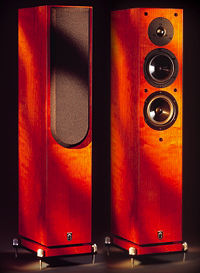
The 5.3s arrived double-boxed. Unpacking and maneuvering was easy—the tall, slim cabinet can be slid or walked on its steel base-plate. The cabinet itself is pretty solid, its rosewood finish is beautifully matched on all visible surfaces, and, with or without the grilles, the 5.3 slips graciously into domesticity. Fit and finish are above reproach.
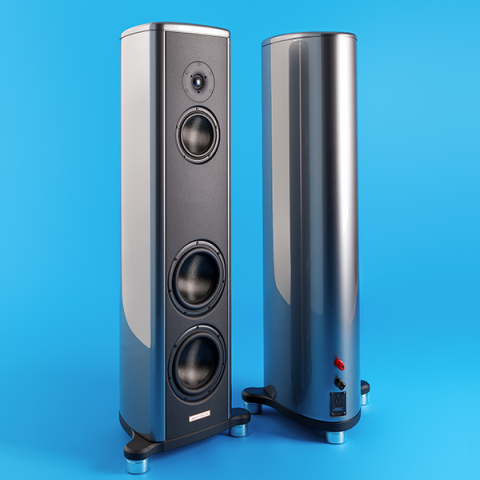
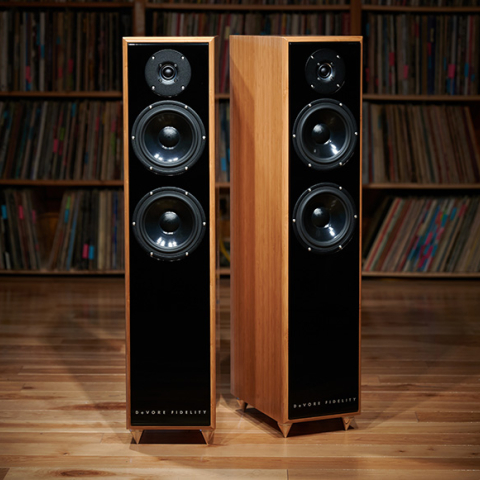
Once the speakers were in place, I screwed down their massive, beautifully machined spikes through the base plate to ensure a solid, level footing. Even with the spikes in place, I could still move a 5.3 by carefully tilting it onto one spike at a time and walking it about. The 1" silk-dome tweeter is near the top of the front panel, the two 5" drivers directly below. The internal crossover is third-order (18dB/octave) at 2.4kHz. Interestingly, the 5.3 is said to have an electrical phase response within ±45 degrees over the entire audible bandwidth. The large-diameter port on the enclosure's rear extends to within 2" of the front panel, which, in the visible area near the port, appears undamped. This close proximity of the front panel and the input of the port suggests high-pressure loading of the port. Polyester stuffing is just visible above and below the port. A nicely inset identification and connection panel toward the bottom of the rear panel bears four heavy-duty, gold-plated five-way binding posts. Gold-plated jumpers are provided for use when not biwiring. By the time the 5.3s arrived, I had forgotten almost everything about them except that it was I who'd written so favorably about them in my CES report. Whether I hooked them up to the hotrodded McCormack DNA-1 or the Sonic Frontiers Power-2 via a pair of Straight Wire Maestro II cables, the 5.3s sounded bright and boomy. There certainly was evidence of clarity and resolution, but the highs seemed excessive. At the other end, the bass was overripe, and the lower mids tended to bark when driven at anything approaching useful levels. Radio announcers were more difficult to tolerate than usual. Clearly, I had made an error of judgment at CES, the guys at Soliloquy had somehow screwed up, or—just mebbe—these babies were too new to be housebroken.
The instruction manual does say that 500 hours of break-in are needed. While you might not be able to put off listening to your new acquisitions that long, please reserve judgment for a few hundred hours.
Skimming Soliloquy's website, I learned that Dennis Had of Cary Audio Design put about four years into the development of the original Soliloquy as a labor of love, and in an effort to allow his electronics to fully express their talents. Not wishing to divert focus from his electronics business, Had sold his interest in the design to Bernie Byers, who then established the Soliloquy High Fidelity Loudspeaker Company. I don't know how much of a hand Had had in the 5.3, but its family resemblance to its forebears is clear. Other models on view at the website include the Models 5.2 (stand-mounted, 5" low-mid, 1" silk-dome HF) and 8.2 (floorstander, 8" low-mid, the same HF dome). The 5.3—a floorstander with two 5" midrange/woofers and the 1" dome—seems to be their offspring. All Soliloquies have narrow faces, that silk HF dome, and rear-ported enclosures. Moreover, I'm told that all have been developed via an arduous, reiterative process of "design-produce-listen-redesign...repetitions." (Now, where have I heard that before?) Setup and Break-In The 5.3s arrived double-boxed. Unpacking and maneuvering was easy—the tall, slim cabinet can be slid or walked on its steel base-plate. The cabinet itself is pretty solid, its rosewood finish is beautifully matched on all visible surfaces, and, with or without the grilles, the 5.3 slips graciously into domesticity. Fit and finish are above reproach.