|
Recent Additions
Budget Components Audacious Audio
Loudspeakers
Amplification
Digital Sources
Analog Sources
Accessories Listening / Art Dudley The Fifth Element / John Marks Music in the Round / Kal Rubinson Fine Tunes / Jonathan Scull Special Features Reference Interviews Think Pieces Historical Recording of the Month Records 2 Die 4 Music/Recordings Stephen Mejias Robert Baird Fred Kaplan Wes Phillips Audio News Past eNewsletters FSI 2008 CES 2008 RMAF 2007 CEDIA 2007 HE 2007 FSI 2007 CES 2007 China 2006 RMAF 2006 HFN 2006 CEDIA 2006 HE 2006 FSI 2006 CES 2006 Forums Galleries Vote Previous Votes Dealer Locator AV Links Audiophile Societies Contact Us Customer Service New Subscription Digital Subscription Renew Give a Gift Sub Services Recordings Backissues More . . . Phono Preamp Hi-Fi Phono Cartridge Amplifiers Stereo Speakers |
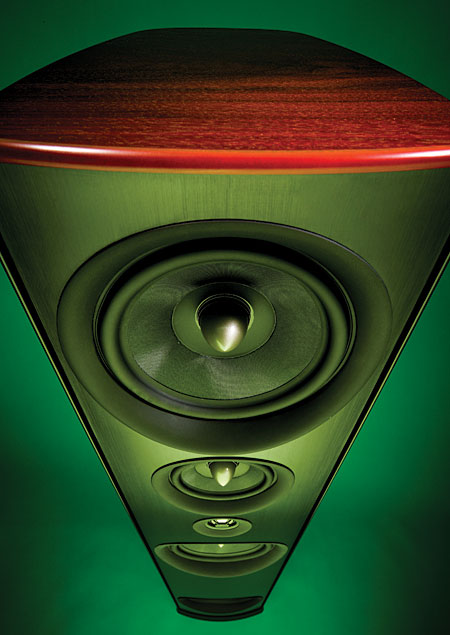
PSB Synchrony One loudspeaker
"Something's wrong. It sounds confused." Cantus producer Erick Lichte and I were working on the preliminary mixes for the choir's forthcoming album of works by contemporary American composers, which we had recorded last June at Goshen College, Indiana. I was sitting at the computer, Erick in my listening chair, and we were using PSB's Synchrony One towers as monitors. "Ah." I tried not to look sheepish. "I forgot to time-align the outputs from the three pairs of microphones I used."
Now, it's fair to note that the improvement made by time-aligning microphones is not one of night and day. But it is an improvement, and such was the resolving power of the PSBs that the degradation in the stability and focus of the soundstage due to the different arrival times was very audible. Sliding the pairs of microphone tracks forward and backward in time to synchronize the waveform in each of a centrally placed slapstick brought the image of the choir, as heard through the Synchrony Ones, into precise focus.
Synchronicity
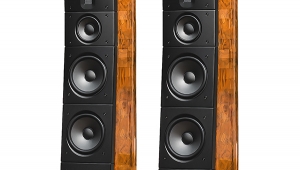
In fact, the drivers are mounted to an aluminum sub-baffle, with a ring of hard, molded rubber smoothly filling the space between the surround and the curved front of the baffle. Each woofer is loaded with its own vented subenclosure, the three ports firing from the black-aluminum rear panel. The placement of the woofers on the front baffle, the exact reflex tuning for each, and the crossover filter slopeseach is fed from its own low-pass filteras well as the placement of the midrange unit, were arranged to eliminate the usual "floor dip" in the response that results from destructive interference between the drive-units' direct sound and the reflection of that sound from the floor. It is relatively straightforward to arrange for the floor dip from the midrange unit to occur below its passband and that from the lowest woofer to occur above its passband, but optimizing the behavior of the two upper woofers must have been a more complex matter. The tweeter uses a neodymium magnet. Electrical connection to all five drivers is via two pairs of binding posts inset at the base of the rear panel, and the upper crossover is a Linkwitz-Reilly type, to give minimal overlap between the tweeter and midrange unit and optimal dispersion. The lower-frequency drivers have cones of felted natural fibers laminated with fiberglass to get the requisite combination of lightness, stiffness, and self-damping. Rather than a conventional dustcap, each has a central, stationary, aluminum "phase plug" attached to the front of its voice-coil former. Copper shorting rings on the voice-coils and aluminum rings on the rear of the magnets are said to keep THD in the midband below 0.1% at 96dB SPL, which is more akin to amplifier behavior. The result, says PSB's founder and chief engineer, Paul Barton, is a speaker that goes louder and deeper more cleanly than his flagship Stratus Gold i of a decade ago, while being smaller and more elegant in appearance. When launched 11 years ago, the Stratus Gold i cost $2499/pair; the Synchrony One costs $4500/pair, which is actually less expensive when inflation is taken into account. This is made possible by the new speaker being manufactured, as are so many others these days, in China. But also like many other Chinese-made speakers, the Synchrony One's fit'n'finish are world-class. The enclosure's gracefully curved, veneered sidewalls, laminated from seven layers of MDF, are seamlessly fitted to the extruded-aluminum front and rear baffles. The black grille of cloth on perforated metal seamlessly fits into vertical slots either side of the drive-units. The visual impression given by the speaker is of understated elegance.
Sonics
I ended up with the speakers farther apart than is usual in my room, which gave the smoothest integration of their balance through the lower midrange. This done, I fitted the supplied carpet-piercing spikes to the PSBs' bases and toed the speakers in to the listening position, which gave the best high-treble balance. I auditioned the speakers without their grilles: not only did I prefer the Synchrony One's appearance au naturel, I needed the little bit of extra top-octave energy that they produced without the grilles. The PSB's top two octaves then sounded clean and silky, with sufficient "air." I settled back for some serious listening.
Article Continues: Page 2 »
|
|
|||||||||||||||||||||||||||||||||||||||||||||