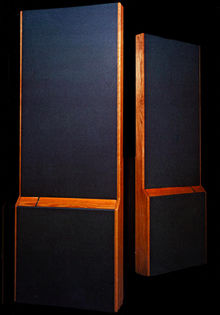
Most Stereophile readers are aware by now of why the full-range electrostatic should, in theory, be the ideal transducer. (If you aren't aware, see the accompanying sidebar.) Acoustat was the first manufacturer to design a full-range electrostatic that was so indestructible it came with a lifetime warranty. (MartinLogan is now offering a three-year warranty on their speakers, and is considering going to a lifetime warranty). But Acoustat was never able to solve another problem that has plagued all flat-panel speakers: treble beaming.
 Until recently, all push-pull electrostatic designs were flat panels, and when sound is produced from a flat panel, interference patterns cause the high frequencies to be radiated from the panel's center in a beam whose width becomes narrower with increasing frequency. Most designers of full-range electrostatics have attempted to circumvent this beaming through the use of several narrow vertically oriented panels arranged in a gently convex curve but, while this seemed to increase the apparent HF dispersion of the system, it did so at the expense of imaging precision. The reason is that the more discrete radiating sources there are (horizontally), the more each source interferes with all the others. With only one panel per side (as in Acoustat's Models 1 and 1+1), a flat-panel electrostatic can produce incredibly specific imaging for a listener positioned dead-center between the speakers (the so-called "sweet spot"), but the imaging deteriorates if you move to either side by more than a few inches. Adding additional panels to each side broadens the seating area from which one can hear acceptable imaging, but at the same time degrades imaging heard from the sweet spot.
It has long been assumed that the electrostatic's beaming problem would be eliminated if the large diaphragm's width could be accomplished via a single, curved diaphragm, but this was generally dismissed as an impossible goal because, regardless of the shape of a flexible membrane's outer edges, any tension on it acts to flatten its center area. This brings us to the MartinLogan Monolith.
Curved Panels
Until recently, all push-pull electrostatic designs were flat panels, and when sound is produced from a flat panel, interference patterns cause the high frequencies to be radiated from the panel's center in a beam whose width becomes narrower with increasing frequency. Most designers of full-range electrostatics have attempted to circumvent this beaming through the use of several narrow vertically oriented panels arranged in a gently convex curve but, while this seemed to increase the apparent HF dispersion of the system, it did so at the expense of imaging precision. The reason is that the more discrete radiating sources there are (horizontally), the more each source interferes with all the others. With only one panel per side (as in Acoustat's Models 1 and 1+1), a flat-panel electrostatic can produce incredibly specific imaging for a listener positioned dead-center between the speakers (the so-called "sweet spot"), but the imaging deteriorates if you move to either side by more than a few inches. Adding additional panels to each side broadens the seating area from which one can hear acceptable imaging, but at the same time degrades imaging heard from the sweet spot.
It has long been assumed that the electrostatic's beaming problem would be eliminated if the large diaphragm's width could be accomplished via a single, curved diaphragm, but this was generally dismissed as an impossible goal because, regardless of the shape of a flexible membrane's outer edges, any tension on it acts to flatten its center area. This brings us to the MartinLogan Monolith.
Curved Panels
Rather than building their electrostatic as a series of panels, MartinLogan uses a diaphragm that is curved in the horizontal plane over its entire surface. The diaphragm is held in place at top and bottom to curved structural members, but it was necessary for ML to develop a special manufacturing process to keep it curved over its entire horizontal dimension. The result is the first beam-free electrostatic (footnote 2).
The Monolith is a two-way hybrid system that uses a large electrostatic radiator to span the range from 100Hz upwards, crossing over to a 12" woofer below 100Hz. The Monolith's woofer "isolation" from the power amplifier is minimized through the use of a huge crossover coil—about the size of those two-gallon plastic jugs of distilled water sold in supermarkets.
MartinLogan contends that the driver blending is "seamless" and that although it is possible to bi-amplify the system, this is not necessary. But even before I audidoned the Monolith, I had doubts that its 12" woofer would be able to mesh properly with the much faster electrostatic upper range.
At the time of first testing these speakers the two best amplifiers I had in the house were the solid-state Electron Kinetics Eagle 7A and a pair of the mono Paoli SOB tube units. I would judge both to be state-of-the art designs, but each has its unique areas of almost unchallenged superiority. With the Eagle that superiority is in its low-end range, where it possesses impact, detail, and control—in abundance. But it has never sounded very good through its higher-frequency range with electrostatics. The SOB, on the other hand, has the sweetest, most delicately musical high end of any amplifier I have ever heard, and has proven to be the most nearly perfect complement to every electrostatic speaker I have tried it on. But, while it exercised better LF control than most tube amplifiers, it still has less control than the beefiest solid-state amps.
I started my tests using the Eagle because I was particularly curious to find out what the speaker's woofers could do under the best of circumstances, since woofer "meshing" is the most common problem with hybrid speaker systems. For example, experimenters have been trying for years to come up with a cone subwoofer for the Quad ESL-63 that can match its transient agility, and the Monolith's electrostatic section does not sound a whit slower than the ESL-63.
Sound
I found the Monolith's low-end extension to be remarkably good—subjectively flat down to almost 35Hz in my listening room, with usable output to slightly below 30Hz. Low-end detail, however, was not very good, though I am not at all sure that the problem results from a poor meshing between the woofer and the electrostatic. The problem seems to start at a frequency much higher than the system's crossover. The diminution of attack and detail sounded as if it set in at around 500Hz. In general, the Monolith's middle-range performance was quite a bit better than that of most audiophile speakers. It has none of that laid-back, unctuously over-rich coloration so admired by LS3/5A lovers. The Monoliths reproduce cellos, lower brasses, and piano bass strings better than do most other perfectionist speakers and, perhaps because of this, they have more apparent dynamic range than the speakers I have grown resignedly accustomed to auditioning these days. They are far superior to the Acoustats in this regard, which is perhaps why so many observers have complained about the Acoustats' lack of authority during fortissimos. The Monoliths are also very efficient (for electrostatics), playing cleanly at near ear-shattering levels with amplifiers rated at (only!?) 100 watts/channel.
Relative midrange superiority notwith standing, the Monoliths still exhibited, with the best amplifiers I had, some deficiency of "gutsiness," compounded by a distinctly ill-defined low end. Bowed double basses lacked delineation (ie, the feeling that one could count the cycles), and plucked bass strings and kick drum sounded soggy and shy of attack. With piano, progression of notes descending into this region sounded as if the piano's hammers had become less hard; some of the percussiveness just disappeared. Kettledrums had sharp attacks but undercontrolled and somewhat aimless decays, like harmonics in search of their fundamentals. And this, remember, was with the Eagle 7A power amplifier, which has better LF detail and control than any amplifier I know of.
There were some other less-than-appealing things to be heard from this system with the Eagle. To begin with, the Monoliths had what I feel to be too much high end (above 10kHz) content—far more, relative to the lower ranges, than one would ever hear from live musiC. They were also exceedingly bright-sounding, to the point of steely hardness. (By "bright" "I refer to excessive apparent output in and about the 5kHz range—the mid-treble range—not the range around and above 10kHz that many audiophiles incorrectly call the "brightness" range. Since I pioneered the use of this terminology in the first place, I can define its meanings without risk of contradiction—I should hope!)
And that was only half of the problem with the Eagle! On top of the hardness was an overlay of harsh grittiness. Since the Eagle sounds superb with a number of other speakers (all of them cone speakers, by the way), this only confirmed my contention that you cannot judge an amplifier except in terms of the speaker it is being used with. And vice versa.
So, I switched to the Paolis. These amplifiers effected improvements in some areas and regressions in others. Expectedly (in view of what I knew about the SOBs), the extreme high end became softer and more musical, but the middle high-frequency content increased and the bass became a little less tight—not what the Monoliths needed. I still considered the sound to be totally unacceptable.
I also borrowed the BEL 2002 amplifier (favorably reviewed in Vol.7 No.6). This elicited smoother and more natural upper-range sound from the Monoliths than did either of the previous two amplifiers but, oddly enough, had markedly less ability to control the 12" woofer than did the other two amps. The bass with the BEL was inordinately heavy and woolly. Clearly, none of these amplifiers was ideal for these speakers. (ML tells me they have gotten excellent results with Threshold and Krell power amps. I have arranged to re-borrow the Threshold S/500 for further testing of the Monoliths.) Next, I decided to try biamplifying the speakers.
Footnote 1: When a large-diaphragm panel is "aimed" directly at a listener, putting him the same distance from the left and right sides of the panel, all of the radiated `waveforms will reach his ears simultaneously and in step with one another. But if he moves to the right of the panel's axis, sounds from the panel's right-hand side will reach his ears slightly before those from its left-hand side, and the resulting interference between them will cause partial cancellation of each signal. The effect is wavelength-related; it is most pronounced at the higher frequencies, and the subjective result is the well-known electrostatic "hot spot"—a tendency for the panel to radiate an on-axis "beam" of treble that becomes progressively narrower with increasingly frequency.
Footnote 2: The Quad ESL-63 is inherently as beamy at high frequencies as any other flat-panel system, but it utilizes delay lines and annular rings of radiator diaphragm to simulate electrically the behavior of a curved diaphragm.
Until recently, all push-pull electrostatic designs were flat panels, and when sound is produced from a flat panel, interference patterns cause the high frequencies to be radiated from the panel's center in a beam whose width becomes narrower with increasing frequency. Most designers of full-range electrostatics have attempted to circumvent this beaming through the use of several narrow vertically oriented panels arranged in a gently convex curve but, while this seemed to increase the apparent HF dispersion of the system, it did so at the expense of imaging precision. The reason is that the more discrete radiating sources there are (horizontally), the more each source interferes with all the others. With only one panel per side (as in Acoustat's Models 1 and 1+1), a flat-panel electrostatic can produce incredibly specific imaging for a listener positioned dead-center between the speakers (the so-called "sweet spot"), but the imaging deteriorates if you move to either side by more than a few inches. Adding additional panels to each side broadens the seating area from which one can hear acceptable imaging, but at the same time degrades imaging heard from the sweet spot.
It has long been assumed that the electrostatic's beaming problem would be eliminated if the large diaphragm's width could be accomplished via a single, curved diaphragm, but this was generally dismissed as an impossible goal because, regardless of the shape of a flexible membrane's outer edges, any tension on it acts to flatten its center area. This brings us to the MartinLogan Monolith.
Curved Panels
Rather than building their electrostatic as a series of panels, MartinLogan uses a diaphragm that is curved in the horizontal plane over its entire surface. The diaphragm is held in place at top and bottom to curved structural members, but it was necessary for ML to develop a special manufacturing process to keep it curved over its entire horizontal dimension. The result is the first beam-free electrostatic (footnote 2).
I found the Monolith's low-end extension to be remarkably good—subjectively flat down to almost 35Hz in my listening room, with usable output to slightly below 30Hz. Low-end detail, however, was not very good, though I am not at all sure that the problem results from a poor meshing between the woofer and the electrostatic. The problem seems to start at a frequency much higher than the system's crossover. The diminution of attack and detail sounded as if it set in at around 500Hz. In general, the Monolith's middle-range performance was quite a bit better than that of most audiophile speakers. It has none of that laid-back, unctuously over-rich coloration so admired by LS3/5A lovers. The Monoliths reproduce cellos, lower brasses, and piano bass strings better than do most other perfectionist speakers and, perhaps because of this, they have more apparent dynamic range than the speakers I have grown resignedly accustomed to auditioning these days. They are far superior to the Acoustats in this regard, which is perhaps why so many observers have complained about the Acoustats' lack of authority during fortissimos. The Monoliths are also very efficient (for electrostatics), playing cleanly at near ear-shattering levels with amplifiers rated at (only!?) 100 watts/channel.
Footnote 1: When a large-diaphragm panel is "aimed" directly at a listener, putting him the same distance from the left and right sides of the panel, all of the radiated `waveforms will reach his ears simultaneously and in step with one another. But if he moves to the right of the panel's axis, sounds from the panel's right-hand side will reach his ears slightly before those from its left-hand side, and the resulting interference between them will cause partial cancellation of each signal. The effect is wavelength-related; it is most pronounced at the higher frequencies, and the subjective result is the well-known electrostatic "hot spot"—a tendency for the panel to radiate an on-axis "beam" of treble that becomes progressively narrower with increasingly frequency.