| Columns Retired Columns & Blogs |

Monitor Audio Silver 9i loudspeaker
English manufacturer Monitor Audio has been around for just about as long as people have been putting "high-end" and "audio" together—they opened their doors in 1972. Back in the mid '80s, when I was a young and carefree (and impoverished) consumer of hi-fi reviews, I'd read about the gold-deposited metal tweeters that Mo Iqbal was concocting and think, "Man, that's some exotic, far-out stuff!"
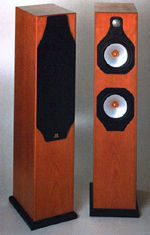 Now '00 is almost over, and Monitor Audio is still going strong. The Silver Series is their next-to-the-top line, and the Silver 9i is that line's pinnacle. And at $1999/pair, it seems within reach. Even though I have a bit more scratch now than I had 20 years ago, I'm still a tightwad—in Y2K, any component must answer the question "Why $2k?" before I'll call it a deal.
Dressed to the Nines
The Monitor Silver 9i's that showed up on my doorstep made a handsome couple. Outfitted in a warm, natural cherry veneer, they have the look of fine furniture, with a tall, elegant, narrow profile. I usually prefer speakers with their grilles removed, and doing so only improved the Silver 9i's appearance—the silvery-white C-CAM (Coated Ceramic Aluminum Magnesium) midrange-woofers, surrounded by a basic black mini-baffle and accessorized with gold dustcaps, make quite a fashion statement. The tweeter is also gold-colored—as I was saying, a Monitor Audio signature item for years—but it peeks out demurely from behind a protective silver screen.
Each Silver 9i comes with a detachable black MDF base that accepts supplied threaded spikes. You can also screw the spikes directly into the bottom of the speaker, into the same inserts for attaching the base, but I don't see anyone doing that solely for looks—the bases go with the ensemble quite nicely. The bases increase the footprint somewhat, and so provide greater stability—safe and sound. If you really want to make sure your Silver 9i's stay put and cut down on cabinet resonances while you're at it, a plastic plug on the back of each speaker can be removed in order to fill the cabinet with sand. Monitor suggests you put an empty plastic bag in the hole, then pour sand into the bag. The review pair came with sand bags already in place; I left them that way.
Connections are made via two sets of substantial, all-metal, gold-plated five-way binding posts that are jumpered together; removing the jumpers allows biwiring. Beside the mass-loading plug at the bottom, there's also a rear-firing port nearer the top, directly behind the upper midrange-woofer. The cabinet felt solid, and gave a reassuring thunk when rapped.
The two 6.5" C-CAM midrange/bass drivers and 1" gold-dome tweeter are arrayed in what one might call a deconstructed D'Appolito configuration. Instead of placing the tweeter between the two larger drivers, a la D'Appolito—there is enough room to do so—Monitor Audio instead placed it above the upper one, putting it closer to ear height.
The 9i is a two-and-a-half-way design; the top mid-bass driver crosses over to the tweeter at 3.2kHz, while the bottom one rolls off at 600Hz. The crossover filters are second-order, or 12dB/octave.
According to the published specs, the 9i's sensitivity is 91dB, with a nominal impedance of 8 ohms. David Solomon of Monitor tells me that the lowest the impedance dips to is about 5.4 ohms (we'll see what John Atkinson's measurements say), which means that the 9i should be an easy load for just about any amplifier.
Would You Be My Neighbor?
One of the core concepts of the review-by-listening school is that of the reference system. The practitioner of this form of criticism builds a system of components that work well together, and, equally important, with which he or she is intimately familiar. By so doing, when a new component is inserted into the mix, any sonic differences should be readily apparent. Changes happen slowly over time, as new components are found that offer incremental increases in the system's quality.
Well, this humble reporter has just changed a major component—the major component. The Silver 9i's had the honor of christening my new listening room (see sidebar, "In My Room").
The user's manual is generic for all Monitor Audio speakers, and the recommendations for placement might be better suited to Monitor's monitors: at least 1.5' from the side walls, but only 8" from the back wall (and 6-7' between the speakers). Putting the speakers that close to the rear wall is problematic in the new room—it puts the front of the speakers behind the plane of the equipment shelves between them—but I tried it anyway. When I measured the results with the RadioShack SPL meter and the original Stereophile Test CD, I expected an overall bass boost, but what I got was a huge dip in the upper bass, followed by a mild rise in the midbass and a quick falloff in the low bass.
I moved the Silver 9i's forward a bit at a time, until I got to a place that, while suffering from a little more rolloff in the low bass, provided smoother output across the range. The final position was 4'5" from the back wall, 4'6" from the sides, about 6' between, and roughly 7' from the plane of the speakers to my ears. This position provided excellent imaging as well. I also toed the cabinets in a bit, such that I could still see quite a bit of their inner side walls. That firmed up the center image without the sound becoming edgy or harsh. I also found that focus and tonal balance locked in when the top of the speaker cabinet would just disappear from view. My listening chair and I are both tall, so slouching a bit more than is my norm was required. I could've adjusted the spikes to tilt the cabinet back, but I'm lazy—slouching works for me!
NEXT: Page 2 »
 | |||||||||||

|
|
| |||||||||
- Log in or register to post comments










| Loudspeakers Amplification Digital Sources | |
Analog Sources Accessories Featured | |
Music Columns Retired Columns | |
Show Reports | |
Features Latest News Community | |
Resources Subscriptions |
 © 2024 Stereophile
AVTech Media Americas Inc., USA
All rights reserved