It was my hunt for new and interesting-looking turntables at the 2004 Consumer Electronics Show that introduced me to the loudspeakers from DeVore Fidelity. In the Glass Amplifier room I spied a Teres turntable with a Darth Vader-ish look and sat down to listen. From a pair of nondescript, two-way, floorstanding speakers so small they were almost lost in the room, came surprisingly present, full-bodied, and notably coherent music. Their sound so far exceeded my low expectations that I exclaimed, "What are those?! Whoever designed them sure knows what he's doing!"
 My reaction probably couldn't have pleased my hosts less—the speaker manufacturer was not partnering with them in the room. In fact, they didn't even know who had made the speakers. Turns out their own speakers had gotten lost; in desperation, they'd gone down the hall and borrowed the first pair they could get their hands on. I forgot all about turntables and headed for that room down the hall.
That's where I met the young designer John DeVore, learned about his loudspeaker lines, both named for apes (Gibbon, Silverback), and, after hearing his flagship model, the Silverback Reference, became determined to review a pair at home. As good as the little Gibbon 8s had sounded in the Glass Amplifier room, the tall, narrow-baffled, three-way Silverbacks sounded even more promising in DeVore's own room.
Despite his youthful appearance, John DeVore has had plenty of experience in the audio industry. He graduated from the Rhode Island School of Design, worked as a professional drummer, sold audio gear at Sound by Singer and Stereo Exchange in New York City, and has been designing loudspeakers for more than a decade.
It took well over a year of scheduling, rescheduling, speaker upgrades, and the like before a pair of Silverback References arrived and the review process could begin. In the interim, I heard the Silverbacks at Home Entertainment 2004 and 2005, with mixed results. Sometimes I was mesmerized, other times I found them a bit aggressive. Shows are like that.
These look familiar
My reaction probably couldn't have pleased my hosts less—the speaker manufacturer was not partnering with them in the room. In fact, they didn't even know who had made the speakers. Turns out their own speakers had gotten lost; in desperation, they'd gone down the hall and borrowed the first pair they could get their hands on. I forgot all about turntables and headed for that room down the hall.
That's where I met the young designer John DeVore, learned about his loudspeaker lines, both named for apes (Gibbon, Silverback), and, after hearing his flagship model, the Silverback Reference, became determined to review a pair at home. As good as the little Gibbon 8s had sounded in the Glass Amplifier room, the tall, narrow-baffled, three-way Silverbacks sounded even more promising in DeVore's own room.
Despite his youthful appearance, John DeVore has had plenty of experience in the audio industry. He graduated from the Rhode Island School of Design, worked as a professional drummer, sold audio gear at Sound by Singer and Stereo Exchange in New York City, and has been designing loudspeakers for more than a decade.
It took well over a year of scheduling, rescheduling, speaker upgrades, and the like before a pair of Silverback References arrived and the review process could begin. In the interim, I heard the Silverbacks at Home Entertainment 2004 and 2005, with mixed results. Sometimes I was mesmerized, other times I found them a bit aggressive. Shows are like that.
These look familiar
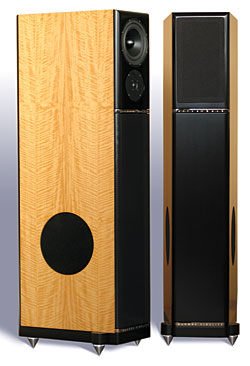
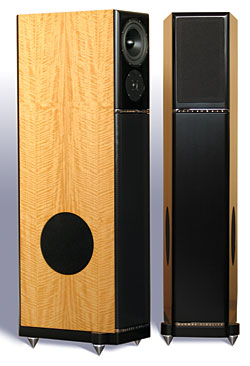
Once installed in my listening room, the Silverback References looked very familiar—and not because I'd seen them before. With a woofer firing from each side of a tall, deep, narrow-baffled cabinet and a midrange and tweeter mounted on a molded black baffle, the Silverback bore more than a passing resemblance to the Audio Physic Virgo II ($5500/pair), one of my favorite speakers ever. I'm not alone in thinking the Virgo II something very special. Like those who bought Spica TC-50s, Virgo owners are a loyal bunch, and I hear from some of them regularly. I've always felt that when I traded my Virgo IIs for far more expensive speakers (at first a pair of Sonus Faber Amati Homages), I was getting something better in most ways, but at the same time giving something up: the Virgo IIs' astounding, unforgettable imaging and soundstaging capabilities. Nothing I've owned or heard since has matched the Virgo IIs in that regard.
At 47.5" tall, a bit over 8" wide in front and 11" in the rear, 18" deep, and weighing 100 pounds, the Silverback Reference is quite a bit bigger than the Virgo II. And at $15,000/pair, it costs nearly three times as much. (Adjusted for the inflation of 1994 dollars, the DeVore's price is probably closer to twice the Virgo II's.) But the look was familiar enough that facing the Silverback References produced a flood of great Virgo memories, not to mention anticipation: of a speaker that went beyond disappearing and into the realm of View-Master–like three-dimensionality. The Silverbacks sure looked the part. Still, there are many substantial differences between the speakers, particularly in terms of cabinet construction. The Virgo II's box was rectangular; the Silverback's sides flare out from front to back, to reduce the effects of internal standing waves.
 The Silverback's low frequencies are produced by two long-throw, 8", treated-paper woofers in push-push configuration. There is one of these on each side of a rigid subenclosure with nonparallel walls and vents at top and bottom. This subenclosure is encased within the main cabinet; below it is another chamber with a rear port unloaded via two tubes mounted to the main enclosure bottom.
The 0.75" silk-dome tweeter and 6.5" polypropylene-cone midrange driver, both built to DeVore's specifications, are independently mounted on the cabinet via a "very high density D-MASS" split subbaffle, with the midrange above the tweeter. Precisely what D-MASS is—high-density fiberboard? a composite material?—DeVore won't say. The midrange is fitted with a large phase plug and is sealed in its own triangular enclosure. This enclosure is formed by the D-MASS main cabinet top and an internally mounted slab of D-MASS material angled at about 45° down from the top rear cabinet corner, secured to a thick, solid block and internally attached to the cabinet front. The idea is for the midrange driver to operate undisturbed by the woofers below.
The machine screws holding the tweeter go through the front baffle and into that thick block, as does the tweeter's magnet assembly, which fits through a hole in the baffle, allowing the rear wave to fire into the cabinet's open central chamber. Thus the tweeter, too, effectively operates in its own isolated enclosure.
Yet another slab of unspecified material, this one with large holes of different diameters machined through it, runs parallel to the cabinet top to form another triangular chamber in the top third of the structure. DeVore calls this the "anechoic woofer enclosure terminus." Think of a large Z-shaped structure within the cabinet and you'll understand the construction and placement of the two chambers.
In response to a rap from my knuckles, the main chamber, between the upper and lower subenclosures, sounded unusually lively. This is deliberate; John DeVore has carefully tuned this chamber to resonate in a particular manner. He was concerned, he told me, about how the accelerometer test John Atkinson routinely performs on speakers would appear in this review's "Measurements" section.
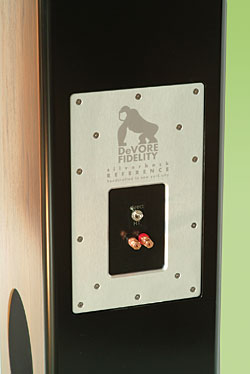
The DeF SVDX crossover network is encapsulated in vibration-damping Vibraplex and attached to a D-MASS panel that is itself attached to an aluminum panel sandwiched between elastomer isolation material. The network fits into a square cutout on the speaker's rear panel. The crossover uses silver-foil capacitors and is hardwired with silver wire. Binding posts of solid copper secured to the aluminum ensure a very short signal path from the network, though that means speaker cables hang from midway up the back of the cabinet. Are you an audio purist or an interior decorator? Okay, you might be both. You'll have to deal with it.
The Silverback's low frequencies are produced by two long-throw, 8", treated-paper woofers in push-push configuration. There is one of these on each side of a rigid subenclosure with nonparallel walls and vents at top and bottom. This subenclosure is encased within the main cabinet; below it is another chamber with a rear port unloaded via two tubes mounted to the main enclosure bottom.
The 0.75" silk-dome tweeter and 6.5" polypropylene-cone midrange driver, both built to DeVore's specifications, are independently mounted on the cabinet via a "very high density D-MASS" split subbaffle, with the midrange above the tweeter. Precisely what D-MASS is—high-density fiberboard? a composite material?—DeVore won't say. The midrange is fitted with a large phase plug and is sealed in its own triangular enclosure. This enclosure is formed by the D-MASS main cabinet top and an internally mounted slab of D-MASS material angled at about 45° down from the top rear cabinet corner, secured to a thick, solid block and internally attached to the cabinet front. The idea is for the midrange driver to operate undisturbed by the woofers below.
The machine screws holding the tweeter go through the front baffle and into that thick block, as does the tweeter's magnet assembly, which fits through a hole in the baffle, allowing the rear wave to fire into the cabinet's open central chamber. Thus the tweeter, too, effectively operates in its own isolated enclosure.
Yet another slab of unspecified material, this one with large holes of different diameters machined through it, runs parallel to the cabinet top to form another triangular chamber in the top third of the structure. DeVore calls this the "anechoic woofer enclosure terminus." Think of a large Z-shaped structure within the cabinet and you'll understand the construction and placement of the two chambers.
In response to a rap from my knuckles, the main chamber, between the upper and lower subenclosures, sounded unusually lively. This is deliberate; John DeVore has carefully tuned this chamber to resonate in a particular manner. He was concerned, he told me, about how the accelerometer test John Atkinson routinely performs on speakers would appear in this review's "Measurements" section.
The DeF SVDX crossover network is encapsulated in vibration-damping Vibraplex and attached to a D-MASS panel that is itself attached to an aluminum panel sandwiched between elastomer isolation material. The network fits into a square cutout on the speaker's rear panel. The crossover uses silver-foil capacitors and is hardwired with silver wire. Binding posts of solid copper secured to the aluminum ensure a very short signal path from the network, though that means speaker cables hang from midway up the back of the cabinet. Are you an audio purist or an interior decorator? Okay, you might be both. You'll have to deal with it.
My reaction probably couldn't have pleased my hosts less—the speaker manufacturer was not partnering with them in the room. In fact, they didn't even know who had made the speakers. Turns out their own speakers had gotten lost; in desperation, they'd gone down the hall and borrowed the first pair they could get their hands on. I forgot all about turntables and headed for that room down the hall.
That's where I met the young designer John DeVore, learned about his loudspeaker lines, both named for apes (Gibbon, Silverback), and, after hearing his flagship model, the Silverback Reference, became determined to review a pair at home. As good as the little Gibbon 8s had sounded in the Glass Amplifier room, the tall, narrow-baffled, three-way Silverbacks sounded even more promising in DeVore's own room.
Despite his youthful appearance, John DeVore has had plenty of experience in the audio industry. He graduated from the Rhode Island School of Design, worked as a professional drummer, sold audio gear at Sound by Singer and Stereo Exchange in New York City, and has been designing loudspeakers for more than a decade.
Once installed in my listening room, the Silverback References looked very familiar—and not because I'd seen them before. With a woofer firing from each side of a tall, deep, narrow-baffled cabinet and a midrange and tweeter mounted on a molded black baffle, the Silverback bore more than a passing resemblance to the Audio Physic Virgo II ($5500/pair), one of my favorite speakers ever. I'm not alone in thinking the Virgo II something very special. Like those who bought Spica TC-50s, Virgo owners are a loyal bunch, and I hear from some of them regularly. I've always felt that when I traded my Virgo IIs for far more expensive speakers (at first a pair of Sonus Faber Amati Homages), I was getting something better in most ways, but at the same time giving something up: the Virgo IIs' astounding, unforgettable imaging and soundstaging capabilities. Nothing I've owned or heard since has matched the Virgo IIs in that regard.
The Silverback's low frequencies are produced by two long-throw, 8", treated-paper woofers in push-push configuration. There is one of these on each side of a rigid subenclosure with nonparallel walls and vents at top and bottom. This subenclosure is encased within the main cabinet; below it is another chamber with a rear port unloaded via two tubes mounted to the main enclosure bottom.
The 0.75" silk-dome tweeter and 6.5" polypropylene-cone midrange driver, both built to DeVore's specifications, are independently mounted on the cabinet via a "very high density D-MASS" split subbaffle, with the midrange above the tweeter. Precisely what D-MASS is—high-density fiberboard? a composite material?—DeVore won't say. The midrange is fitted with a large phase plug and is sealed in its own triangular enclosure. This enclosure is formed by the D-MASS main cabinet top and an internally mounted slab of D-MASS material angled at about 45° down from the top rear cabinet corner, secured to a thick, solid block and internally attached to the cabinet front. The idea is for the midrange driver to operate undisturbed by the woofers below.
The machine screws holding the tweeter go through the front baffle and into that thick block, as does the tweeter's magnet assembly, which fits through a hole in the baffle, allowing the rear wave to fire into the cabinet's open central chamber. Thus the tweeter, too, effectively operates in its own isolated enclosure.