If you've read Stereophile regularly over the past decade, you know that ProAc Audio's Stewart Tyler has a winning formula for designing loudspeakers. In review after review, this magazine's writers have celebrated the sonic profile he has created for ProAc speakers: a spacious soundstage with a big, coherent image; a clean, grain-free midrange; extended highs that don't intrude on the music; and tight, tuneful bass response. 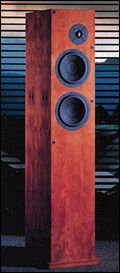 Jack English found both the $6500/pair Response Three (Stereophile, September 1991, Vol.14 No.9) and the $18,000/pair Response Four (March 1994, Vol.17 No.3; May and June 1994, Vol.17 Nos.5 and 6) truly Class A recommended loudspeakers. Hearing Jack's Response Threes triggered Corey Greenberg's review of the $3000/pair Response Two (July 1992, Vol.15 No.7), wherein he said, "leave the audionuts to their speaker-angst and audition the Response Twos." Two years later, Michael Fremer fell under the ProAc spell, claiming that the $4500 Response 2.5 "makes great music, totally free of grain, crispies, and edge" (January 1996, Vol.19 No.1). Wes Phillips was forewarned of the spell but succumbed anyway, stating that his September 1994 review of the ProAc Response One S (Vol.17 No.9) was "such an over-the-top rave that John Atkinson felt obliged to audition the speakers himself before running my report." Four years later, Wes reviewed the $2000/pair Response One SC (March 1998, Vol.21 No.3), advising readers to "pair the ProAcs with triodes and you'll up the seduction factor—this ProAc is touched by magic." What's going on here? My betters appear to have begun a tradition of positive—even gushing—reviews of ProAc Response loudspeakers. I had to see for myself, so I contacted Richard Gerberg of Modern Audio Consultants (ProAc's US importer). Gerberg obliged by having a pair of the latest Response loudspeakers, the 3.8s, shipped to me for review. Three point eight
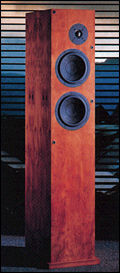
The Response 3.8 is a three-way, floorstanding tower loudspeaker with three transducers—one tweeter and two 7" midbass drivers—arranged with the tweeter on top. The cabinet is just over 4' tall but less than 1' wide, and a bit over 1' deep. The midbass units are in a reflex alignment; each has a port, one at the top and one at the bottom of the Response's rear panel. The dual-bass-driver array is said to produce better bass control and extension. Besides the two reflex ports, the rear panel features four rhodium-plated speaker terminals for biwiring, and a brass plate for the unit's serial number and specifications.
The 3.8's drivers are made by Scan-Speak and SEAS to Tyler's exact specifications. The SEAS tweeter uses a specially coated silk dome and a 1", air-cooled voice-coil. The 3.8s' imaging has been optimized by offsetting this tweeter to one edge of the enclosure baffle to reduce the effects of sidewall reflections—the 3.8 comes in mirror-imaged pairs. The instruction manual advises that the speakers be placed with the ProAc grille badges (themselves offset to the opposite side from the tweeter), toward the outside." The two midwoofers use the same Scan-Speak 7" carbon-fiber-impregnated paper-cone woofers with 1.5" voice-coils that Michael Fremer so admired in the 2.5. Having the woofers built to ProAc's specifications allowed Stewart Tyler to dispense with the drinking-straw port-loading used in earlier ProAc designs. Highly braced and carefully damped, the cabinet varies in thickness to reduce standing waves, and is packed with bonded acrylic fiber. The Response's 85 lbs, while not featherweight, can be moved around a living room by one person. The biwirable/bi-ampable rhodium-plated Michell binding posts are finely machined, very substantial, and bolted directly to the crossover board. The crossover itself uses silver capacitors and high-wattage ceramic capacitors through-hole-soldered to a high-grade fiberglass printed-circuit board. Multistrand oxygen-free copper wiring is used throughout. The crossover rolls off the lower midbass driver at 12dB/octave above the lower midrange. The upper midbass driver works in tandem with the lower woofer from the lowest frequencies up to 3kHz, where it crosses over to the tweeter with a 18dB/octave (third-order) low-pass filter slope. The tweeter is rolled off below 3kHz using the same third-order filter.
I found the review samples' ebony veneer exquisite. Every millimeter of the Response 3.8 reflects attention to detail, from the countersunk hexbolts to the massive cabinet. The first-rate fit'n'finish of these elegant cabinets contribute to a superb visual presentation.
Jack English found both the $6500/pair Response Three (Stereophile, September 1991, Vol.14 No.9) and the $18,000/pair Response Four (March 1994, Vol.17 No.3; May and June 1994, Vol.17 Nos.5 and 6) truly Class A recommended loudspeakers. Hearing Jack's Response Threes triggered Corey Greenberg's review of the $3000/pair Response Two (July 1992, Vol.15 No.7), wherein he said, "leave the audionuts to their speaker-angst and audition the Response Twos." Two years later, Michael Fremer fell under the ProAc spell, claiming that the $4500 Response 2.5 "makes great music, totally free of grain, crispies, and edge" (January 1996, Vol.19 No.1). Wes Phillips was forewarned of the spell but succumbed anyway, stating that his September 1994 review of the ProAc Response One S (Vol.17 No.9) was "such an over-the-top rave that John Atkinson felt obliged to audition the speakers himself before running my report." Four years later, Wes reviewed the $2000/pair Response One SC (March 1998, Vol.21 No.3), advising readers to "pair the ProAcs with triodes and you'll up the seduction factor—this ProAc is touched by magic." What's going on here? My betters appear to have begun a tradition of positive—even gushing—reviews of ProAc Response loudspeakers. I had to see for myself, so I contacted Richard Gerberg of Modern Audio Consultants (ProAc's US importer). Gerberg obliged by having a pair of the latest Response loudspeakers, the 3.8s, shipped to me for review. Three point eight The Response 3.8 is a three-way, floorstanding tower loudspeaker with three transducers—one tweeter and two 7" midbass drivers—arranged with the tweeter on top. The cabinet is just over 4' tall but less than 1' wide, and a bit over 1' deep. The midbass units are in a reflex alignment; each has a port, one at the top and one at the bottom of the Response's rear panel. The dual-bass-driver array is said to produce better bass control and extension. Besides the two reflex ports, the rear panel features four rhodium-plated speaker terminals for biwiring, and a brass plate for the unit's serial number and specifications.