| Columns Retired Columns & Blogs |

Mirage M-7si loudspeaker
Audiophiles have long had a love-hate relationship with dipolar loudspeakers. These devices are nearly always a pain to position properly, they tend to dominate a room, and more often than not they're fussy about amplification. But when it all comes together, the best of them can make magic.
 Almost invariably, dipoles are flat panel designs—electrostatics such as those made by MartinLogan or Sound-Labs, or planar magnetics like Magnepans or Apogees. About six years ago, however, Mirage Loudspeakers, based in the Great White Northern wastes of Canada (well, okay, Toronto), came out with a variation on this theme—something they dubbed a bipolar design.
The flagship Mirage M-1 is housed in a large but shallow enclosure, with three conventional loudspeaker drive-units working up front, and three more identical units pumping away in the back. Like a dipole, therefore, it radiated from opposite sides of the cabinet.
But where the front and back radiations of a dipole are by nature out of phase, the M-1 was designed so that the outputs from front and back were in phase. Because the out-of-phase front and back radiations of a dipole tend to cancel out when they meet each other at the sides and top, such a design produces little output in these directions. There is no such so-called "dipole cancellation" in a bipolar design. A dipole is prone to bass cancellation below a certain frequency (the precise frequency will depend on the size of the baffle); a bipole is not. In actuality, a bipole design radiates much like a pulsating cylinder, with reduced output at the sides (90° to the plane of the drive-units) at middle and higher frequencies; an ideal dipole radiates in a figure-8 pattern at all frequencies.
The bipole concept proved so intriguing that other companies began to introduce less-expensive versions of the design. Not to be outdone, Mirage brought out more economical bipolar models of their own—they have a total of seven such models in their line as of this writing.
Stereophile has already reviewed the M-1si (yours truly in Vol.16 No.6) and the M-3si (Guy Lemcoe in Vol.15 No.11), as well as earlier versions of those two designs. Having heard sensational results from four M-1sis in a Home Theater setup (Vol.16 No.10), I resolved to listen to a surround array based on the smaller, less-expensive Mirage M-7si (the review appears in the 1995 Stereophile Guide to Home Theater). It became obvious to me from this experience that the baby of the M-si series deserved a solo review as an audio-only loudspeaker, as well as a complete set of measurements (which weren't possible in the space-limited Guide).
Description
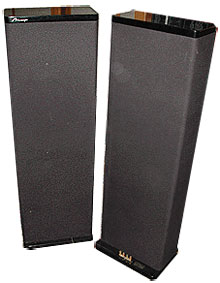
Cosmetically, the M-7si, with its black grillecloth and gloss-black top and bottom, is clearly a member of the M-si Series. The grillecloth is intended to be left in place during listening. Apart from size, the only way in which the M-7si differs visibly from its larger siblings, the M-1si and M-3si, is that its grillecloth wraps around the cabinet. (The M-1si and M-3si are finished in the same gloss black on the sides as on the top.) Weighing-in at a well-braced, thick-walled (about 1") 80 lbs, the M-7si is nevertheless easy to move. It's also less prone than its larger siblings to physically dominate a room.
Unlike the M-1si, the M-7si is a nonsymmetrical design—that is, the driver complement on the back is not the same as that on the front. The main output of the loudspeaker is handled by an 8" woofer and a 1" tweeter. A single 5" driver, mounted directly behind the tweeter but on the back of the enclosure, operates above 480Hz. Mirage calls the rear driver an "MSE," for Broad Spectrum Mirage Soundstage Enhancement Transducer. Both the MSE and the woofer have cones of injection-molded polypropylene impregnated with carbon and other additives. The MSE is enclosed in its own, sealed chamber; the woofer is reflex-loaded with two ports—one each on the cabinet front and back.
The M-7si's PTH (Pure Titanium Hybrid) tweeter is the same design used in all of the M-si Series, including the big M-1si. Its titanium dome uses a cloth suspension which is said to reduce distortion and eliminate high-frequency ringing. A low fundamental resonance allows the tweeter to be crossed-over to the woofer at a moderately low 2kHz. This makes the woofer's job easier—the higher it has to operate, the greater the potential for dispersion and coloration problems in the upper midrange and low treble.
Rear-channel connections allow for bi-wiring; jumper cables are provided for those who prefer to use conventional single wiring. As with the Energy Veritas v2.8 I reviewed in June 1994 (Vol.17 No.6—both the Mirage and Energy brands are manufactured by Audio Products International), the M-7si uses five-way binding posts with 10mm heads instead of the more common ½" variety (your ½" nut-driver will not work on them). Spikes are also provided.
System & setup
I auditioned the M-7sis in my approximately 11' by 18' by 26' listening room. The speakers were set up firing on a diagonal in the room—a setup I've used successfully with six other pairs of loudspeakers—positioned about 9' apart and 11' from the listening position.
The rest of the system consisted of a Mark Levinson No.35 D/A converter connected via Kimber AGDL digital coaxial cable to a Krell KPS-20i CD player used as a transport. TARA Labs Master RSC (unbalanced) connected the Levinson to a Rowland Consummate preamp. The primary amplifier was a Krell KSA-300S, with other amplifiers also cycled through the system. Preamp-to-power-amp interconnects were either Cardas Hexlinks or Monster M1500s; loudspeaker cables were a bi-wired set of Monster M1.5s.
Sound
My general observations on the sound of the Mirage M-7sis when I used them as part of a surround-sound system centered on their sweet yet detailed top end, unusually spacious sound, and surprising bass power—combined with a prodigious dynamic capability. Although my listening tests for the present review were conducted in a different room, the general character of the sound remained the same in an audio-only, two-channel setting.
NEXT: Page 2 »
 | |||||||||||

|
|
| |||||||||
- Log in or register to post comments






| Loudspeakers Amplification Digital Sources | |
Analog Sources Accessories Featured | |
Music Columns Retired Columns | |
Show Reports | |
Features Latest News Community | |
Resources Subscriptions |
 © 2024 Stereophile
AVTech Media Americas Inc., USA
All rights reserved